
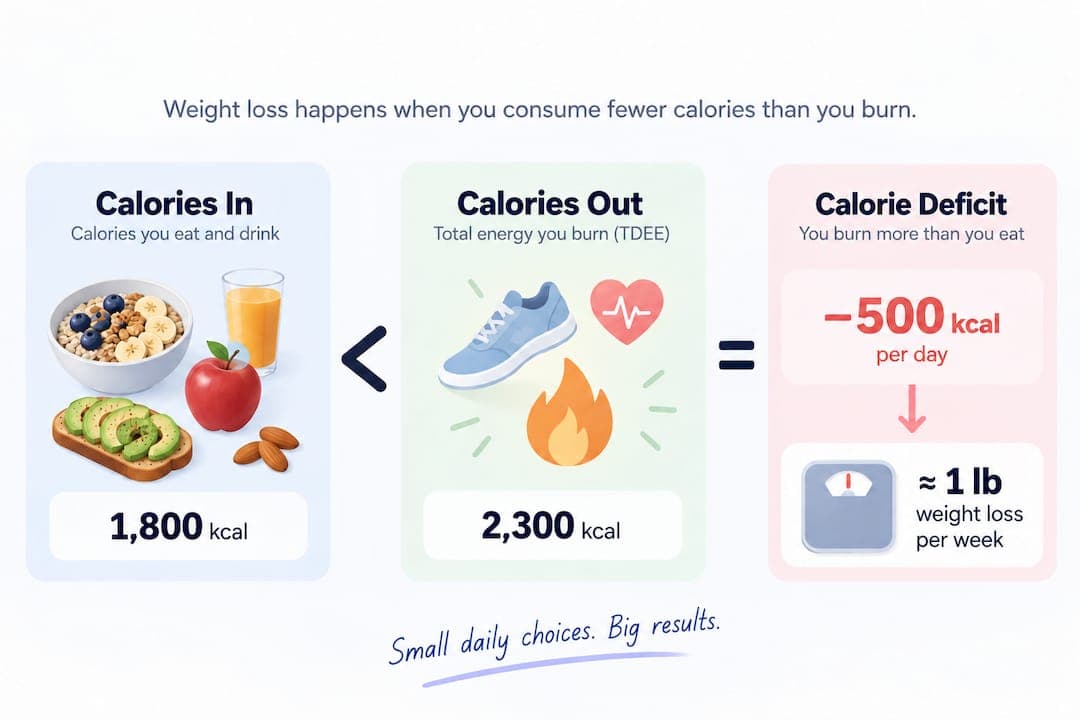
Calorie deficit equals calories consumed minus total calories burned, known as your TDEE. Subtract about 500 calories a day from your maintenance level and you land near the most studied benchmark for safe weight loss: roughly 1 pound, or 0.45 kilograms, per week. Don’t push your intake below the safety floors covered below, and plan to recalculate every few weeks as your body changes.
Worths knowing:
A 500-calorie daily deficit typically results in about 1 pound of weight loss per week, but this decreases as body weight drops and requires regular recalculation.
Calculating your TDEE using the Mifflin-St Jeor equation and activity factor ensures accurate planning, especially when weight or activity levels change over time.
Most safe weight loss plans stay within 1 to 2 pounds per week, using a deficit of 500 to 1,000 calories, but dropping below 1,200 calories for women or 1,500 for men increases health risks.
Precise tracking of food intake, weekly trend analysis, and periodic recalibration of targets are crucial to maintaining a sustainable and effective calorie deficit.
Automated logging tools and Recalculation reminders can improve consistency, while formulas provide estimates that should be adjusted based on real-world results.
Table of Contents
How Do You Calculate a Calorie Deficit?
The math runs in three steps: estimate your BMR, convert it to TDEE, then subtract your deficit.
Start with the Mifflin-St Jeor equation, the formula most dietitians and the Medical News Today overview point to as the current standard:
-
Men: BMR = (10 × weight in kg) + (6.25 × height in cm) − (5 × age in years) + 5
-
Women: BMR = (10 × weight in kg) + (6.25 × height in cm) − (5 × age in years) − 161
If you know your body fat percentage, the Katch-McArdle formula (which factors in lean mass) tends to run more accurately for lean, muscular individuals. The older Harris-Benedict equation still shows up in some calculators, but Mifflin-St Jeor has replaced it as the more accurate default for most people.
Once you have BMR, multiply by an activity factor to get TDEE:
-
Sedentary (little or no exercise): 1.2
-
Lightly active (light exercise 1 to 3 days a week): 1.375
-
Moderately active (moderate exercise 3 to 5 days a week): 1.55
-
Very active (hard exercise 6 to 7 days a week): 1.725
-
Extra active (physical job plus training): 1.9
Be honest here. Most people round up their activity level and end up eating more than their plan allows. Once you have TDEE, your daily target is TDEE minus your chosen deficit, either a flat number like 500 calories or a percentage like 20%.
One pound of body fat holds about 3,500 calories. A 500 calorie daily deficit, multiplied by 7 days, works out to roughly 3,500 calories a week, which is the arithmetic behind the classic “1 pound a week” guideline. It’s a useful planning tool, not a precise biological law, since real-world results shift with water weight, hormones, and how consistently you’re tracking intake.

Two Worked Examples of a Daily Calorie Deficit
Numbers make this concrete. Here’s how the formula plays out for two different people.
-
Moderately active man, 80 kg, 35 years old, 178 cm tall. BMR = (10 × 80) + (6.25 × 178) − (5 × 35) + 5 = 800 + 1,112.5 − 175 + 5 = 1,742.5 calories. TDEE = 1,742.5 × 1.55 (moderately active) = 2,701 calories. Subtracting a flat 500 calorie deficit puts his daily target at 2,201 calories.
-
Sedentary woman, 65 kg, 30 years old, 165 cm tall. BMR = (10 × 65) + (6.25 × 165) − (5 × 30) − 161 = 650 + 1,031.25 − 150 − 161 = 1,370.25 calories. TDEE = 1,370.25 × 1.2 (sedentary) = 1,644 calories. Using a percentage-based cut instead, 15% off TDEE brings her to about 1,398 calories a day.
Run each deficit through the 3,500-calorie-per-pound rule and both examples land near 1 pound a week, assuming the deficit holds steady and nothing else changes. That “assuming” matters. As body weight drops, TDEE drops with it, so the same fixed deficit gradually produces less loss over time, which is exactly why recalculation later in this guide isn’t optional.
What’s a Safe Calorie Deficit Size?
Most health authorities converge on a similar range: 1 to 2 pounds of weight loss per week for most adults, achieved through a deficit of roughly 500 to 1,000 calories a day, or 15% to 25% below maintenance.
Below that range, things get risky fast. NHS guidance and other health bodies commonly flag 1,200 calories a day for women and 1,500 calories a day for men as thresholds you shouldn’t drop under without medical supervision. Go lower and you’re courting nutrient shortfalls, hormonal disruption, and a metabolism that fights back.
A handful of specific risks show up repeatedly in aggressive cutting:
-
Muscle loss accelerates when the deficit is too steep, since the body pulls energy from lean tissue as well as fat.
-
Nutrient shortfalls (iron, calcium, B vitamins) become likely once total intake drops too low to cover a full diet.
-
Metabolic slowdown compounds the problem. Your body adapts to lower intake by burning less, so the deficit that worked in week one quietly shrinks by week eight.
-
Extreme plans fail at higher rates simply because they’re harder to sustain past the first few weeks.
Any calculator or plan projecting more than roughly 1% of body weight lost per week deserves a second look. That’s usually a sign the inputs are off. An honest activity rating, rechecked every few weeks, fixes most of these overestimates.
Pro Tip: If a calculator’s projected timeline sounds almost too good, cut the daily deficit by 20% and re-run the numbers. A slower, sustainable plan beats a fast one you abandon in three weeks.
How Do You Apply a Calorie Deficit in Practice?
The formula only works if the numbers behind it are real. Here’s the sequence that keeps a plan honest.
-
Track your actual intake for 1 to 2 weeks before changing anything. Most people underestimate what they eat, sometimes by a wide margin once portion sizes and cooking methods are accounted for, according to NHS guidance on eating habits. You can’t set an accurate deficit on top of an inaccurate baseline.
-
Judge progress with a 14-day moving average, not daily weigh-ins. Water retention and digestion swing daily numbers by several pounds; Cleveland Clinic recommends trend lines over single readings for exactly this reason.
-
Re-run your BMR and TDEE every few weeks, or after a 3 to 5% body weight change. Maintenance calories fall as you lose weight, a pattern the NIDDK documents as part of ongoing metabolic adaptation.
-
Prioritize protein and resistance training to protect muscle mass, and lean toward the moderate end of the deficit range, 10% to 25%, rather than the aggressive end.
Pro Tip: Set a calendar reminder to recalculate every 4 weeks. Skipping this step is the single most common reason people plateau despite “doing everything right.”
How Do You Choose a Reliable Calorie Deficit Calculator?
A trustworthy calculator uses a validated equation like Mifflin-St Jeor, offers honest activity-level descriptions instead of vague labels, flags unsafe deficits, and lets you update your numbers as your weight changes.
Static calculators have a built-in flaw: they assume your maintenance calories stay fixed, so they tend to overpredict long-term results. Tools like the NIDDK Body Weight Planner address this by modeling how energy needs shift as weight drops, which is closer to how metabolism actually behaves.
For genuine precision, indirect calorimetry, which measures gas exchange during breathing to calculate resting energy expenditure, is the closest thing to a clinical gold standard. It’s not something most people need, but it explains why formulas are estimates, not guarantees.
On the intake side, logging accuracy matters just as much as the math. AI-based tools that use photo recognition, barcode scanning, and large verified food databases cut down on the guesswork that causes manual logs to drift.

What Actually Determines Success With a Calorie Deficit
Most plans don’t fail because the math is wrong. They fail because people chase a number on the scale instead of a trend, or they guess at intake instead of tracking it honestly for a couple of weeks first.
The formula is the easy part. Consistency, protein intake, and a willingness to recalculate as your weight shifts do the heavy lifting. If a deficit feels unsustainable or your weight loss stalls despite tracking well, that’s a signal to talk with a doctor or dietitian, not to cut calories further.
Hero AI is designed and built for a sustainable calorie deficit with its 3M+ verified nutrition data — Creator of Hero AI - Elena
A Faster Way to Keep Your Deficit Accurate
Running the numbers is the easy part. Logging every meal accurately, day after day, is where most calorie deficit plans quietly fall apart. Some apps handle that half of the equation: snap a photo of your plate, scan a barcode, or capture a nutrition label, and they log calories and macros against a large food database.

Beyond logging, some apps build personalized calorie and macro plans from user body metrics and weight goals, using the same TDEE-minus-deficit math covered above, without users having to rerun equations by hand every few weeks. It’s not a substitute for medical guidance, but it removes the estimation errors that throw off even a well-built plan. If tracking intake accurately is the part of this process you’d rather automate, start with Hero AI and let the app handle the recalculating while you focus on consistency.