

Maintenance calories equal your Basal Metabolic Rate (BMR) multiplied by an activity factor: for men, BMR = (10 × weight in kg) + (6.25 × height in cm) − (5 × age) + 5, and for women, subtract 161 instead of adding 5. Multiply that number by an activity multiplier between roughly 1.2 and 1.9 depending on how active you actually are. That gives you your Total Daily Energy Expenditure (TDEE), the number of calories that keeps your weight stable. Run the math now, then track your weight for two to four weeks to see if the number holds up.
Keys of Maintenance Calories
The Mifflin-St Jeor equation is the most trusted and accurate for most adults unless you have precise lean body mass data, in which case Katch-McArdle is preferable.
Actual maintenance calories typically fall within a broad range, and frequent weight tracking over 2 to 4 weeks helps adjust initial estimates more reliably.
Common shortcuts, such as 15 kcal per pound of body weight, are rough and less accurate for athletes or those at body composition extremes.
Population-based formulas carry a margin of error of about 10 to 20%, with actual metabolism affected by factors like diet history and thyroid function.
Table of Contents
-
How Do You Calculate Your Maintenance Calories Step By Step?
-
Turning Your Number Into a Weight-Loss, Gain, or Maintenance Plan
How Do You Calculate Your Maintenance Calories Step By Step?
Grab a scale, a measuring tape or height record, and your birth year. That’s the entire input list. Here’s the process, start to finish:
-
Convert your weight to kilograms. Divide pounds by 2.2. A 165-pound person weighs about 75 kg.
-
Convert your height to centimeters. Multiply inches by 2.54. Five feet six inches (66 inches) comes out to about 168 cm.
-
Plug into the Mifflin-St Jeor equation. For a 30-year-old woman at 75 kg and 168 cm: (10 × 75) + (6.25 × 168) − (5 × 30) − 161 = 750 + 1,050 − 150 − 161 = 1,489 kcal. That’s her BMR, the energy her body burns at complete rest.
-
Choose your activity multiplier. Someone with a desk job and no regular exercise sits close to 1.2. Someone training five or six days a week lands closer to 1.6 or higher.
-
Multiply BMR by the multiplier. At 1.4 (lightly active), 1,489 × 1.4 = 2,085 kcal. Round to the nearest 50 for simplicity: about 2,100 kcal a day.
-
Sanity check the result. Adult maintenance calories for most people usually fall within a broad daily range considered typical for many individuals. If your number lands wildly outside that band, recheck your unit conversions before trusting the output.
That’s the full calculation. Everything past this point is about refining accuracy and knowing when to use a different formula.
Which BMR Formula Should You Actually Use?
The Mifflin-St Jeor equation is the default for good reason: it’s the formula most fitness professionals and dietitians trust for the general population, and a peer-reviewed comparison of predictive equations found it tends to outperform older alternatives across most body types. But it’s not the only tool worth knowing.
-
Mifflin-St Jeor uses weight, height, age, and sex. It’s fast, requires no special equipment, and works well for most non-athletic adults.
-
Katch-McArdle swaps body weight for lean body mass: BMR = 370 + (21.6 × lean mass in kg). If you know your body-fat percentage from a DEXA scan or reliable calipers, this formula tends to be more accurate, since muscle burns more energy than fat and Mifflin-St Jeor doesn’t account for that directly. Research comparing resting metabolic rate equations backs this up, particularly for leaner or more muscular individuals.
-
Harris-Benedict, published in 1919 and revised in 1984, was the standard for decades. It tends to overestimate BMR compared to newer equations, largely because the original data came from a narrower, less representative population. It’s still floating around in older calculators, but there’s little reason to use it today.
If you don’t know your body-fat percentage, stick with Mifflin-St Jeor. If you do, and you carry noticeably more or less muscle than average, Katch-McArdle usually gets you closer to reality. Either way, treat the output as a starting estimate rather than a guaranteed number.
What Activity Multiplier Fits Your Actual Week?
Picking the wrong multiplier is the single biggest error people make in this calculation, and it’s an easy one to make, because most people overestimate how active they really are.
-
Sedentary (1.2): Desk job, little to no exercise, minimal walking.
-
Lightly active (1.375): Light exercise or sports one to three days a week.
-
Moderately active (1.55): Moderate exercise three to five days a week.
-
Very active (1.725): Hard exercise six to seven days a week.
-
Super active (1.9): Physical job plus daily intense training, common among athletes and manual laborers.
These ranges align with standard practitioner guidance used across fitness and clinical settings.
Here’s the gap that trips people up: take that same 1,489 kcal BMR from the earlier example. At sedentary (1.2), maintenance is 1,787 kcal. At very active (1.725), it’s 2,568 kcal. That’s a swing of over 780 calories from one multiplier choice alone, more than a typical meal.
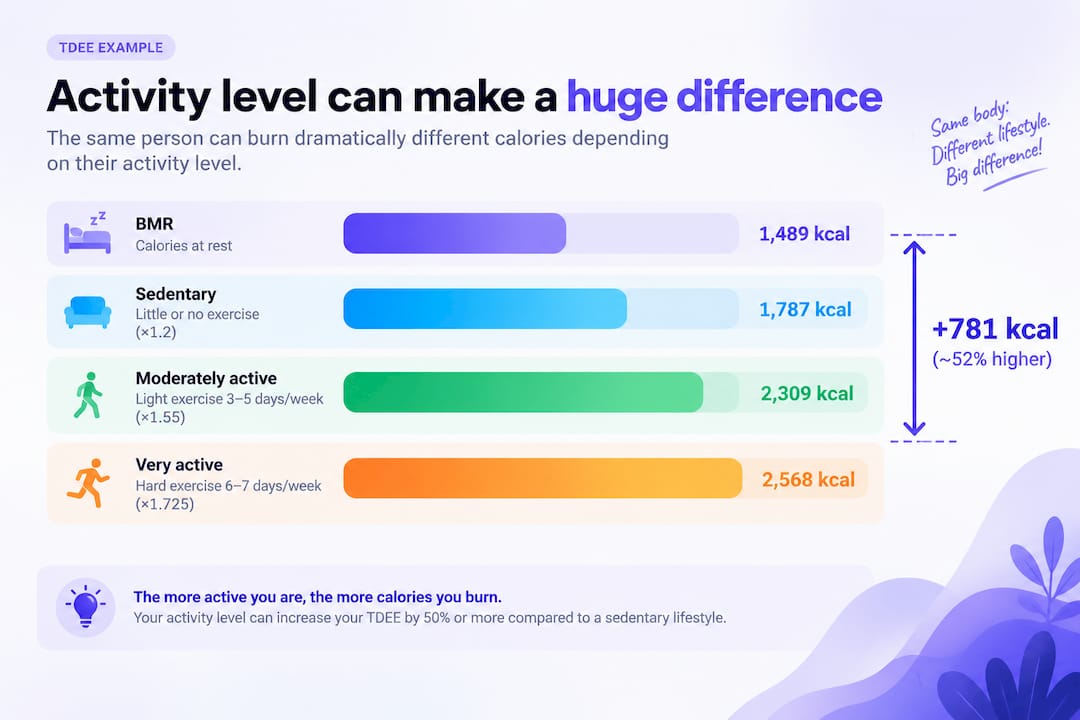
Resting metabolism accounts for roughly 60 to 75% of total daily expenditure, which means activity is the most variable piece of the whole equation. Don’t base your multiplier on your best workout day. Average your actual week, including the two days you skipped the gym and sat at a desk for nine hours.
Fast Shortcuts When You Don’t Want to Do the Full Math
Formulas take a minute. Sometimes you want an estimate in ten seconds. Rough heuristics exist for exactly that, though Harvard Health notes they’re meant as quick approximations, not replacements for tracked data.
-
Approximately 15 kcal per pound of body weight for moderately active adults provides a rough maintenance estimate.
-
About 33 kcal per kilogram works out to roughly the same number using metric units.
-
The 4/4/9 rule (4 kcal per gram of protein and carbs, 9 kcal per gram of fat) helps you translate a calorie target into grams of macronutrients on a food label. It’s a food-energy conversion, not a metabolic calculation, so it doesn’t replace BMR math.
Pro Tip: Shortcuts get shakier at the extremes. If you’re a competitive athlete, over 65, or carrying unusually low or high body fat, the per-pound rule can miss by several hundred calories. Run the full Mifflin-St Jeor formula instead and treat the shortcut as a rough cross-check.
How Accurate Is This, and How Do You Test It?
No formula reads your metabolism directly. Population equations like Mifflin-St Jeor carry a typical margin of error around 10 to 20%, driven by variables the equation can’t see: your actual body composition, thyroid function, and whether you’ve been dieting recently.
Two physiological factors explain most of that gap. The thermic effect of food, the energy your body spends digesting what you eat, varies by macronutrient mix and adds a modest, individual-specific bump to expenditure. Adaptive thermogenesis is trickier: after extended dieting, metabolism can run lower than formulas predict, because the body adjusts downward in response to sustained restriction.
Your maintenance-calorie estimate could be off by 200 to 400 calories in either direction, and the only way to know is to test it. Here’s a workable protocol:
-
Eat your calculated maintenance number consistently for 2 to 4 weeks.
-
Weigh yourself under the same conditions each morning and track the weekly average, not daily fluctuations.
-
If your weight climbs more than a pound over that stretch, subtract 100 to 150 kcal and reassess.
-
If it drops noticeably while eating at “maintenance,” add 100 to 150 kcal.
-
If weight holds steady within a pound, your number is close enough to trust.
Pairing a formula with consistent tracking and regular weigh-ins beats relying on any single calculation, no matter how precise it looks on paper. If your weight swings unpredictably despite consistent logging, or you have a thyroid condition or another metabolic concern, that’s a signal to talk to a doctor or registered dietitian rather than keep adjusting the formula on your own.
Three Worked Examples From Real-World Profiles
Numbers make this concrete. Here are three different people running the exact same formula.
-
Male, 28, sedentary office job. Weight: 82 kg (180 lb). Height: 180 cm. BMR = (10 × 82) + (6.25 × 180) − (5 × 28) + 5 = 820 + 1,125 − 140 + 5 = 1,810 kcal. Sedentary multiplier (1.2): 1,810 × 1.2 = 2,172, rounded to 2,150 kcal. This is his ceiling before he starts gaining weight at a desk job.
-
Female, 34, moderately active, gym three to five days a week. Weight: 65 kg (143 lb). Height: 165 cm. BMR = (10 × 65) + (6.25 × 165) − (5 × 34) − 161 = 650 + 1,031 − 170 − 161 = 1,350 kcal. Moderate multiplier (1.55): 1,350 × 1.55 = 2,093, rounded to 2,100 kcal. That’s her baseline before considering a deficit or surplus.
-
Male athlete, 24, known lean body mass of 68 kg out of 80 kg total weight. Because his body-fat percentage is documented, Katch-McArdle fits better: BMR = 370 + (21.6 × 68) = 370 + 1,469 = 1,839 kcal. Very active multiplier (1.725): 1,839 × 1.725 = 3,172, rounded to 3,150 kcal. Using Mifflin-St Jeor here would have underestimated his needs, since it can’t account for his higher muscle mass.
Each number represents a starting point, not a fixed law. The next step is deciding what to do with it.
Turning Your Number Into a Weight-Loss, Gain, or Maintenance Plan
Once you trust your TDEE, applying it is straightforward.
-
For fat loss: subtract 250 to 750 kcal from maintenance. A 500-calorie daily deficit roughly matches 1 pound of weight loss per week, a pace most people can sustain without excessive hunger or muscle loss.
-
For muscle gain: add 200 to 500 kcal, paired with resistance training, to support growth without excess fat gain.
-
Respect a floor. Clinical guidance generally advises against dropping below roughly 1,200 kcal for women or 1,500 kcal for men without medical supervision, since extreme restriction risks nutrient deficiency and metabolic slowdown.
-
Re-test every 4 to 6 weeks. As you lose or gain weight, your BMR shifts too, so the same multiplier applied to your old weight will eventually be wrong.
Why tracking and iteration matter more than any single formula
Every formula in this guide is a hypothesis, not a verdict. What actually separates people who reach their goal from people who stall isn’t which equation they used. It’s whether they logged consistently long enough to correct course. Tools that reduce the friction of that logging, like Hero AI’s photo-based meal tracking and barcode scanning, matter less for the math and more for whether you keep doing it on a Tuesday when you’re tired.
Tracking calories with Hero AI is extremely easy , quick snap of photo, and meal is matched with the nutrition data — Elena
Skip the Manual Math With Hero AI
Some apps offer alternatives to spreadsheet formulas and food journals: instead of recalculating your maintenance number by hand every few weeks, you can snap a photo of your plate, scan a barcode, or capture a nutrition label, and the app logs the calories and macros automatically against a personalized plan built from your own body metrics and goals.

With access to a large database of verified foods, you don’t have to guess at portion sizes or hunt down obscure nutrition labels while trying to hit the target you just calculated. Some apps build your calorie and macro targets from inputs like those this guide walks through, then adjust as your weight trends over time. If you’d rather spend your energy on consistency than on recalculating BMR every month, try Hero AI and let the tracking happen in the background.
This article is general information, not a substitute for advice from a qualified doctor. Consult a qualified healthcare professional about your own circumstances before acting on anything here.