

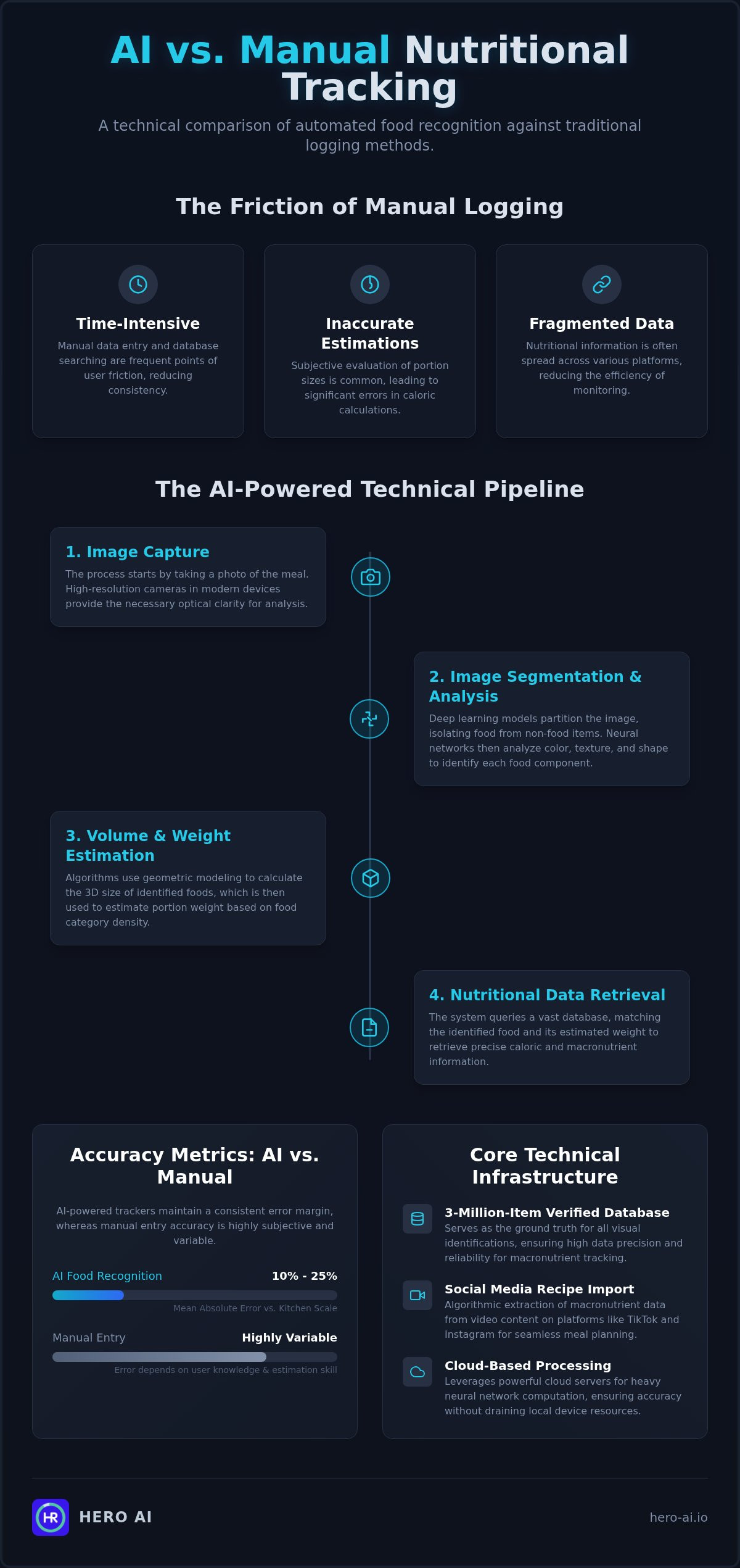
AI-powered trackers currently maintain a mean absolute error of 10% to 25% when compared to kitchen-scale measurements. This statistic highlights the technical limitations and potential of the modern food recognition calorie app. Manual data entry remains a primary point of friction for users. It's frequently time-intensive and results in inaccurate estimations of portion sizes. Fragmented data across various platforms further reduces the efficiency of nutritional monitoring.
This article delivers a functional evaluation of visual recognition technology and nutritional data accuracy. It examines the integration of automated meal logging via photography with a 3-million-item verified food database. The analysis covers the technical requirements for importing recipes directly from TikTok and Instagram. Readers will understand the infrastructure needed for precise macronutrient tracking. This evaluation focuses on the transition from manual inputs to automated nutritional systems. It provides a technical overview of the 1-year subscription as a comprehensive tracking solution.
Key Takeaways
- Identify the technical protocols for image segmentation and volume estimation within automated nutrition systems.
- Compare the accuracy metrics and error rates of a food recognition calorie app against traditional manual entry methods.
- Examine the algorithmic extraction of macronutrient data from TikTok and Instagram video content.
- Utilize a 3-million-item verified food database via the HERO AI 1-Year Subscription to ensure data precision.
What is a Food Recognition Calorie App?
A food recognition calorie app is a digital infrastructure designed for automated nutritional analysis. It utilizes computer vision to identify food items from photographic data. This technology represents a technical shift from manual database searching to automated image analysis. Core components include deep learning neural networks, comprehensive food databases, and streamlined user interfaces. These elements work together to estimate caloric and macronutrient values. AI reduces user friction by eliminating the need for text-based searches. It minimizes logging latency through rapid image processing. The system identifies specific food groups and estimates their weight based on visual cues. This process replaces the subjective estimation common in manual entry. Neural networks analyze specific visual attributes:
- Color and texture patterns for food identification.
- Shape and volume characteristics for portion estimation.
- Contextual clues from the plate or environment for item categorization.
The Evolution of Nutritional Logging
Nutritional logging has transitioned through several technical stages. Early methods relied on manual recording in physical journals. Text-based digital databases followed. These required users to search for specific items. This approach had limitations. Users faced database fatigue. Inaccurate portion size estimations were common. The introduction of photo-based food logging marked a significant advancement. Computer vision now allows for automated data capture within a food recognition calorie app. This reduces the cognitive load on the user. It increases the frequency of logging by simplifying the process. Modern systems use image segmentation. They distinguish between different food items on a single plate. This level of detail was previously impossible with manual text searches.
Key Functional Requirements
High-resolution cameras are the primary hardware requirement. Most current mobile devices provide the necessary optical clarity. Processing is typically split between on-device analysis and cloud-based computation. Cloud servers handle the heavy lifting of neural network processing. This ensures high accuracy. It does not drain local device resources. Integration with an ai calorie counter allows for real-time analysis. The Hero AI 1-Year Subscription provides the necessary access to these cloud resources. It also includes a 3-million-item verified food database. This database serves as the ground truth for all visual identifications. Accurate tracking requires this level of technical precision. A stable internet connection is required for cloud-based data synchronization. This ensures that the 3-million-item verified food database is always accessible for real-time verification.
Technical Methodology of Photo-Based Nutrition Tracking
The food recognition calorie app relies on a multi-stage technical pipeline to convert visual data into nutritional metrics. Image segmentation begins the process by partitioning a digital image into multiple segments. This allows the system to isolate food items from non-food objects like cutlery or plates. High-precision segmentation is vital for defining the spatial boundaries of each ingredient. These boundaries provide the foundation for subsequent volumetric calculations. Automated systems use these pixel-level maps to estimate the physical dimensions of the meal.
Image Analysis Protocols
Deep learning models identify specific food categories through texture and shape analysis. These models require training on diverse datasets to recognize variations in food preparation. Handling complex meals involves multi-layered identification to manage overlapping items. A technical guide on photo based nutrition tracker operations provides further details on these neural network layers. Accuracy in these protocols is essential to prevent misidentification of high-density ingredients. The identification phase must occur before any volumetric data can be converted into caloric values.
Volume estimation algorithms calculate the three-dimensional size of the identified segments. These algorithms use geometric modeling or depth data to estimate weight. Technical research indicates that some AI systems underestimate calories and fat when analyzing complex dishes. To address this, the system applies standardized nutritional density data to the calculated volume. This step ensures that the final caloric output remains within verified parameters. The system adjusts for density variations based on the identified food category.
Database Synchronization
Once an item is identified and its volume estimated, the system initiates a database query. Real-time synchronization is achieved through API integration with global nutritional repositories. The Hero AI infrastructure utilizes a 3-million-item verified food database to ensure the highest level of data integrity. This database acts as the authoritative source for caloric values and macronutrient ratios. Processing latency is minimized by performing these queries on high-concurrency cloud servers. The retrieval of data occurs in milliseconds to provide immediate feedback to the user interface.
Continuous updates to the database ensure that new products and regional variations are included. This synchronization maintains the relevance of the tracking system over long durations. Users can access these advanced methodological features via a 1-year subscription. This model supports the ongoing computational costs of high-speed image analysis and database maintenance. Accurate nutritional tracking requires this level of back-end technical support to remain functional and precise.
Accuracy Metrics: AI vs. Manual Calorie Counting
Quantitative analysis reveals a significant disparity between manual and automated nutritional logging. Manual entries are susceptible to cognitive bias and memory recall issues. Users frequently under-report intake by 30% or more. A food recognition calorie app mitigates these human factors by providing objective visual analysis. Current 2026 data indicates that AI-driven systems achieve a mean absolute error rate of 10% to 25%. This performance level exceeds traditional manual logging accuracy. Technical limitations exist when visual data is compromised. Low-light environments and obscured views reduce the precision of segmentation. Research on Calorie Estimation From Food Images identifies these environmental variables as primary drivers of error. High-precision systems use secondary verification protocols to address these variances.
Precision in Macro Calculation
Macro-specific identification accuracy varies by food density and texture. Protein sources generally allow for higher identification precision due to distinct fiber patterns. Fats and oils integrated into complex dishes remain more difficult to quantify visually. The technical methodology for macro calculation from images provides a scalable alternative to chemical analysis. While laboratory testing is more precise, it's not functional for daily use. AI models provide a consistent standard deviation in daily reporting. Most systems target a variance of less than 150 calories for a standard adult profile. This consistency allows for reliable long-term trend analysis.
Data Verification Systems
Reliable tracking requires a verification layer between identification and logging. The Hero AI 3-million-item verified food database serves as the technical ground truth for this process. It cross-references visual estimates with laboratory-verified nutritional profiles. This reduces the impact of identification errors. User-in-the-loop verification allows individuals to confirm low-confidence results. This iterative process improves the neural network's performance over time. Longitudinal accuracy tracking monitors system performance across thousands of logging events. This ensures that the 1-year subscription maintains high data integrity. These verification protocols include several specific technical steps:
- Comparison of visual data with historical user patterns.
- Automated flagging of statistical anomalies in macronutrient ratios.
- Real-time updates to the 3-million-item verified food database.
- Refinement of volume estimation based on user-corrected weights.
These systems ensure that the food recognition calorie app remains a functional tool for precise health management. Consistent data verification is the standard for high-performance nutrition platforms.
Operational Integration: Social Media and Recipe Importation
Modern automated nutrition systems extend beyond static image analysis. A high-performance food recognition calorie app now integrates directly with social media platforms. This functionality allows for the algorithmic extraction of nutritional data from video content. TikTok and Instagram serve as primary sources for digital recipes. Automated systems use specific protocols to parse these recipes into macronutrient components. This process eliminates the requirement for manual ingredient entry. It streamlines the transition from content consumption to nutritional logging. Data extraction occurs in real-time. This ensures that the user's fitness plan remains updated with the latest dietary data.
Social Media Data Extraction
Optical Character Recognition (OCR) and Natural Language Processing (NLP) techniques facilitate recipe parsing. OCR identifies text overlays in video content. NLP interprets the spoken instructions or written captions. These tools identify specific ingredients and quantities mentioned in social media posts. The system then maps these ingredients to standardized nutritional IDs. This mapping ensures that the data is consistent with laboratory-verified standards. It prevents errors caused by non-standardized measurement terms. Efficiency gains are significant. Users no longer need to transcribe data from a video to a tracking log. The 3-million-item verified food database provides the necessary reference points for this extraction. This ensures that international ingredients are identified accurately. The system maintains data integrity by cross-referencing every extracted item with verified nutritional profiles.
Workout and Nutrition Synchronization
Operational integration includes the synchronization of nutrition with physical activity. Automated platforms allow users to schedule fitness activities based on social media content. This feature aligns caloric intake with planned physical expenditure. Technical workflows for health management involve bidirectional data sharing. When a user saves a workout from a social media post, the system calculates the estimated metabolic equivalent. This value is used to predict caloric burn. The food recognition calorie app then suggests nutritional adjustments to support recovery. This integration ensures that the user's energy balance remains within specified parameters. It provides a data-driven approach to combining nutrition and exercise. Data remains centralized within a single interface. This prevents the fragmentation common in traditional tracking methods.
Verification remains a critical component of the importation process. Every social media recipe is cross-referenced against the 3-million-item verified food database. This step prevents the propagation of inaccurate nutritional claims often found in unverified online content. The system flags discrepancies between user-generated recipes and verified data. This ensures high-precision tracking for every meal. To access these advanced integration features, users can purchase a 1-year subscription. This model provides the necessary infrastructure for continuous social media data processing and synchronization.
HERO AI: Technical Specifications and Subscription Benefits
HERO AI functions as an automated health platform for international users. The 1-Year Subscription provides the technical framework for comprehensive nutritional monitoring. A core component of this framework is the 3-million-item verified food database. This database contains validated data points for global food products. It ensures that the food recognition calorie app delivers precise results regardless of the user's location. The photo recognition engine is built on a high-concurrency cloud architecture. This design allows the system to process complex images in less than three seconds. It identifies multiple food groups simultaneously while calculating volume and density. Social media integration allows for the seamless transfer of recipes from TikTok and Instagram. This feature also supports workout scheduling based on fitness content found on these platforms.
Automated Nutritional Management
Automation removes the administrative burden of manual meal logging. The AI handles the identification of ingredients and the calculation of macronutrients. This data-led approach supports specific outcomes like muscle gain or body fat reduction. The system analyzes caloric intake against physical expenditure to provide real-time feedback. Technical support is a standard inclusion for all subscription holders. It covers software updates and database synchronization issues. Users receive regular reports summarizing their nutritional compliance. This ensures that the user remains informed of their progress without needing to perform manual calculations.
Implementation and Deployment
Activating the 1-Year Subscription requires a few sequential steps. Users first complete the digital registration process to secure their account. The next phase involves configuring the photo recognition engine. Accuracy is maximized when the camera is calibrated for different environments. Users should perform this calibration in both natural and artificial light. This helps the food recognition calorie app adapt to specific user settings. Linking social media profiles is the final step in the setup process. This allows the system to begin the algorithmic extraction of recipe and workout data. The transition to a fully automated food diary is then complete. This deployment method is designed for efficiency and immediate technical integration. The system remains updated through cloud-based patches. This ensures that the latest neural network improvements are always active.
Transitioning to Automated Nutritional Systems
The transition from manual database entry to an integrated food recognition calorie app represents a fundamental shift in health data management. Technical analysis confirms that automated visual recognition reduces the cognitive load on users while improving the accuracy of caloric logs. The system utilizes an AI-powered visual recognition engine to process complex food images and estimate volumes with high precision. This infrastructure is supported by a 3-million-item verified food database. This database serves as the ground truth for all nutritional identifications.
Operational efficiency is further enhanced through automated TikTok and Instagram recipe imports. This ensures that digital content is parsed into actionable macronutrient data without manual transcription. These systems provide a stable framework for long-term health monitoring and data-led optimization. Reliability and technical precision remain the core priorities for modern automated nutritional diaries. Each component works to minimize user friction and maximize data integrity.
Access the HERO AI 1-Year Subscription for automated tracking to begin the transition to a streamlined nutritional system. Professional infrastructure supports consistent progress toward established fitness objectives.
Frequently Asked Questions
How does a food recognition calorie app identify specific ingredients?
Identification occurs through image segmentation and object identification protocols. Neural networks analyze pixels to distinguish between food items, plates, and backgrounds. The system categorizes items based on color, texture, and shape. It then cross-references these visual data points with a verified database to determine the exact ingredient. This process replaces manual text-based searches with automated visual analysis. It ensures that every component on a plate is identified before the volume estimation phase begins.
Is photo-based calorie counting more accurate than manual entry?
Photo-based methods provide a more objective assessment than manual entry, which is often compromised by user bias. While manual entry can lead to underestimation by 30% or more, AI-powered trackers show a mean absolute error of 10% to 25%. A food recognition calorie app uses volume estimation algorithms to calculate portion sizes more consistently than the human eye. This technical approach reduces the frequency of estimation errors in daily nutritional logs.
Can I import recipes from TikTok and Instagram into HERO AI?
Yes, the platform supports direct recipe importation from TikTok and Instagram. It uses Optical Character Recognition (OCR) and Natural Language Processing (NLP) to parse video content and captions. The system extracts ingredient lists and quantities, mapping them to standardized nutritional IDs. This functionality is included in the 1 Year Subscription. It allows users to convert social media content into actionable nutritional data without manual transcription or data entry.
How many items are included in the HERO AI verified food database?
The HERO AI database contains over 3 million verified food items. This extensive repository provides the ground truth for caloric and macronutrient calculations. Every identification made by the photo recognition engine is cross-referenced against this lab-verified data. Maintaining a database of this scale ensures high-precision tracking across diverse cuisines and international food products. Users access this verified data through the 1 Year Subscription model to ensure their nutritional logs remain accurate.
What technical requirements are needed for AI food recognition?
Users require a mobile device with a high-resolution camera for clear image capture. A stable internet connection is necessary for cloud-based processing and real-time database synchronization. The system performs complex neural network analysis on remote servers to maintain device performance. Calibration for varying light conditions is also recommended to ensure the food recognition calorie app identifies textures and colors accurately. These requirements facilitate the transition to automated nutritional tracking.
Does the HERO AI 1-Year Subscription include workout tracking?
The 1 Year Subscription includes comprehensive workout scheduling and tracking features. Users can import and schedule fitness activities directly from social media content. The system aligns these planned physical expenditures with caloric intake data to manage daily energy balance. This integration allows for a unified view of health metrics. It prevents data fragmentation by consolidating nutrition and exercise logs within a single automated interface. Users can track muscle gain or weight loss progress efficiently.
How are macronutrients calculated from a single meal photo?
Macronutrients are calculated by combining object identification with volume estimation. The AI identifies the food type and determines its three-dimensional volume through depth-sensing or reference point analysis. It then applies standardized nutritional density data from the 3-million-item verified database to the estimated weight. This multi-step protocol provides a breakdown of proteins, carbohydrates, and fats. The resulting data is logged automatically into the user's fitness plan to ensure consistent nutritional monitoring.
What is the error rate of AI-driven nutritional analysis?
Current technical standards for AI-driven analysis show a mean absolute error rate of 10% to 25% compared to kitchen-scale measurements. This represents a significant improvement over the subjective estimation errors common in manual logs. Factors such as low lighting or obscured views can impact these metrics. To maintain high accuracy, the system utilizes a 3-million-item verified food database. This ensures that the margin of error remains within acceptable parameters for professional nutritional management.


