

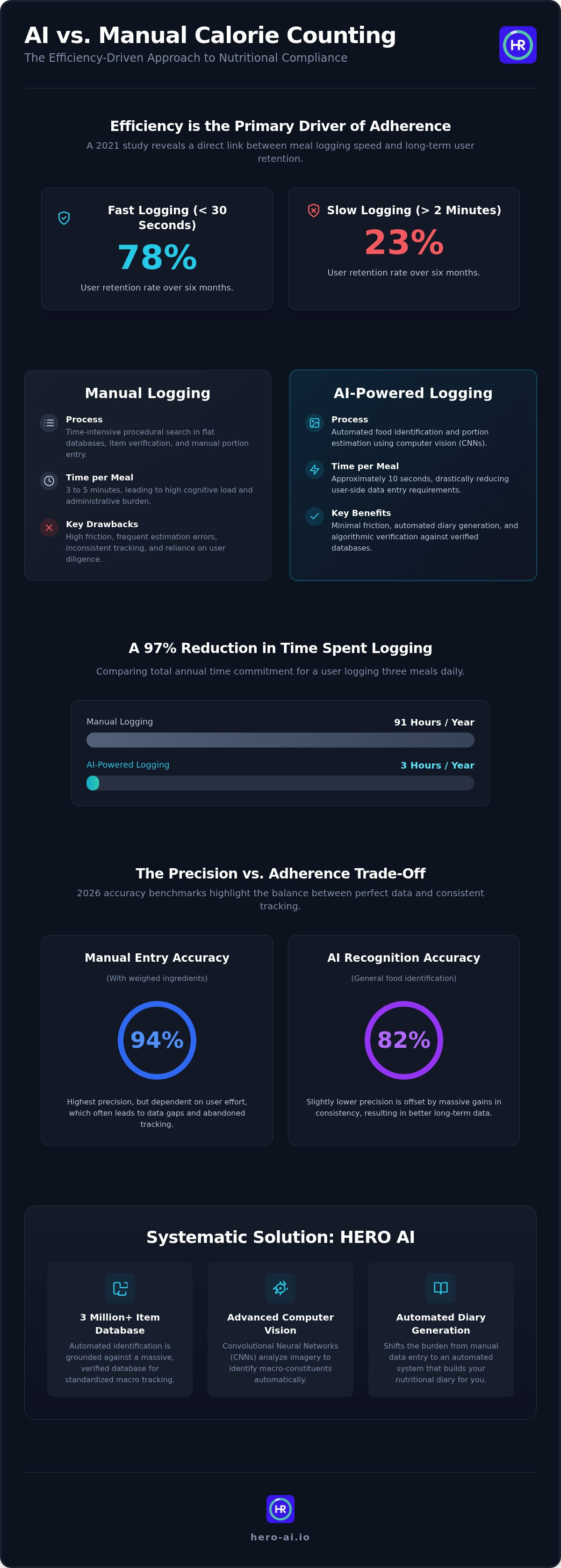
A 2021 study shows that users spending less than 30 seconds logging meals achieve a 78% retention rate over six months. In contrast, those requiring more than two minutes see retention drop to 23%. These figures establish efficiency as the primary driver of nutritional compliance. The comparison of ai vs manual calorie counting is now a matter of balancing capture speed against data precision.
Traditional manual logging is often a high-friction process. It involves time-intensive database searches and frequent estimation errors in complex meals. You've likely experienced how this administrative burden leads to inconsistent tracking. This report evaluates automated nutritional data capture against manual entry protocols for fitness management.
Readers will gain a technical understanding of how automated systems reduce daily logging time by 90%. The analysis previews current 2026 computer vision error rates and the role of verified databases in macro calculation. It positions Hero AI as a systematic solution for transitioning from manual logs to automated diaries for improved long-term adherence.
Key Takeaways
- Manual logging requires procedural searches in flat databases, while AI systems utilize computer vision for automated identification.
- A technical analysis of ai vs manual calorie counting identifies a 90% reduction in logging time, facilitating higher daily compliance.
- Automated workflows allow for the algorithmic verification and importation of nutritional data from social media platforms.
- User retention rates correlate with reduced logging friction and the implementation of instant visual feedback protocols.
- The HERO AI 1-year subscription provides access to a 3-million-item verified database for standardized macro tracking.
Functional Definitions: AI vs. Manual Nutrition Logging
Nutritional tracking relies on the scientific basis of calories to quantify energy intake. Manual logging is a procedural system. The user searches a flat database for specific items. They then select a match. AI logging uses computer vision. It automates the identification process. This distinction is central to the ai vs manual calorie counting debate. Efficiency depends on the method of data capture. Manual systems require active user participation at every stage. AI systems shift the burden to digital infrastructure.
The Manual Logging Protocol
Manual logging follows a strict sequence of administrative tasks. The user must first search for a food item by name or barcode. They must then verify the brand or manufacturer details against the available entries. Finally, the user inputs the portion weight or volume. This protocol takes 3 to 5 minutes per meal entry. Errors often occur during the estimation phase. Users typically struggle to quantify ingredients in complex restaurant dishes. Inconsistent logging is a frequent result of this high friction. Accuracy depends entirely on the quality of the database and user diligence. If the database contains crowdsourced errors, the log becomes unreliable. The process is repetitive. It requires high cognitive load for every meal logged.
AI-Enabled Visual Recognition Systems
AI systems utilize Convolutional Neural Networks (CNN) for food recognition. These networks analyze food imagery through multiple layers of feature extraction. They identify macro-constituents automatically by recognizing patterns in shape, color, and texture. Depth estimation algorithms calculate portion volumes from the photographic data. This reduces user-side data entry requirements significantly. Hero AI integrates this technology with a 3-million-item verified database. This ensures that the automated identification matches a standardized reference point.
Automated systems standardize Type 2 nutritional data capture. In this model, the software handles both the identification and the quantification of the food. The user only provides the raw visual data. It's a shift from manual database management to automated diary generation. The Hero AI 1-year subscription provides the infrastructure for this automated capture. This transition addresses the primary efficiency gaps found in ai vs manual calorie counting comparisons. The objective is a functional reduction in logging time for the user. Accuracy is maintained through algorithmic verification and database grounding. This system is designed to support long-term adherence by removing the barriers of traditional entry. It provides a stable infrastructure for fitness management.
Comparative Analysis of Data Entry Efficiency and Accuracy
Efficiency in nutritional tracking is measured by the ratio of data accuracy to the time cost of entry. Quantitative data shows that AI-powered logging requires approximately 10 seconds per meal. Traditional manual entry requires an average of 300 seconds. This discrepancy creates a significant operational gap when evaluating ai vs manual calorie counting for long-term health management. While manual entry allows for granular detail, the administrative burden often leads to data gaps.
Speed and Time-Saving Metrics
Over a 365-day tracking period, the time difference is substantial. A user logging three meals daily via manual methods spends approximately 91 hours per year on data entry. AI automation reduces this to roughly 3 hours per year. This 97% reduction in administrative overhead directly impacts tracking fatigue. Research suggests that users who spend less than 30 seconds per entry maintain a 78% retention rate over six months. High-performance users can optimize these workflows by utilizing automated nutritional data capture to maintain continuity without the time penalty of manual searching.
Accuracy Benchmarks for 2026
Current 2026 benchmarks indicate an accuracy variance based on meal complexity. Manual database entry achieves approximately 94% accuracy when users weigh ingredients. AI-powered photo recognition currently operates at an 82% accuracy level for general food identification. This data is supported by academic research on logging accuracy, which highlights the trade-offs between speed and precision in digital health applications.
Simple meals with distinct ingredients show higher AI precision. Complex dishes with hidden variables, such as cooking oils or blended sauces, present technical challenges for computer vision systems. However, the Precision-Adherence Paradox suggests that a slightly less accurate log maintained consistently is more valuable than a precise log that is abandoned. Automated systems often include human-in-the-loop verification to bridge this gap. This allows users to review and adjust the automated output to account for specific preparation methods. In the ai vs manual calorie counting analysis, the speed of capture offsets the minor precision gains of manual entry for the majority of fitness goals. Consistent data continuity remains the primary driver of successful nutritional management.
Operational Workflows: Database Grounding and Verification
Effective automation requires a robust data foundation. In the context of ai vs manual calorie counting, the primary technical challenge is grounding visual recognition in verified facts. Raw image analysis identifies an object; it doesn't provide nutritional values. Systems must map these visual identifiers to a structured dataset. This process prevents the "hallucination" of nutritional data. It ensures that the digital diary reflects objective reality rather than statistical guesswork. Data integrity depends on the quality of the underlying library.
Social Media Recipe Importation Protocols
Users frequently consume nutritional content from TikTok and Instagram. These platforms provide unstructured recipe data. Manual entry of these ingredients is inefficient and prone to user error. Algorithmic verification now allows for direct nutrient extraction from social media content. The Hero AI system identifies ingredient lists within video captions or overlays. It then standardizes this non-structured data for macro calculation. This automation removes the need for users to type every item manually. It converts a complex manual task into a near-instant importation. Data integrity is maintained by mapping these ingredients back to the 3-million-item verified database.
Verified Database Integration
A verified database is the core of any automated nutrition platform. Hero AI utilizes a 3-million-item verified database to ensure accuracy. When the photo recognition system identifies a meal, it cross-references the result against this database. This step is critical for maintaining global food data standards. It allows international users to access consistent information regardless of their location. Barcode scanning serves as a secondary validation protocol. It provides a discrete data point to confirm the AI's visual assessment. This multi-layered approach ensures data integrity across the entire library.
Maintaining a library of 3 million items requires constant administrative oversight. The 1-year subscription model supports this digital infrastructure. It ensures the database remains updated with new product releases and manufacturing changes. Transitioning from manual search to automated verification optimizes the tracking workflow. It replaces human estimation with algorithmic precision grounded in verified data. This systematic approach is essential for high-performance fitness management. It provides the reliability needed for long-term goal achievement without the friction of traditional entry methods.
Impact on Long-Term Compliance and Fitness Goal Achievement
User retention in nutritional tracking is inversely proportional to logging friction. High administrative burdens in manual entry often lead to inconsistent data collection. In the ai vs manual calorie counting assessment, long-term compliance is the critical success factor. If a tracking protocol is too complex, users typically abandon the process. Automated systems address this by lowering the barrier to entry and maintaining data continuity over extended periods.
Friction Reduction and User Retention
Systematic data collection improves when logging takes approximately 10 seconds. This speed allows for real-time capture during meal consumption. It eliminates the need for retrospective logging. Retrospective entry is often prone to memory bias and nutritional underestimation. Photo evidence provides a functional record of choices. This visual feedback loop strengthens awareness of portion sizes. It facilitates several behavioral benefits:
- Instant visual verification of food quality and volume.
- Reduction in the psychological barrier to initiating a daily log.
- Elimination of the data gaps caused by manual entry fatigue.
These factors facilitate a transition from temporary dieting to permanent, data-led health management. Reducing the cognitive load of searching for items allows users to focus on dietary choices. They don't have to manage a flat database manually. This shift is essential for individuals with high professional demands who require efficient systems.
Technical Analysis of Goal Optimization
Fitness goals require different levels of data precision. Bodybuilding protocols demand exact macro-nutrient distribution analysis for muscle protein synthesis. General weight loss goals benefit more from consistent calorie tracking over time. Automated systems provide instant macro calculations from diverse sources. This includes direct imports from social media recipes. Nutritional compliance in the context of AI automation is defined as the consistent digital capture of dietary intake facilitated by minimized user intervention. These systems ensure that data continuity remains high even during periods of increased schedule density.
Quantitative progress tracking for weight loss and muscle gain relies on longitudinal data sets. Missing entries create gaps in the metabolic profile. AI automation ensures these gaps are minimized by integrating tracking into existing digital habits. Busy people require solutions that function as reliable digital infrastructure. You can access these automated tools through a HERO AI 1-year subscription to maintain long-term nutritional integrity. The objective is to replace human effort with a stable, automated workflow. This shift supports sustained adherence to fitness objectives. It provides a standardized framework for achieving measurable health outcomes without the friction of traditional entry methods.
HERO AI: Automated Nutritional Data Capture and Systems Integration
HERO AI operates as a digital infrastructure for automated fitness management. It provides a systematic resolution to the efficiency gaps identified in the ai vs manual calorie counting analysis. The core functionality is delivered through a 1-year subscription. This model ensures continuous access to a 3-million-item verified food database. This database serves as the ground truth for all automated captures. It eliminates the reliance on user-generated data which often contains inaccuracies. The system is designed for busy individuals who require a stable and predictable tool for health tracking.
Automated Food and Macro Tracking
The platform utilizes a photo based nutrition tracker to achieve instant logging. This system analyzes visual data to identify ingredients and estimate portion sizes automatically. Technical precision in macro calculation from images is achieved through depth-sensing algorithms and pattern recognition. Users interact with a food recognition calorie app interface designed for high-speed data entry. The protocol standardizes the capture of proteins, fats, and carbohydrates. It removes the need for manual weight input or database searches. This automation supports a significant reduction in daily logging time compared to traditional methods. The process is modular and repetitive; it ensures a steady rhythm of data collection.
Unified Fitness Management System
HERO AI integrates nutritional tracking with physical activity scheduling to provide a comprehensive management tool. This unified approach addresses the technical requirement for total fitness oversight. Users can schedule workouts directly from social media content found on TikTok and Instagram. This feature centralizes disparate data sources into a single operational diary. It ensures that energy expenditure data aligns with nutritional intake logs without requiring manual data transfers. The ai calorie counter serves as the central pillar for this methodology. It provides an automated analysis of metabolic data across diverse sources.
The system maintains data integrity by cross-referencing all automated inputs with the verified database. This multi-layered verification process is essential for professional-grade fitness tracking. It provides the stability required for long-term health objectives. The transition from manual searching to automated capture is a functional optimization. This infrastructure prioritizes accuracy and speed above user-driven administrative tasks. It represents the current technical standard for automated nutritional data capture. Every line of data serves as a standalone unit of information in the user's digital diary. This structure favors clarity and speed over complex storytelling. Accuracy is maintained through algorithmic grounding in the 3-million-item verified database.
Optimizing Nutritional Efficiency with Automated Capture
The technical evaluation of ai vs manual calorie counting demonstrates that efficiency is the primary driver of nutritional adherence. Manual entry protocols average 300 seconds per meal; automated systems require 10 seconds. This reduction in cognitive load prevents tracking fatigue. System reliability depends on a 3-million-item verified database and automated social media recipe importation. These features ensure that data capture is both fast and accurate.
Unified systems now integrate fitness scheduling with nutritional logs to provide total oversight. This infrastructure supports permanent, data-led health management. It replaces human estimation with algorithmic precision. Implementing these tools allows for the continuous collection of metabolic data. It's a systematic approach that provides the stability needed for long-term goal achievement.
Access the HERO AI 1-Year Subscription for Automated Nutrition Tracking to optimize your daily workflow. Reliable data collection is the first step toward optimized fitness outcomes.
Frequently Asked Questions
Is AI calorie counting as accurate as weighing food on a scale?
Weighing food on a scale remains the gold standard for absolute precision in nutritional science. AI tracking provides a functional alternative by offering approximately 82% accuracy. Manual database entry averages 94% but involves significant user friction. For most fitness goals, the high adherence rate of AI offsets this precision gap. Consistency is a more reliable predictor of long-term success than perfect accuracy achieved through unsustainable manual protocols.
How does AI identify ingredients in complex restaurant meals?
AI uses computer vision and depth estimation to analyze food imagery. It identifies macro-constituents by recognizing patterns in shape, color, and texture. For complex restaurant meals, the system references a 3-million-item verified database to find the closest match. While it can struggle with hidden variables like internal oils, it provides a data-driven estimate based on standardized preparation models. This method is significantly faster than manual estimation for ai vs manual calorie counting protocols.
Can I import recipes from TikTok and Instagram into HERO AI?
Yes. HERO AI includes a direct recipe import feature for social media platforms like TikTok and Instagram. The system uses nutrient extraction algorithms to identify ingredient lists within video captions or overlays. It then standardizes this non-structured data to calculate macros automatically. This functionality eliminates the need for manual ingredient entry and searching. It allows users to transition recipes from digital content to their nutritional diary with minimal intervention and high efficiency.
Does the HERO AI database include verified nutritional data?
Yes. The platform utilizes a database of 3 million verified food items to ground its recognition results. This verified data prevents "hallucination" in nutritional estimates by providing a standardized reference point. Every photo-based identification or barcode scan is cross-referenced against these entries. This ensures that the macro-nutrient and calorie calculations reflect objective nutritional standards. The 1-year subscription provides continuous access to these updated data sets for users maintaining a global health perspective.
How much time does AI tracking save compared to manual entry?
AI tracking reduces logging time by approximately 90% compared to traditional entry. Manual entry requires an average of 300 seconds per meal for searching and weighing. AI-powered photo recognition takes roughly 10 seconds. Over one year, this saves approximately 88 hours of administrative work. It's a core factor in the ai vs manual calorie counting comparison. It allows busy people to maintain consistent logs without the time penalty or friction of traditional manual entry methods.
Can AI detect the difference between different types of cooking oils?
Visual recognition systems currently face limitations with hidden or translucent variables. AI identifies ingredients based on visible surface features and texture patterns. It cannot definitively distinguish between olive oil and vegetable oil through a photo alone. Users can utilize the human-in-the-loop verification feature to adjust specific preparation details manually. This ensures the log remains accurate when meal preparation involves variables that are not visually distinct to the computer vision system during capture.
What happens if the AI misidentifies a food item in a photo?
The system allows for immediate manual verification and correction if an item is misidentified. If the automated identification is incorrect, users can select the correct item from the 3-million-item verified database. Barcode scanning serves as a secondary validation protocol to confirm specific packaged goods. This hybrid approach maintains data integrity while leveraging the speed of automation. It ensures the nutritional diary remains a reliable record of actual dietary intake for fitness management and progress tracking.
Does HERO AI support workout scheduling alongside nutrition tracking?
Yes. HERO AI provides an integrated social media workout scheduler alongside nutrition tracking. This feature allows users to schedule physical activity directly from content found on TikTok and Instagram. It centralizes nutritional and workout data into a single operational interface. This integration provides a holistic view of energy balance and metabolic progress. The 1-year subscription includes full access to these unified fitness management tools for streamlined health tracking and improved long-term goal achievement.


