

Leading AI models now achieve over 87% accuracy across more than one million food items. This technical milestone transforms the macro tracking app from a manual entry tool into an automated infrastructure for health management. It's common for users to find manual logging a time-intensive process. Estimating portion sizes and calculating macros from social media recipes often results in data inaccuracies. These friction points lead to inconsistent tracking and unreliable nutrition plans.
This guide provides a technical analysis of how automated systems utilize AI and global databases to eliminate manual entry. The analysis covers the integration of social media content into nutrition plans. It details the use of verified global food databases to ensure data integrity. Readers will gain insight into how a 1 Year Subscription to a digital health platform supports systematic health data management. This functional overview explains the transition from reactive logging to proactive nutritional monitoring through automated digital systems. The objective is to provide a clear status of current AI-driven nutrition technology.
Key Takeaways
- Identify technical components that allow a macro tracking app to automate nutrient data capture.
- Review protocols for converting TikTok and Instagram video data into nutrition logs.
- Access a global database of 3 million verified food items to ensure nutrient data accuracy.
- Compare the functional efficiency of AI photo recognition against manual data entry methods.
- Implement a systematic health data strategy using a 1 Year Subscription for long-term monitoring.
The Evolution of Macro Tracking App Technology
A macro tracking app is defined as a digital nutrient management system designed to monitor macronutrient intake. These systems track protein, carbohydrates, and fats to assist users in reaching specific physiological or fitness targets. The technology has shifted from static paper logs to dynamic, automated platforms. This transition represents a move toward systematic data management in personal nutrition.
The core functionality of a modern macro tracking app centers on the precise calculation of daily intake against predefined targets. These targets are often based on metabolic rates and activity levels. In the past, users had to perform these calculations manually, which increased the likelihood of mathematical error. Modern digital systems automate these calculations in real-time. This provides immediate feedback on remaining nutrient allowances, which is critical for maintaining a specific dietary protocol.
From Manual Logs to Digital Databases
Early iterations of digital tracking were limited by manual input requirements. Users had to search for individual items and manually enter nutritional values. This process was prone to human error and data inconsistencies. The Evolution of fitness apps introduced barcode scanning as the first layer of automation. This feature allowed users to access nutritional information by scanning product packaging, which linked to a central database. Today, these systems rely on cloud-synced food libraries. These libraries provide access to verified data points across different regions, ensuring that the information remains current and accurate.
The Problem of User Friction in Traditional Apps
User friction is a major factor in the failure of traditional nutrition tracking. Manual data entry is time-intensive and often leads to tracking fatigue. When the administrative burden becomes too high, users frequently stop logging their intake. This lack of compliance prevents the collection of long-term health data.
Data integrity is another significant concern. Traditional methods often rely on user estimation for portion sizes and ingredients. This "guesswork" introduces inaccuracies that can skew total caloric and macronutrient counts. AI automation solves this by removing the need for manual estimation. HERO AI utilizes photo recognition and a database of 3 million verified items to improve data precision. Implementing a 1 Year Subscription allows for a consistent, long-term data strategy. This long-term commitment is necessary for accurate health monitoring and trend analysis. The shift toward automated capture is not just a convenience; it's a requirement for data-driven nutrition management.
Functional Architecture of AI-Driven Nutrition Trackers
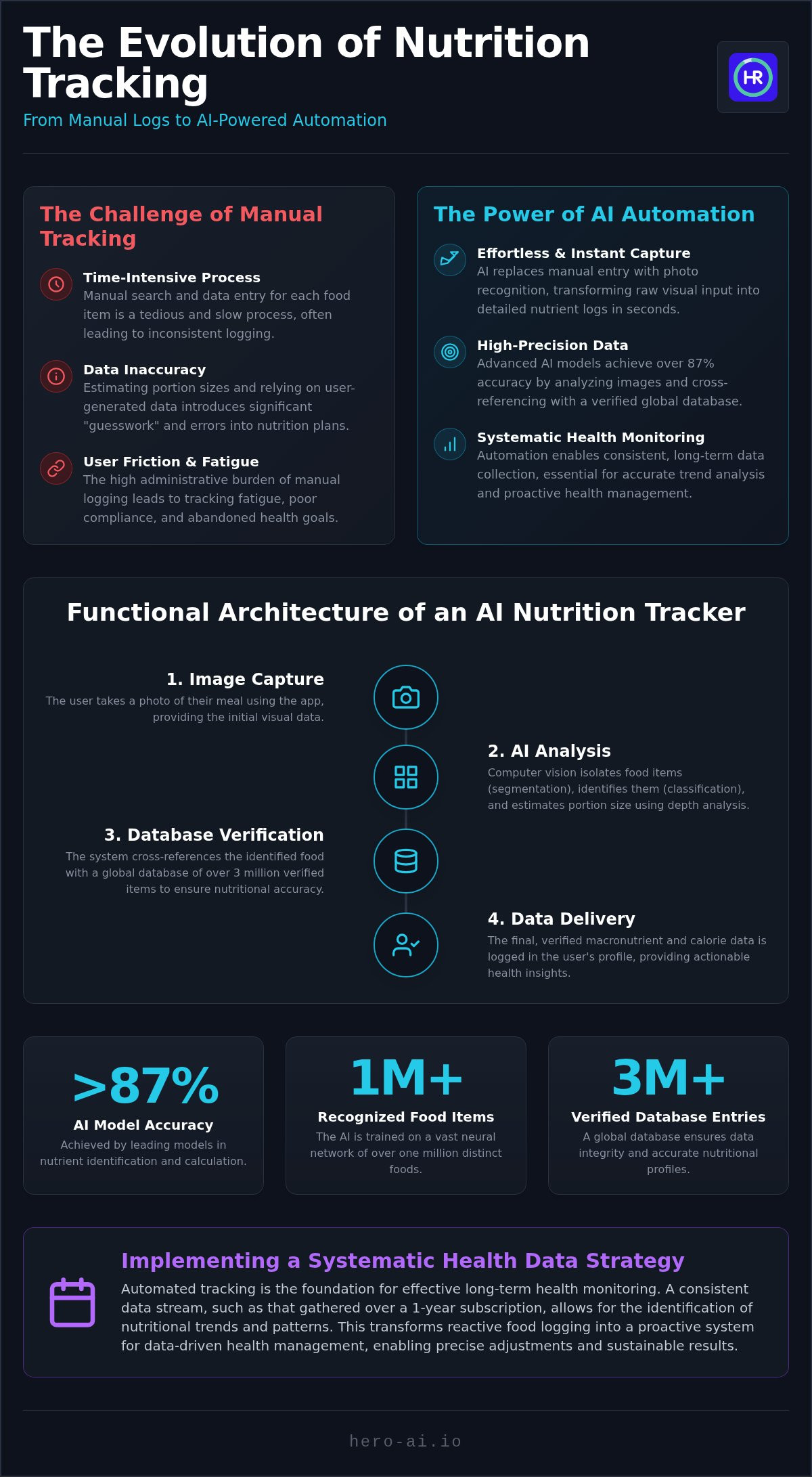
The functional architecture of a modern macro tracking app integrates advanced image processing with extensive data libraries. This system replaces manual data entry with automated recognition protocols. The architecture consists of several discrete layers that work in sequence to ensure data integrity. These layers transform raw visual input into actionable nutritional data for the user.
Computer Vision and Photo Recognition Protocols
The process begins with image segmentation. The AI isolates food items from non-food elements in the photo by identifying boundary edges. Classification algorithms then compare the isolated pixels against known food patterns within neural networks. To determine portion size from a 2D image, the system utilizes depth estimation and spatial context. It analyzes the relationship between the food item and its environment to approximate physical dimensions. This doesn't require a physical scale for the macro tracking app to calculate the volume of the food item. Photo-based nutrition tracking is the automated conversion of visual food data into nutrient values, a process where leading AI models in 2026 achieve over 87% accuracy across more than 1 million food items. The system accounts for density variations within different food categories to ensure the resulting gram weight is precise.
Verification Systems and Global Food Databases
Identification is followed by a rigorous verification layer. The system cross-references the classified item with a database of 3 million verified foods. It's necessary to distinguish between similar-looking items that have different nutritional profiles, such as low-fat versus full-fat variations. Academic research into AI in personalized nutrition suggests that deep learning models are becoming more efficient at this cross-referencing task by using contextual metadata. Integrating an AI Calorie Counter: Automated Nutritional Data Capture and Analysis ensures that the captured data is grounded in verified nutritional facts rather than user-generated estimates. This multi-layered approach minimizes the reporting errors common in manual tracking. Reliable data capture is essential for users monitoring long-term health trends. Accessing this technical infrastructure via a 1 Year Subscription provides a stable environment for systematic nutrient management.
Comparative Analysis: Manual Entry vs. Automated Capture
The efficiency of a macro tracking app is measured by data accuracy and the time required for input. Manual entry protocols rely on user-initiated searches and subjective estimations. Automated capture utilizes computer vision to identify items and determine volume without user intervention. This technical shift addresses the primary limitations of traditional nutrient management systems.
Accuracy Metrics in Nutrient Reporting
Human estimation of portion sizes is a significant source of data variance. Research indicates that individuals often underestimate caloric intake by significant margins due to visual bias. A scientific analysis of AI in personalized nutrition demonstrates how machine learning models stabilize these estimations. AI systems analyze pixel density and spatial relationships to calculate weight more reliably than human observation. In complex meal scenarios, such as mixed salads or stews, AI identifies individual components that users frequently overlook. This precision is supported by database depth. While standard apps may rely on limited or unverified datasets, advanced systems use millions of verified items to cross-reference visual data. This reduction in the margin of error is critical for maintaining the integrity of a nutrition plan.
Time-Saving Efficiency and Compliance Rates
Administrative burden is the leading cause of tracking cessation. Manual logging requires several minutes per meal to search, select, and adjust portions. In contrast, photo-based logging reduces the input time to seconds per entry. This speed is a primary driver of daily user adherence. Data suggests a direct correlation between the reduction of logging friction and long-term compliance. Users are more likely to maintain a tracking protocol when the technical interface requires minimal effort.
Technical reliability also extends to barcode scanners. Modern apps integrate high-speed scanners to handle packaged goods, providing a hybrid solution for varied food sources. A Photo Food Tracker Subscription: A Technical Analysis of Automated Nutrition Systems explores how these combined technologies improve user retention. A 1 Year Subscription ensures that this efficiency remains a consistent part of the user's health infrastructure. By automating the data capture process, the system prioritizes accuracy and speed over manual administrative tasks.
Social media platforms serve as primary sources for modern nutritional inspiration. A macro tracking app must now interface with unstructured data from TikTok and Instagram. This integration allows for the conversion of viral content into structured nutritional logs. Automated systems parse video captions and visual overlays to identify recipe components. This process expands dietary variety while maintaining data integrity. It addresses the limitation of traditional systems that require users to manually calculate ingredients from video content. The system standardizes these inputs to ensure they align with the user's established nutrient targets.
Algorithmic Recipe Importation from TikTok and Instagram
The extraction process utilizes Natural Language Processing (NLP) and Optical Character Recognition (OCR). These technologies identify ingredient lists and quantity specifications within social posts. Once extracted, the system cross-references these items with a verified database of 3 million foods. This verification ensures that the nutritional profile of a social media recipe is accurate and grounded in established data. Syncing TikTok recipes to a macro tracking app automates the conversion of unstructured video data into precise macronutrient totals without manual input. This technical layer removes the need for users to guess the caloric content of trending meals. It provides a standardized method for logging diverse food sources found online. The system also accounts for cooking methods mentioned in captions to adjust for fat or moisture loss during preparation.
Synchronization of Social Media Workouts
Digital nutrition systems also synchronize with social media fitness content. AI models analyze workout descriptions to estimate energy expenditure. This data is translated into a digital fitness plan that communicates directly with the nutrition log. The system balances caloric intake with scheduled physical activity in real-time. Managing energy expenditure based on imported fitness protocols ensures that the user's macronutrient targets remain aligned with their actual activity levels. This synchronization prevents the data gaps that occur when nutrition and fitness are tracked in isolation. The AI evaluates the intensity of the imported movements to refine the daily caloric allowance. A 1 Year Subscription provides the necessary infrastructure to manage these complex data streams over time. Access social media recipe and workout integration tools to streamline your health data management through the HERO AI platform.
Implementing a Systematic Macro Tracking Strategy
A systematic approach to nutrition requires a stable technical infrastructure. The selection of a macro tracking app should be based on technical specifications rather than aesthetic features. Database depth and AI precision are the primary metrics for evaluation. A system that utilizes a database of 3 million verified foods minimizes the risk of data corruption. This ensures that the nutritional summaries generated are based on accurate, verified information. Periodic nutritional adjustments are then possible through the analysis of automated reports. These reports aggregate daily intake data to provide a comprehensive view of nutritional trends over time.
Selecting a Comprehensive Annual Subscription
Long-term health tracking relies on the accumulation of continuous data sets. Short-term tracking often fails to capture the metabolic fluctuations necessary for accurate health optimization. The HERO AI 1-Year Subscription: Functional Service Overview details the benefits of this long-term commitment. A 1 Year Subscription provides the duration required to establish a baseline of nutritional habits. It allows the AI to identify patterns in energy expenditure and nutrient absorption that are invisible over shorter periods. This model ensures that the user's health data remains centralized and accessible for annual review. It's the only way to verify the effectiveness of a specific dietary protocol over a significant duration. It also prevents the data fragmentation that occurs when switching between different platforms or subscription models.
Setting Quantitative Goals for Nutrient Management
Quantitative goals must be defined by physiological requirements such as Basal Metabolic Rate (BMR) and Total Daily Energy Expenditure (TDEE). Users set specific targets for weight loss, maintenance, or muscle gain within the digital interface. The macro tracking app then monitors progress through AI-generated nutritional summaries. These summaries provide a technical status report on the user's adherence to their predefined targets. Transitioning from simple data capture to strategic health optimization requires this continuous feedback loop. Automated reports highlight areas of nutrient deficiency or excess, allowing for precise adjustments to the nutrition plan. By utilizing these systematic tools, users move beyond manual guesswork toward a technical management of their health outcomes. The system automates the analysis of complex data points, ensuring that the user remains informed of their progress relative to their initial objectives.
Advancing Systematic Nutrition Management
The transition to an AI-driven macro tracking app addresses the technical failures of manual logging. Automated systems utilize computer vision to provide precise nutrient analysis from visual data. These platforms cross-reference photo inputs with a database of 3 million verified food items to ensure data integrity. Integration with TikTok and Instagram allows for the seamless importation of social media recipes into a structured nutrition plan. This technical layer removes the subjective estimation common in traditional methods.
Systematic health data management requires a stable infrastructure. Implementing a 1 Year Subscription ensures consistent monitoring of macronutrient intake relative to physiological targets. The removal of manual friction points increases daily adherence and data accuracy. It's a functional state that allows users to focus on strategic health optimization rather than administrative data entry. Reliable data capture is the primary requirement for long-term health monitoring.
Access the HERO AI 1 Year Subscription for automated macro tracking to utilize AI-powered photo recognition and direct social media integration. This infrastructure provides a reliable foundation for consistent health optimization.
Frequently Asked Questions
How does a macro tracking app identify food from a photo?
A macro tracking app identifies food using computer vision and image segmentation to isolate items within a photo. Classification algorithms then compare isolated pixels against known food patterns stored in neural networks. Depth estimation and spatial context allow the system to determine portion size from a 2D image. This technical process converts visual data into precise macronutrient grams, replacing the need for manual ingredient estimation and guesswork.
Is an AI calorie counter more accurate than manual logging?
AI-driven analysis reduces the margin of human error in portion size estimation. Research shows leading AI models in 2026 achieve over 87% accuracy across more than 1 million items. Manual logging relies on subjective guesswork, which often leads to underreporting. The macro tracking app uses verified data points to stabilize these estimations. This ensures consistent reporting and more reliable progress toward health goals.
Can I import recipes from Instagram into my macro tracker?
Users can import recipes from Instagram by utilizing automated parsing tools that extract data from post captions and video overlays. The system identifies ingredient lists and quantities, then cross-references them with a verified database to calculate the total nutritional profile. This automation removes the administrative burden of manually entering each ingredient. It ensures that social media content is integrated accurately into the nutrition plan without data loss.
What is the benefit of a 1 Year Subscription for nutrition tracking?
A 1 Year Subscription provides the necessary timeframe for systematic health data management. It allows for the collection of long-term data sets to identify metabolic trends and absorption patterns. Consistent monitoring over twelve months is required for strategic health optimization. This model ensures that the user's nutritional history remains centralized and accessible for periodic review. It establishes a stable infrastructure for achieving health targets.
Does the app database include verified food items?
The system includes a database of 3 million verified food items to ensure data integrity. These items are cross-referenced with AI visual data to distinguish between similar-looking foods with different nutritional profiles. Access to verified data reduces the reporting errors common in user-generated databases. This verification layer is essential for maintaining an accurate and reliable macro tracking app protocol for long-term health monitoring.
How do I track macros for meals found on TikTok?
Tracking macros for TikTok meals involves using the direct recipe import feature. The platform uses Natural Language Processing to identify ingredients mentioned in the video or caption. Once the data is extracted, the system calculates the macronutrient totals automatically. This allows users to integrate trending social media recipes into their nutrition plan without manual calculations. It provides a standardized data capture method for viral culinary content.
Can a macro tracking app schedule workouts from social media?
The platform enables users to schedule workouts directly from social media content into a personalized fitness plan. The AI analyzes workout descriptions to estimate energy expenditure and synchronize it with the nutrition log. This ensures that caloric intake and physical activity remain balanced. Managing these protocols through a single system provides a holistic view of the user's health data and simplifies overall fitness planning.
What happens if the AI fails to recognize a specific food item?
If the AI encounters an unrecognized item, the system allows for manual verification or barcode scanning. Users can scan product packaging to access nutritional data from the cloud-synced library. The system also provides a search function for the database of 3 million verified items. This multi-layered approach ensures that every food item is logged accurately regardless of the initial photo recognition result or visual complexity.


