

What if the primary bottleneck in nutritional tracking is not the user's discipline but the interface's technical architecture? Manual data entry remains a significant barrier to consistent dietary logging for most individuals. Users frequently encounter inconsistent results from unverified databases or struggle with complex recipes sourced from social media platforms. This technical reference guide provides an analysis of how a calorie tracker with food database integration utilizes AI to eliminate these administrative frictions.
You'll understand the mechanisms behind automated nutrition systems that prioritize data integrity and speed. The text examines the specifications of the Hero AI verified database containing over 3 million items and the logic behind AI-powered photo recognition. It also details the protocols for seamless recipe importation from platforms like TikTok and Instagram. This overview covers the transition from manual input to automated, visual-first data acquisition for precise fitness management. The following sections outline the technical requirements for a 1-year subscription to these functional automation tools.
Key Takeaways
- Understand the technical architecture of AI-integrated systems that automate macronutrient data capture.
- Analyze the efficiency of a calorie tracker with food database containing 3 million verified items.
- Evaluate the reduction in time-to-log metrics through the use of AI-powered photo recognition technology.
- Identify the protocols for direct recipe importation from social media platforms like TikTok and Instagram.
- Review the implementation requirements for the Hero AI platform via a 1-Year Subscription.
The Role of Food Databases in Quantitative Nutritional Tracking
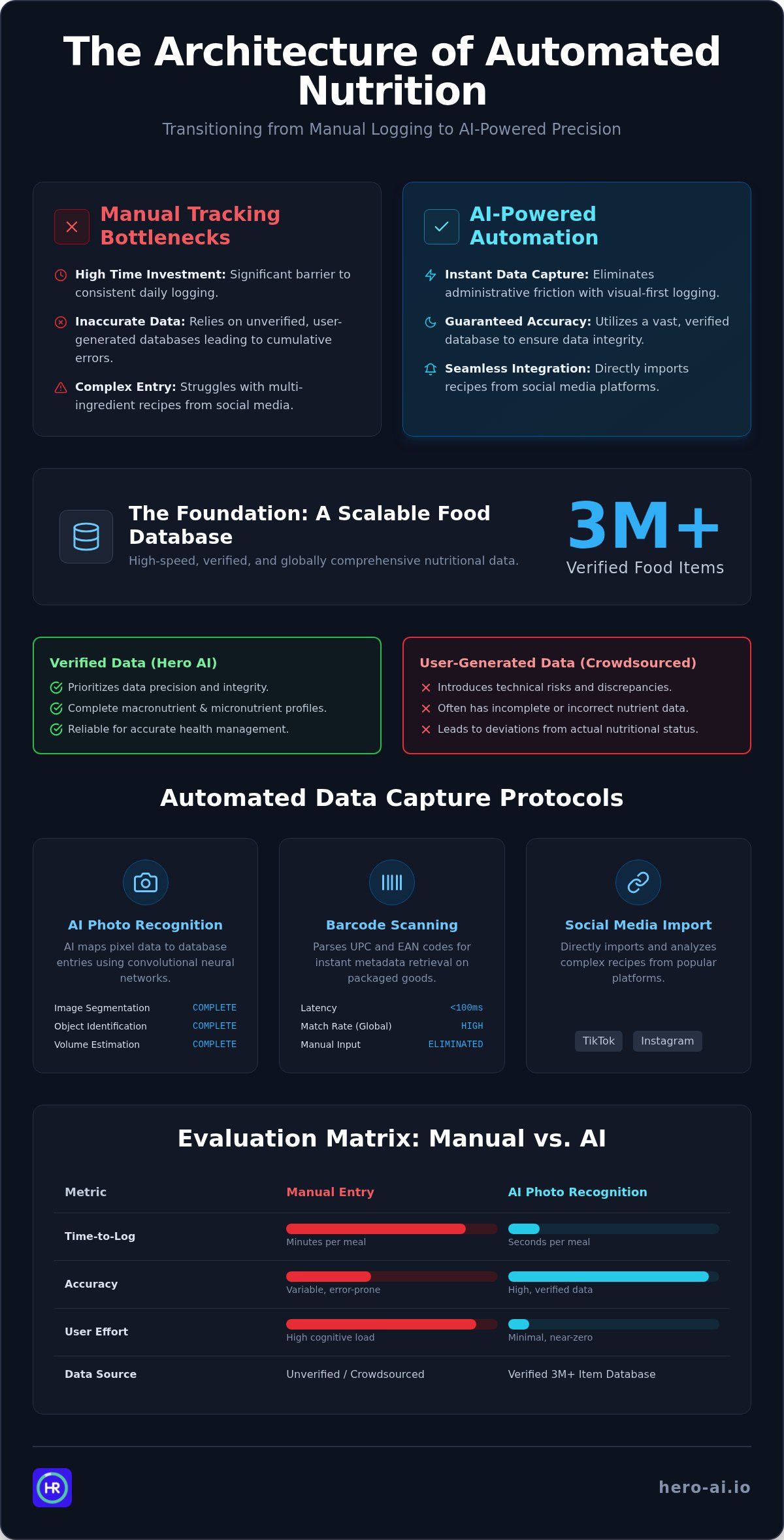
A nutritional database functions as a structured repository for macronutrient and micronutrient information. These systems provide the necessary data points for quantitative dietary analysis. Digital platforms rely on food composition databases to ensure the accuracy of nutritional reporting. A calorie tracker with food database integration enables the immediate retrieval of these metrics for end-users. This infrastructure is a requirement for any automated nutrition system that prioritizes data integrity. It serves as the primary source for metabolic record keeping.
Nutritional logging has transitioned from static paper-based records to dynamic cloud-based systems. Paper logs are often incomplete and lack real-time feedback. Cloud databases allow for automated updates and cross-device synchronization. This shift reduces the administrative burden on the user. It also enables the integration of advanced features such as barcode scanning. Cloud-based repositories facilitate the ingestion of third-party APIs to expand data availability. These APIs provide information on niche products and international items.
Verified data is critical to prevent cumulative error in caloric reporting. Unverified data often leads to discrepancies that aggregate over time. These errors result in deviations from a user's actual nutritional status. High-performance systems prioritize verified entries to maintain precision. Database latency also impacts user compliance. If search results are slow, users are less likely to maintain consistent logs. An efficient calorie tracker with food database must prioritize low-latency retrieval. A system isn't effective if it creates friction during the data entry process.
Verified vs. User-Generated Food Data
Relying on crowdsourced nutritional information introduces technical risks. User-generated entries often lack complete micronutrient profiles or contain incorrect calorie counts. Algorithmic verification is used to maintain database integrity by identifying and removing outliers. These outliers don't match standard food profiles. Hero AI prioritizes verified entries to ensure data precision. This technical safeguard ensures that the information is reliable for health management. It's a necessary step for accurate reporting and metabolic tracking.
Database Scaling and Global Utility
A global nutrition platform must support diverse dietary patterns. Managing a database of 3 million+ discrete food entries requires scalable infrastructure. This involves the continuous ingestion of new product data and the standardization of serving sizes. Consistent data mapping allows for the interpretation of international food labels. The system must handle high request volumes without performance degradation. Load balancing and distributed caching are used to maintain speed. This ensures that the 3 million+ items are accessible within milliseconds. This global utility ensures that the system is functional for all users.
Technical Specifications of the HERO AI 3-Million Item Database
HERO AI utilizes a distributed database architecture designed for horizontal scalability. This structure supports high-speed data retrieval for nutritional logging across global server nodes. The system is accessible through a 1-Year Subscription. This subscription provides the necessary credentials for encrypted, low-latency access to the central repository. This calorie tracker with food database architecture prioritizes automated metadata acquisition over manual input. It uses a RESTful API to ensure seamless communication between the mobile client and the cloud infrastructure.
Barcode scanning serves as a primary method for immediate metadata retrieval. The system parses Universal Product Codes (UPC) and European Article Numbers (EAN) to identify packaged goods instantly. This method eliminates the need for manual text searches and reduces input latency. The database serves as a benchmark for accuracy, comparable to the data standards of USDA's FoodData Central. A repository of 3 million verified items ensures high match rates for global food products. This scale allows for the inclusion of niche brands and seasonal items that smaller databases often omit.
Automated Data Capture via Visual Recognition
Advanced ai calorie counter systems map pixel data to specific database entries through image segmentation. This process involves convolutional neural networks that identify food shapes, textures, and colors. The system analyzes multi-component meals by segmenting the image into discrete objects. AI protocols then calculate volume estimation to determine portion sizes based on depth mapping. This technical approach reduces the margin of error associated with subjective human estimation. Real-world accuracy for these systems ranges from 68% to 86% as of 2026. Users may perform quick edits to the AI's initial identification to further increase precision.
Systematic Verification of Nutritional Values
Maintaining database integrity requires a systematic auditing methodology. Each of the 3 million items undergoes algorithmic verification to ensure data consistency. This process flags discrepancies between manufacturer labels and standard nutritional profiles. The platform handles regional variations by localized data mapping within the global infrastructure. This ensures that a product's nutritional profile remains accurate regardless of its distribution point. Technical superiority is maintained through continuous data ingestion and automated validation cycles. This automated oversight provides a functional advantage over manual search applications. Users can secure access to these automated tools via a 1-Year Subscription to maintain consistent dietary documentation.
Evaluation Matrix: Manual Entry vs. AI Photo Recognition
The utility of a calorie tracker with food database depends on the efficiency of its input method. Manual data entry is the historical standard for nutritional logging. It requires users to search, select, and quantify every ingredient. This process takes an average of 45 to 90 seconds per meal. High friction levels often lead to user abandonment. AI photo recognition provides a functional alternative by reducing logging time to 5 or 10 seconds. This method uses computer vision to identify items without text-based searches. The HERO AI 1-Year Subscription prioritizes this automated workflow to maintain user compliance.
Accuracy benchmarks vary between these methods. Manual entry depends on the user's ability to estimate weights and find matching database entries. AI-driven systems use pixel data for identification. Research into an AI-powered food-tracking system shows that computer vision can identify ingredients that users might overlook. While manual apps are often free, they impose a high "friction cost." Automated systems require a subscription but provide a significant reduction in administrative labor. This trade-off is essential for individuals managing complex dietary requirements over long durations.
Efficiency Metrics in Daily Meal Logging
Quantifying the time saved per meal is necessary for a technical evaluation. Photo-based tracking saves approximately 2 to 4 minutes of active logging time per day. There's a direct correlation between logging speed and long-term data consistency. Systems that eliminate the "search-and-select" bottleneck see higher retention rates. This efficiency is critical for users who consume multiple meals and snacks. Automated capture ensures that the logging process doesn't interfere with daily productivity. It transforms a complex administrative task into a discrete, three-second action.
Precision Analysis of Visual Data Capture
AI systems handle complex dishes by segmenting images into component parts. Manual entry often relies on broad approximations for mixed meals. These approximations frequently ignore secondary ingredients like oils or dressings. A photo food tracker subscription provides the computational resources needed for these deep-learning models. Real-world identification accuracy ranges from 68% to 86%. This is lower than lab-based claims of 90% plus, but it remains superior to unassisted human estimation. The primary technical limitation is portion estimation, which currently averages 60% to 75% accuracy. Future trajectories involve the use of multi-spectral imaging to improve macro-composition analysis. Users can improve current precision by performing brief edits to the AI's initial identification. This hybrid approach ensures the highest level of data integrity for a calorie tracker with food database.
Optimization Protocols for Meal Logging via Social Media Integration
Social media platforms serve as significant repositories for contemporary nutritional data. Integrating these sources into a tracking system requires a structured technical workflow. The process begins with the ingestion of a post URL from TikTok or Instagram. The system then initiates algorithmic parsing of both video content and associated captions. This transforms unstructured social media content into structured nutritional data. A calorie tracker with food database then cross-references these ingredients against verified records to ensure accuracy. This automation eliminates the administrative burden of manual ingredient entry for complex recipes.
TikTok and Instagram Recipe Importation
The HERO AI protocol for recipe importation follows a three-stage verification process. First, the Natural Language Processing (NLP) engine extracts ingredient names and measurements from captions. The AI interprets non-standardized formats, such as colloquial measurements or missing units of weight. Second, computer vision identifies ingredients within the video frames to confirm the text-based data. Third, the system cross-references every identified component against the 3-million item verified database. This ensures that viral recipes are logged with technical precision. The system identifies potential discrepancies between the video content and the written instructions. This automated mapping provides a functional advantage for users who frequently prepare meals found on social media. It maintains data integrity without requiring the user to perform manual searches for every individual ingredient.
Unified Fitness and Nutrition Planning
Effective nutritional tracking requires synchronization with physical activity metrics. The platform includes an integrated social media workout scheduler to facilitate this alignment. This tool allows for the direct importation of exercise routines sourced from social media content. Users can schedule these workouts within the HERO AI interface to maintain a centralized fitness record. This integration ensures that nutritional planning reflects actual caloric expenditure. Maintaining a unified record across multiple digital sources improves the accuracy of metabolic forecasting. A calorie tracker with food database remains the core component of this integrated system. It provides a functional overview of health status without the need for manual data aggregation from different apps. This centralized approach reduces the risk of data fragmentation and supports long-term fitness goal attainment. Access these integration tools by securing a 1-Year Subscription.
Implementing Automated Nutrition Tracking with HERO AI
Modern mobile hardware is required for the HERO AI platform to function optimally. These devices provide the computational power needed for image segmentation and real-time database queries. The operating system must support the latest AI processing frameworks to ensure low-latency performance. It's necessary for the onboarding process to begin with the activation of a 1-Year Subscription. Users must establish a profile that includes baseline metabolic data and specific fitness targets. This grants access to a calorie tracker with food database containing 3 million verified items. Transitioning from legacy manual logs requires a shift in user behavior. Users shouldn't rely on manual text entry and should adopt visual-first data acquisition protocols. This ensures that the system maintains a consistent and accurate fitness record without the errors common in manual search methods.
Consistency in data capture is the primary requirement for system efficacy. Users should follow these best practices for optimal results:
- Ensure adequate lighting for all photo recognition tasks.
- Center the food item within the camera frame for accurate segmentation.
- Use the barcode scanner for all packaged goods to ensure immediate verification.
- Review the AI's initial identification for accuracy before confirming the log.
Maximizing the Utility of the Verified Database
The barcode scanner provides immediate access to nutritional metadata for packaged goods. This tool cross-references product codes against the verified repository to prevent data entry errors. Users can create personalized meal templates for frequently consumed items or complex home-cooked recipes. These templates reduce the need for repeated scans or photo captures during subsequent logs. Detailed nutritional reports allow for precise macro and micro-management over daily, weekly, and monthly intervals. These reports aggregate data from the calorie tracker with food database into actionable technical summaries. It's information that's critical for adjusting dietary protocols based on objective real-world data. The system allows for the export of these records into standardized formats for professional review or personal archiving.
Long-Term Systematic Health Monitoring
Automated tracking facilitates specific objectives like muscle gain or weight loss through precise caloric monitoring. It provides a continuous, objective record of caloric intake and energy expenditure. Data-driven insights help in adjusting nutritional intake based on observed metabolic trends and body composition changes. The system identifies correlations between dietary habits and physical performance metrics. This allows for the systematic optimization of nutrient timing and macronutrient composition. It's a stable, professional infrastructure for health management. The platform prioritizes speed, accuracy, and administrative efficiency over manual tasks. The 1-Year Subscription ensures continuous access to these automated tools and the 3-million item database updates. This technical framework supports the maintenance of long-term nutritional compliance across a global user base.
Advancing Nutritional Accuracy through Automation
The transition from manual data entry to automated systems represents a technical shift in nutritional management. Utilizing a calorie tracker with food database integration allows for the immediate conversion of visual data into structured records. It's a process that utilizes AI-powered photo recognition to identify meal components with objective precision. This methodology eliminates the administrative bottlenecks associated with legacy tracking applications that rely on manual searches. Each entry is validated against a repository of 3 million verified food items to maintain data integrity.
The HERO AI ecosystem provides the stable infrastructure needed for long-term health monitoring. It includes a social media recipe importer that parses content from TikTok and Instagram into actionable macronutrient data. These technical specifications support the maintenance of accurate dietary logs through a streamlined digital interface. It's a functional solution for users who prioritize efficiency and accuracy in their fitness documentation. Consistent dietary documentation is achievable through the implementation of these automated protocols.
Access the HERO AI 1-Year Subscription for Automated Nutrition Tracking
Frequently Asked Questions
How accurate is a calorie tracker with an AI-driven food database?
Real-world identification accuracy for AI-driven systems ranges from 68% to 86%. These systems utilize convolutional neural networks to identify food shapes and textures from photos. A calorie tracker with food database integration reduces human estimation errors common in manual logging. Accuracy improves significantly when users perform brief edits to portion sizes. This automated approach provides a more consistent record than unassisted manual entry for long-term tracking.
Can I import recipes from TikTok and Instagram into HERO AI?
Yes, HERO AI includes a direct recipe importation feature for social media content. Users ingest a post URL from TikTok or Instagram to extract nutritional data. The system uses Natural Language Processing to interpret captions and computer vision to verify video ingredients. This process automates the conversion of viral recipes into structured macros. It eliminates the administrative burden of performing manual searches for every individual ingredient.
What are the benefits of a 3-million item verified food database?
A 3-million item database ensures high match rates for diverse global products. It contains verified macronutrient and micronutrient data to prevent cumulative reporting errors. This scale allows for the inclusion of niche brands and seasonal items that smaller databases omit. Verified entries provide a technical safeguard against the inaccuracies found in crowdsourced data. It's a foundational component for maintaining precise metabolic records across various dietary patterns.
Does the HERO AI 1-Year Subscription include workout tracking?
Yes, the 1-Year Subscription includes an integrated social media workout scheduler. Users schedule routines directly from fitness content found on social platforms to streamline planning. This feature allows for the synchronization of physical activity with nutritional data. It creates a centralized fitness record within the HERO AI platform to monitor caloric expenditure. This alignment supports the attainment of specific weight loss or muscle gain objectives through data-driven insights.
How does photo food tracking compare to manual barcode scanning?
Photo food tracking identifies unpackaged or prepared meals through visual analysis and image segmentation. Barcode scanning retrieves metadata from packaged goods by parsing UPC or EAN codes instantly. Both methods reduce input latency compared to manual text searches. Photo recognition is used for segmenting multi-component dishes into discrete objects. Barcode scanning provides immediate verification for manufactured products. Both tools are integrated into the HERO AI automated nutrition system.
Is the food database updated for international products and brands?
Yes, the database is designed for global utility and includes a wide range of international products. It handles regional variations in packaged food data through localized mapping protocols. This ensures that a calorie tracker with food database remains functional for users across different regions. The repository undergoes continuous ingestion of new product data and automated validation cycles. This standardization supports diverse dietary patterns and international food labeling requirements.
What happens if a food item is not found in the verified database?
If an item is not found, the system uses AI to estimate its nutritional profile based on similar food categories. Users can also create personalized meal templates for unique or home-cooked items to use in future logs. The platform continuously updates the verified repository to include missing entries through systematic auditing. This process involves algorithmic verification to ensure data consistency. Users maintain a consistent record even when encountering niche or unlisted products.
Can I use HERO AI to track both macros and calories simultaneously?
Yes, the platform tracks both calories and macronutrients simultaneously for every logged item. The system provides a complete breakdown of proteins, fats, and carbohydrates based on database metadata. This detailed reporting allows for precise macro-management over daily, weekly, and monthly intervals. Users view these metrics in real-time after every automated log for immediate feedback. This dual tracking is essential for comprehensive nutritional monitoring and metabolic goal adjustment.


