

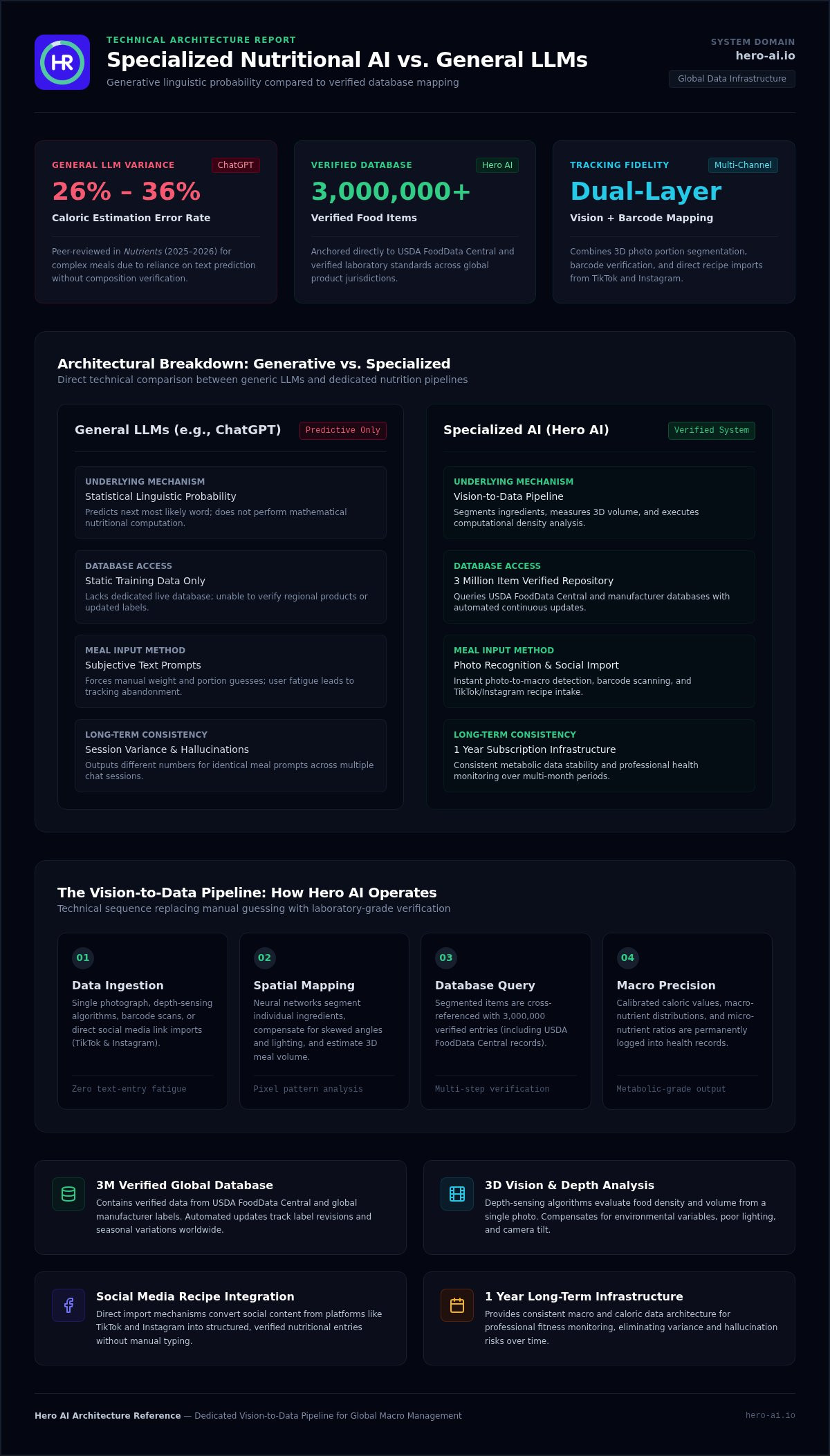
General language models demonstrate a caloric estimation error rate between 26% and 36% for complex meal structures. This lack of precision makes a smart calories counter better than ChatGPT for maintaining accurate nutritional records. Users frequently encounter inaccurate macro estimates and fatigue from manual data entry when using non-specialized tools. General AI platforms also lack the verification protocols required for social media recipes and hidden ingredient detection. Hero AI provides a functional comparison between generative probability and verified nutritional data.
This report analyzes why specialized nutritional AI outperforms general language models through verified database integration and visual recognition protocols. It details the transition from manual logging to automated, verified nutritional systems. You'll gain information on the integration of social media fitness content and the use of a 3 million item verified database. The text outlines the technical advantages of photo-to-macro recognition for precise macro management. It also addresses the utility of a 1 year subscription for consistent long term data infrastructure. It's a stable solution for global fitness data management.
Key Takeaways
- General language models rely on statistical probability for caloric estimates. Specialized systems use verified database queries to ensure data accuracy.
- A smart calories counter better than ChatGPT utilizes vision-to-data mapping to analyze meal volume and ingredient density.
- Direct social media imports from global platforms like TikTok and Instagram reduce tracking friction for modern users.
- Access to 3 million verified items ensures data integrity for global macro-management within the Hero AI ecosystem.
- A 1 Year Subscription provides the necessary long-term infrastructure for consistent and professional health monitoring.
Limitations of General AI in Nutritional Data Capture
General Large Language Models (LLMs) operate on linguistic probability. They predict the next likely word in a sequence. They don't perform mathematical calculations based on laboratory records. This architectural difference makes a specialized smart calories counter better than ChatGPT for nutritional accuracy. General AI lacks a dedicated backend for verified nutritional facts. It provides estimates based on its training data, which often leads to significant variance in caloric reporting.
The Hallucination Problem in Nutrition
AI hallucinations occur when a model generates false information with high confidence. In nutrition, this manifests as fabricated calorie counts or macro-nutrient profiles. Peer-reviewed assessments published in Nutrients (2025-2026) indicate that ChatGPT exhibits a mean absolute percentage error between 26% and 36% for complex meal photographs. Text-only descriptions increase this risk. A user describing a restaurant meal might receive a plausible number that ignores hidden cooking fats or specific ingredient weights. This statistical variance creates inconsistent records over time.
Database Absence vs. Data Integration
General AI uses a static training set. It cannot access real-time food composition data to verify regional products or updated brand labels. Specialized nutritional AI integrates directly with verified databases. These systems query specific records for over 3 million food items. Text-only input remains a significant limitation for general models. Users must estimate weights and portions manually; this introduces subjective bias. Specialized tools use visual recognition protocols to analyze volume and density automatically. This capability makes a smart calories counter better than ChatGPT for precise portion analysis.
Unverified data poses a risk in professional fitness contexts. Inaccurate macro-nutrient ratios disrupt metabolic tracking and goal achievement. Standardized generative models often provide different caloric values for the same prompt across different sessions. This inconsistency makes long-term data analysis unreliable. Professional health management requires the precision of a 1 Year Subscription to a dedicated nutritional infrastructure. Relying on linguistic prediction for health data is technically insufficient for long-term physiological monitoring. Specialized platforms eliminate the guessing inherent in generative models by mapping visual inputs to verified laboratory records.
Specialized AI Architecture for Food Recognition
Specialized systems use vision-to-data pipelines instead of general language processing. This architectural choice makes a smart calories counter better than ChatGPT for objective results. These systems identify objects, segment ingredients, and calculate volume in three-dimensional space. Computational analysis of ingredient density allows for a more accurate estimation of meal weight. General AI lacks the specific vision mapping required for precise tracking. Hero AI utilizes these protocols to ensure data integrity.
Visual Recognition Protocols
Neural networks identify food items by analyzing pixel patterns and geometric features. These protocols compensate for environmental variables like poor lighting or skewed camera angles. Modern architectures use depth-sensing algorithms to estimate portion sizes from a single photograph. The process includes a verification step where users confirm the identification. This ensures the system queries the correct database entry. Multi-step verification prevents the errors common in text-only models. It provides a technical foundation that general models cannot replicate.
The 3M Verified Food Database
Accuracy depends on the data source backing the visual identification. Hero AI utilizes a database of 3 million verified food items to anchor its recognition engine. This infrastructure includes records from sources such as USDA FoodData Central. It maintains data integrity for both macro and micro-nutrients across global jurisdictions. Automated updates track changes in food manufacturer labels and seasonal ingredient variations. This ensures that the nutritional profile remains current for users worldwide. Standardizing data across global regions is essential for maintaining macro-nutrient precision.
For packaged items, barcode scanning provides instant access to manufacturer-verified data. The system cross-references the barcode with the visual image to confirm product identity. This dual-layer approach handles both raw ingredients and processed goods. It eliminates the need for manual data entry and reduces user fatigue. Effective long-term health management requires a reliable technical foundation. Users can secure this infrastructure through a 1 year subscription to access the full database and recognition features. This specialized architecture provides the consistency needed for professional fitness contexts.
Comparative Analysis: Specialized Trackers vs. ChatGPT
The functional difference between general AI and specialized trackers lies in the data ingestion process. ChatGPT operates through text prompts or descriptive image analysis. Specialized systems utilize a dedicated pipeline for photo recognition and barcode scanning. This multimodal approach ensures a smart calories counter better than ChatGPT for high-frequency tracking. Text-based logging requires manual effort and increases the probability of data entry errors. Specialized AI automates these processes by cross-referencing visual inputs with laboratory records such as USDA FoodData Central.
Feature Parity Matrix
A database size of 3 million verified items provides a technical advantage over general training sets. ChatGPT lacks a persistent nutritional database and generates values based on linguistic patterns rather than specific record lookups. Specialized trackers offer automated recipe imports from global platforms like TikTok and Instagram. This feature is absent in general AI workflows. Integrated workout scheduling allows for the alignment of caloric intake with physical activity. This consolidation creates a functional overview of energy balance that conversational models do not support.
Precision Metrics for Athletes
Precision in macro-nutrient tracking is essential for muscle hypertrophy and metabolic regulation. Research shows that general AI models exhibit a 26% to 36% error rate when estimating caloric values from meal photographs. Specialized systems minimize this variance by grounding visual inputs in verified laboratory data. Consistency is a primary requirement for professional fitness management. A smart calories counter better than ChatGPT provides stable accuracy across multiple daily entries. General AI often returns different results for identical prompts; this inconsistency disrupts long-term data integrity.
Efficiency is calculated by the time spent per log entry. Manual text entry in a conversational interface requires significant user input for every meal. Photo-based logging reduces the time investment to seconds per entry. Long-term data visualization enables the tracking of macro-nutrient trends over extended periods. General AI lacks a native dashboard for persistent fitness goal management. Stable data infrastructure is required for professional tracking. A 1 Year Subscription provides the necessary tools for consistent data analysis and physiological monitoring without geographic limitations.
Workflow Optimization for Automated Nutrition Tracking
Digital nutrition tracking has moved beyond manual keyboard input. Users now rely on visual social media platforms for meal inspiration. Algorithmic parsing allows for the direct import of recipes from TikTok and Instagram. This automation converts visual content into structured macro data. A smart calories counter better than ChatGPT handles these imports by cross-referencing ingredients with a 3-million-item verified database. General AI lacks the specialized extraction protocols required to parse recipe videos accurately. It often fails to identify specific quantities mentioned in captions or shown in video segments.
Social Media Data Extraction
Systems analyze recipe captions and visual cues to identify ingredients. This process eliminates the friction of manual data entry. Automation reduces friction. Verified database access ensures that the resulting macro profile matches laboratory standards. Users save Instagram recipes directly to a functional macro plan. This systematic approach prevents the data decay common in unverified tracking methods. It also addresses the pain point of fatigue from repeated manual logging. The extraction engine verifies each ingredient against global nutritional standards. This ensures the macro-nutrient distribution remains accurate regardless of the recipe's origin.
Automated Fitness Scheduling
Efficient health management requires the alignment of nutrition and physical activity. Automated scheduling tools sync workout content from social platforms to a digital calendar. This integration allows for the dynamic adjustment of caloric targets based on scheduled expenditure. Reducing the gap between inspiration and execution improves adherence to fitness goals. A smart calories counter better than ChatGPT provides this unified timeline within a single interface. General conversational models require manual updates for every change in activity levels. They don't offer native calendar synchronization for fitness routines. Data integrity is maintained.
Establishing a daily logging routine depends on low-friction tools. Photo recognition and social media imports automate the majority of the tracking process. This system converts inspiration into actionable data without requiring technical expertise. Consistency is maintained through a stable digital infrastructure. Accessing these advanced automation features is possible via a 1 year subscription. This provides the technical continuity needed for professional-grade health management. It ensures that data remains synchronized across all devices and platforms used for health monitoring.
HERO AI: Systematic Nutrition and Fitness Integration
HERO AI provides a centralized infrastructure for health management. It utilizes a 3-million-item verified database to ensure data accuracy. This specialized approach makes a smart calories counter better than ChatGPT for users requiring verified nutritional records. Automated photo recognition and barcode scanning remove the need for manual data entry. This reduces administrative friction in daily logging routines. Global accessibility is maintained through universal food data standards. These standards ensure consistency across various cuisines and regions. The platform functions as a digital gatekeeper for nutritional integrity.
Functional Benefits of the 1 Year Subscription
The 1 Year Subscription provides continuous access to the platform's technical core. Users receive unlimited photo-to-macro recognition capabilities. This subscription model supports long-term data management and progress tracking. It includes unlimited barcode scanning for packaged goods. Seamless recipe and workout importation features allow for the integration of content from TikTok and Instagram. This creates a unified timeline for nutrition and physical expenditure. The data remains synchronized within a secure digital framework. A 1 Year Subscription ensures that the tracking process remains uninterrupted. It provides the stability needed for year-over-year health analysis. Continuous database updates maintain the relevance of nutritional profiles as manufacturer data changes.
The Future of AI-Driven Health Management
Health management is transitioning from reactive recording to proactive optimization. Data precision allows users to adjust intake before nutritional deficits occur. Proactive tracking relies on stable infrastructure and verified data points. For more information on technical implementation, see AI Calorie Counter: Automated Nutritional Data Capture. This shift enables objective fitness goal achievement. It eliminates the ambiguity of generative estimates. A smart calories counter better than ChatGPT offers the analytical depth required for professional athletes and health-conscious individuals. The integration of social media content into a structured macro plan represents a modular approach to fitness. Objective goal achievement is the result of consistent data precision. Systematic fitness optimization is achieved through automated recognition and verified database querying. Users can initiate a 1 Year Subscription to access these automated features. This ensures long-term consistency in nutritional and fitness data management. The platform provides a functional tool for international health monitoring.
Advancing Nutritional Precision through Automated Infrastructure
Generative language models rely on linguistic probability for nutritional estimates. Specialized tools utilize computer vision and direct database queries to ensure accuracy. This technical distinction makes a smart calories counter better than ChatGPT for professional health management. The integration of automated photo recognition and a 3-million-item verified database eliminates the variance inherent in conversational AI. Users benefit from the direct import of social media recipes and workout content. This reduces manual entry fatigue and creates a functional timeline for energy balance. Maintaining high-fidelity data requires a reliable digital environment. Access to these advanced recognition protocols and global data standards is essential for long-term physiological monitoring. It's necessary to establish a systematic tracking routine through a dedicated platform. Optimize your nutrition with a HERO AI 1 Year Subscription. Consistent data capture supports the achievement of objective fitness targets.
Frequently Asked Questions
Is a smart calorie counter more accurate than ChatGPT?
Specialized AI provides higher accuracy through verified data grounding. ChatGPT relies on statistical word prediction. Peer-reviewed studies indicate ChatGPT exhibits an error rate between 26% and 36% for nutritional estimation. A smart calories counter better than ChatGPT utilizes a 3-million-item database to verify visual inputs. This technical structure eliminates the hallucinations inherent in general language models. It ensures that macro-nutrient tracking remains consistent for professional fitness management.
How does photo recognition calculate calories from a picture?
Neural networks analyze pixel patterns to identify specific food items within a photograph. The system segments the image to perform a volumetric analysis of each ingredient. This process estimates portion sizes by calculating the three-dimensional space occupied by the food. The resulting data is cross-referenced with verified laboratory records. This method determines caloric and macro-nutrient density with higher precision than manual entry or text-based estimation tools.
Can I import recipes from TikTok or Instagram into HERO AI?
Users can directly import recipe data from platforms like TikTok and Instagram. The system uses extraction protocols to parse video captions and visual information for ingredient identification. These ingredients are mapped to a verified database to calculate nutritional profiles. This automation eliminates the need to manually enter data from social media content. It allows for the seamless integration of visual meal inspiration into a structured daily macro-nutrient tracking plan.
Why is a verified food database important for macro tracking?
Verified databases ensure that nutritional values are based on laboratory analysis rather than generative probability. General AI models often fabricate caloric data based on linguistic patterns. A smart calories counter better than ChatGPT queries 3 million verified items to provide factual macro-nutrient profiles. This grounding is necessary for accurate long-term health monitoring. It prevents the significant data errors that occur when relying on the unverified training sets of general language models.
Does HERO AI support barcode scanning for global products?
The platform supports barcode scanning for a wide range of global products. This feature allows users to access manufacturer-verified data instantly. It ensures that packaged items are recorded with precise macro-nutrient values. The system queries international databases to maintain accuracy across different jurisdictions. This barcode functionality works alongside photo recognition to provide a comprehensive tracking solution for both fresh ingredients and processed food products worldwide.
How does specialized AI handle complex restaurant meals compared to ChatGPT?
Specialized systems segment complex meals into individual ingredient components using visual recognition. These tools analyze the plate for volume and density to estimate caloric content. ChatGPT relies on user-provided text descriptions which are often subjective and incomplete. Specialized AI reduces estimation errors by mapping visual segments to standardized food composition data. This technical approach addresses the systematic under-reporting of hidden fats and oils common in manual or general AI tracking.
What are the benefits of a 1 Year Subscription for fitness tracking?
A 1 Year Subscription offers uninterrupted access to the platform's automated tracking infrastructure. It includes unlimited photo recognition and barcode scanning for consistent data capture. This long-term model is designed for users who require persistent tracking to achieve specific fitness goals. It provides continuous database updates and full integration of social media content. This subscription ensures that health data remains synchronized and accurate throughout the entire duration of a fitness program.
Can I schedule workouts directly from social media content?
The platform enables users to schedule workouts found on social media directly into their plans. Users can import fitness content and align it with their nutritional targets on a unified timeline. This integration reduces the administrative effort required to plan physical activity. It ensures that caloric expenditure is tracked alongside intake for a complete view of energy balance. This feature automates the transition from social media inspiration to a functional, scheduled fitness routine.


