

The most useful AI nutrition app for muscle gain isn't necessarily the one with the most tracking options. It’s the one that makes it practical to record meals, review nutrition, and keep the process consistent. Manual logging can take time, while a calorie target alone may not show whether your protein and broader nutrition habits align with your goals.
A photo estimate can also look more precise than the information available. Portions and ingredients may need review, so convenience should not replace judgment. This guide compares the features that matter for muscle-gain tracking, including meal-entry options, nutrition details, and progress review.
It also explains how Hero AI can bring food logging and workout scheduling into one workflow. The app supports meal logging by photo or barcode, recipe importing from TikTok and Instagram, and workout scheduling from social media content. You’ll see how these entry routes may support a manageable routine, and what to consider when choosing a tracking process. Nutrition data can inform your decisions, but it doesn’t guarantee muscle gain or replace training, recovery, or professional care.
Key Takeaways
- Use a clear checklist to assess whether an ai nutrition app for muscle gain makes food records easy to enter, review, and correct.
- Compare apps by workflow, including food capture, editing, database access, recipe importing, and training tools, rather than by AI claims alone.
- Build a repeatable routine for logging meals and reviewing totals. Look for patterns over time instead of drawing conclusions from one meal or day.
- See how Hero AI’s food-tracking and workout-scheduling tools fit a combined routine, and what its one-year subscription includes.
What an AI Nutrition App for Muscle Gain Should Help You Track
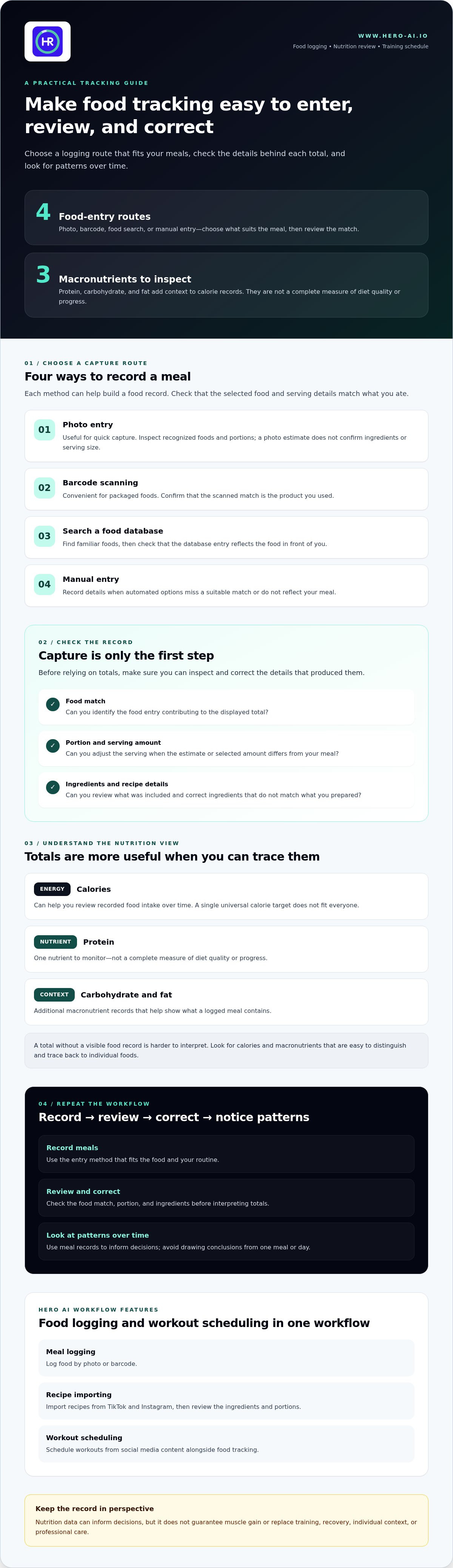
An AI nutrition app for muscle gain is a tool for recording and reviewing food information. Depending on its features, it may help enter foods from images, barcodes, or a searchable database. Its practical value is not an “AI” label. It is whether the records are clear enough to review and correct as part of a wider food and training routine.
Tracking provides information, not a result. An app can organize entries and show patterns in recorded meals. It cannot guarantee muscle gain, establish that an estimate is exact, or account for every factor that affects an individual. Training, recovery, health, and personal circumstances matter too.
Which nutrition data matters when building muscle?
Start by separating the information an app records. Calories describe energy intake. They can help a user review food intake over time, but a single universal calorie target does not fit everyone. A suitable target depends on personal context, including activity and individual needs. If a target is unclear or health circumstances affect dietary decisions, seek guidance from a qualified health professional.
Protein is one nutrient to monitor, not a complete measure of diet quality or progress. Carbohydrate and fat entries provide additional context about the foods recorded. Together, these macronutrient records help show what a logged meal contains; they do not determine whether the meal is suitable for every person. For background on the broader principles of nutrition, review how food and nutrients contribute to the body’s needs.
When evaluating an app, check whether it presents calories and macronutrients separately and makes entries easy to inspect. A total without a visible food record is harder to interpret. You should be able to identify what contributed to the numbers and adjust an entry when the portion or ingredients differ from the app’s assumptions.
What an app can and cannot tell you
Meal data may be entered manually, drawn from a database, or estimated from a photo. Those methods produce records, but a photo-based estimate is not a confirmed measurement of ingredients or portion size. Review uncertain entries and correct them when you have better information. Treat displayed totals as useful tracking data, not automatic proof of exactly what you ate.
Progress also relates to the training routine, recovery, and individual circumstances. Food logs can help you notice patterns, but they cannot explain every change or replace professional advice when it is needed. Use the record to support decisions, then interpret it alongside your broader routine.
An AI nutrition app organizes food records for review; it supports a muscle-building routine but cannot guarantee muscle gain.
How to Evaluate AI Nutrition App Features for Muscle Gain
Choose features by how they support a repeatable record, not by the number of tools listed in an app description. An ai nutrition app for muscle gain should make common foods straightforward to log and make the resulting calorie and macronutrient entries understandable. It should also give you a practical way to correct details that don’t match your meal.
Consider your usual eating routine before comparing entry methods. Packaged foods, meals prepared at home, and saved recipes create different logging needs. The most useful option is one that fits those habits without making accuracy and review difficult.
Food logging and nutrition-data usability
Photo logging can reduce the steps needed to record a meal, while barcode scanning can help identify packaged foods. Searchable food databases offer another route, and manual entry can help when a suitable match is unavailable. Each method has limits. A photo may not show all ingredients or portion details, and database entries may need checking against the food in front of you.
Prioritize editing as well as capture. Check whether you can adjust serving amounts, review the selected food, and correct an entry before relying on its totals. Then consider whether the database includes foods and meals that reflect your actual routine. This AI calorie counter guide provides more context on automated food-data capture and review.
- Photo entry: Useful for quick capture, but inspect the recognized foods and portions.
- Barcode scanning: Convenient for packaged items, provided the scanned match is the product you used.
- Search and manual entry: Helpful for finding familiar foods or recording details that automated options miss.
- Editing: Essential for correcting ingredients, portions, or a mistaken match before reviewing totals.
Next, look at how the app displays its records. Calories and macronutrients should be easy to distinguish and trace back to individual foods. If a total is difficult to inspect, it’s harder to spot an incorrect portion or an unsuitable database match. A large database can broaden the options for logging, but size alone doesn’t show whether a particular entry matches your food.
Workflow features beyond the food diary
Recipe importing may reduce repeated entry if you regularly prepare or save recipes from social platforms. Assess whether the imported recipe reflects its ingredients and portions, and whether you can review the resulting food record. For example, importing a saved meal is useful only if you can identify what was included and correct details that differ from the version you prepared.
Workout scheduling can help organize training alongside food records. It is a planning feature, not evidence that nutrition intake is adequate or that a program will produce a specific result. Keep those functions distinct as you compare apps. This social media fitness integration guide covers how imported fitness content can fit a tracking workflow.
Hero AI combines photo and barcode meal logging with recipe importing and workout scheduling from social media content. If that combination fits your routine, explore Hero AI’s nutrition and fitness platform as one option for connecting food records with training plans.
Compare Muscle-Gain Nutrition Apps by Workflow, Not AI Claims
Feature lists can make different tools look similar. Compare what happens from the moment you record a meal to the point where you review its nutrition data and correct an error. This helps distinguish an ai nutrition app for muscle gain that supports food logging from a meal-plan generator or workout planner. Some apps combine these functions, but each serves a different purpose.
| Workflow area | What to compare | Why it matters |
|---|---|---|
| Food capture | Photo, barcode, searchable food, and manual entry options. | Consider which methods match the foods you usually record and how many steps each entry takes. |
| Editing | Whether you can inspect a match and adjust portions or ingredients. | Correction options help you address estimates or mismatches before reviewing totals. |
| Database | Whether familiar packaged foods and common meal ingredients are searchable. | A broad database is useful only when relevant entries are identifiable and reviewable. |
| Recipe import | Whether saved recipes can be brought into a record and checked. | This may reduce repeated entry, but the imported ingredients still need to reflect the meal you made. |
| Training workflow | Whether the app only records food, schedules workouts, or also generates plans. | These tools support different tasks. Scheduling training does not verify nutrition data. |
A practical checklist for comparing apps
Mark each feature as essential, useful, or unnecessary for your routine. For example, barcode scanning may be essential if you frequently log packaged products, while recipe importing may matter more if you repeat saved meals. Then check whether the app fits your existing way of eating and training, rather than expecting it to replace those routines.
Review subscription duration and the features included with the subscription before deciding. Compare the terms as presented by each app. Avoid estimating value from a feature label alone; consider whether you will use the function and whether it makes recording or review easier.
How to judge AI estimates and evidence
For any estimated entry, look for a clear path to inspect and adjust the result. An AI label does not establish that a meal estimate is accurate. The useful question is whether you can see what the app recorded and correct it when the portion, ingredients, or selected food is wrong.
Separate product capabilities from outcome stories. Testimonials describe individual experiences, but they don’t establish that an app caused a particular result or that another user will have the same experience. Give more weight to clearly described functions and independently supported evidence than to broad claims about building muscle. A sound comparison focuses on capture, correction, review, and fit with your own workflow.
Use a Muscle-Gain Nutrition App in a Repeatable Daily Workflow
A tracking routine works best when it fits meals you already eat and gives you records you can review. Use the same basic steps each day: enter food, inspect the totals, correct obvious mismatches, then consider consistency across repeated records. The process is for gathering information, not judging a single meal as success or failure.
Set up logging around meals you already eat
Choose an entry method that suits each meal. Use a photo when it’s practical, scan a barcode for a packaged item, import a saved recipe when available, or search for the food. Record portions as accurately as the information allows. If the amount or ingredients are uncertain, keep that uncertainty in mind rather than treating the app’s estimate as exact.
Reviewing macronutrient totals is more useful when entries remain connected to the foods and portions that produced them. An overview of macro tracking apps can help clarify what to look for in that record-and-review process.
- Log meals. Enter foods as you eat them, using the method that fits the meal. Logging close to mealtime can help you remember ingredients and portions.
- Review totals. Check recorded calories and macronutrients against the guidance you’ve chosen for your circumstances. Look at the underlying food entries, not only the combined total.
- Correct entries. Adjust a portion, replace a mistaken match, or identify an incomplete entry. If you don’t know the exact amount, avoid presenting the estimate as a confirmed fact.
- Assess consistency. Review repeated records for patterns. Note missed meals or uncertain items so that gaps in the log don’t get mistaken for a complete picture.
Review records without overreacting to daily variation
One meal or one day provides limited context. A meal may differ from your usual routine, and an incomplete log may make a daily total misleading. Look across records for recurring patterns instead of changing your approach in response to a single entry. Consistency in recording makes comparisons more useful, even when some details remain estimates.
Interpret longer-term records alongside training and recovery. A food log cannot show, by itself, whether your training is appropriate or recovery is sufficient. If you’re considering changes to nutrition or training, use guidance suited to your individual circumstances and consult a qualified professional when needed. Do not treat an app-generated total as a personalized prescription.
Consistent tracking can make patterns easier to review, but it does not guarantee a physical outcome. An ai nutrition app for muscle gain can organize meal records and support review; it cannot replace training, recovery, or professional care.
Hero AI brings food logging and workout scheduling into one workflow, which may suit users who want to review meals alongside planned training. Explore Hero AI’s food and training workflow to see how it fits your tracking routine.
Where Hero AI Fits in an AI Nutrition App for Muscle Gain
Hero AI brings food logging and workout scheduling into one nutrition and fitness platform. Its one-year subscription includes photo meal logging, barcode scanning, access to a database of more than 3 million verified foods, recipe importing from TikTok and Instagram, and workout scheduling from social media content. This combination may suit someone who wants food records and training plans in a shared workflow, rather than using a food diary alone.
How Hero AI’s stated features map to the checklist
Photo logging and barcode scanning provide different routes for entering meals. Photos offer a way to record a prepared dish, while barcodes support logging packaged foods. The database provides another reference point for food records. As with any estimated or matched entry, review the information available and avoid treating an automated result as a perfect measurement.
Recipe importing connects saved food ideas from TikTok and Instagram with meal logging. This can be relevant if you use recipes from those platforms and want to bring them into your food-record workflow. The feature’s value depends on whether the imported recipe reflects what you actually prepare, including ingredient or portion changes.
Workout scheduling from social media content adds a planning function alongside nutrition tracking. It can help organize training content, but scheduling is not a training prescription or evidence that a particular routine is suitable for every user. Keep the roles distinct: food features record nutrition information, while scheduling helps organize workouts.
Decide whether the subscription fits your routine
Compare the included features with the criteria you established earlier. If you regularly log prepared meals, consider whether photo entry fits your habits. If you record packaged foods, barcode scanning may be relevant. If you save recipes on supported platforms, importing may reduce the steps between finding a meal idea and recording it. Workout scheduling may be useful if you also want training content organized in the same platform.
Then consider whether you will use these entry routes consistently. A feature list matters less than whether the available workflow fits your meals and training habits. Hero AI’s database contains more than 3 million verified foods, which provides a broad selection for food logging. As with any database, check that the selected item represents the food you consumed.
The Hero AI one-year subscription overview gives further context on the subscription. Tracking can support a routine and make food records easier to review, but it cannot ensure muscle gain or replace appropriate training, recovery, or professional care.
If these features match the way you want to record meals and organize workouts, explore Hero AI as a nutrition and fitness tracking option.
Choose a Tracking Routine You Can Maintain
The right app is the one that supports a routine you can use consistently. Before choosing an ai nutrition app for muscle gain, decide what you need to record and how you’ll use those records. A manageable process is more useful than a long list of features that don’t fit your habits.
Set a clear purpose for tracking. You might use food records to review patterns, make entries easier to revisit, or keep nutrition information alongside your training plans. Treat the data as a reference for informed decisions, not a score or a promise of physical change. Training, recovery, personal circumstances, and appropriate guidance remain part of the wider picture.
Consider whether Hero AI’s combined nutrition and fitness workflow fits the process you want to maintain. Explore Hero AI’s nutrition and fitness tracking features and decide whether they align with your routine. Choose a practical starting point, review how well it works for you, and build consistency one record at a time.
Frequently Asked Questions
Can an AI nutrition app help with muscle gain?
Yes, an app can help you organize food records and check whether your eating habits align with guidance you’re following. It doesn’t build muscle on its own. For example, a training period with changing meal times may make it useful to review whether your usual food routine stays consistent. Interpret the records alongside training, recovery, and your personal circumstances. Seek qualified guidance if you need help setting nutrition or exercise goals.
Is photo-based food tracking accurate enough for muscle gain?
Photo tracking can be a convenient starting point, but it may not identify hidden ingredients or exact portions. A bowl of soup, for example, can contain ingredients that aren’t visible in the image. Use the estimate as a draft record. Add or adjust details when you know what went into the meal, and avoid relying on a photo alone for decisions that require precise nutrition information.
Do I need to track every meal to gain muscle?
No, tracking every meal isn’t a requirement for gaining muscle. Some people use food records for a limited period to understand their usual portions or identify gaps in their notes. Others prefer ongoing tracking. Choose an approach you can maintain without undue burden. If you record only some meals, remember that incomplete entries can’t provide a full picture of your intake.
Can an AI nutrition app create a muscle-gain meal plan?
Some nutrition apps include meal-planning tools, but food tracking doesn’t automatically mean an app creates a meal plan. Check what the specific app does and whether its plans can be reviewed and adapted to your preferences and circumstances. Hero AI’s stated features focus on food logging, recipe importing, and workout scheduling. Those functions can support organization, but don’t assume they provide a personalized meal plan.
What should I compare when choosing an AI nutrition app for muscle gain?
Compare how an app handles the foods you actually eat, how easily you can correct entries, and how clearly it presents nutrition records. Also consider the effort required to use it during a typical day. An ai nutrition app for muscle gain should fit your routine, not just advertise relevant features. Review the subscription terms and included functions before choosing, and avoid treating testimonials as proof of typical results.
Can I use an AI nutrition app without a workout app?
Yes, you can use a nutrition app without using its workout features or a separate workout app. Food logging can help you review eating patterns on its own. You can follow a training routine organized elsewhere, or track training without an app. If your exercise plan or nutrition needs are uncertain, seek guidance from a qualified professional rather than relying on app records to assess your training.
Does a higher protein intake guarantee muscle gain?
No, a higher protein intake doesn’t guarantee muscle gain. Protein is one part of nutrition, while progress also depends on training, recovery, and individual circumstances. Increasing intake without considering your broader diet or health needs may not be appropriate for everyone. Use a tracker to understand what you’re recording, not to set an extreme target. Ask a qualified health professional for advice specific to your situation.


