

No. Cutting phase meal tracker software can estimate portions from meal photos, so you don’t have to weigh every item. It can also help you plan meals in advance and keep protein in view as you follow flexible macro targets.
Exact measurements can be useful, but they’re not the only way to build a consistent record. Use estimates you can repeat, and adjust them when your meals or routine change.
This guide explains how flexible macro targets and weekly averages can make tracking less rigid, how hand portions and meal photos support estimates, and how advance logging can help organize meals. It also covers protein-first habits, including a plus-or-minus 10-gram range for each macro, so you can focus on useful patterns without treating every meal as a precision task.
Key Takeaways
- Use weekly patterns to assess flexible macro targets instead of treating every daily variation as a setback.
- Combine hand-portion estimates with meal photos to create a practical record without weighing every ingredient.
- Plan meals ahead when your schedule is predictable, then adjust the log as meals change.
- Start with protein as a focused tracking habit before adding more macro details.
- Improve estimate consistency by using comparable food entries and recording portions and preparation clearly.
Flexible macro targets and weekly averages
During a cutting phase, flexible macro targets help organize protein, carbohydrates, and fat without requiring the same meals every day. Weekly averages can reveal a consistent pattern that a single higher- or lower-intake day may obscure.
Flexible Macro Targets
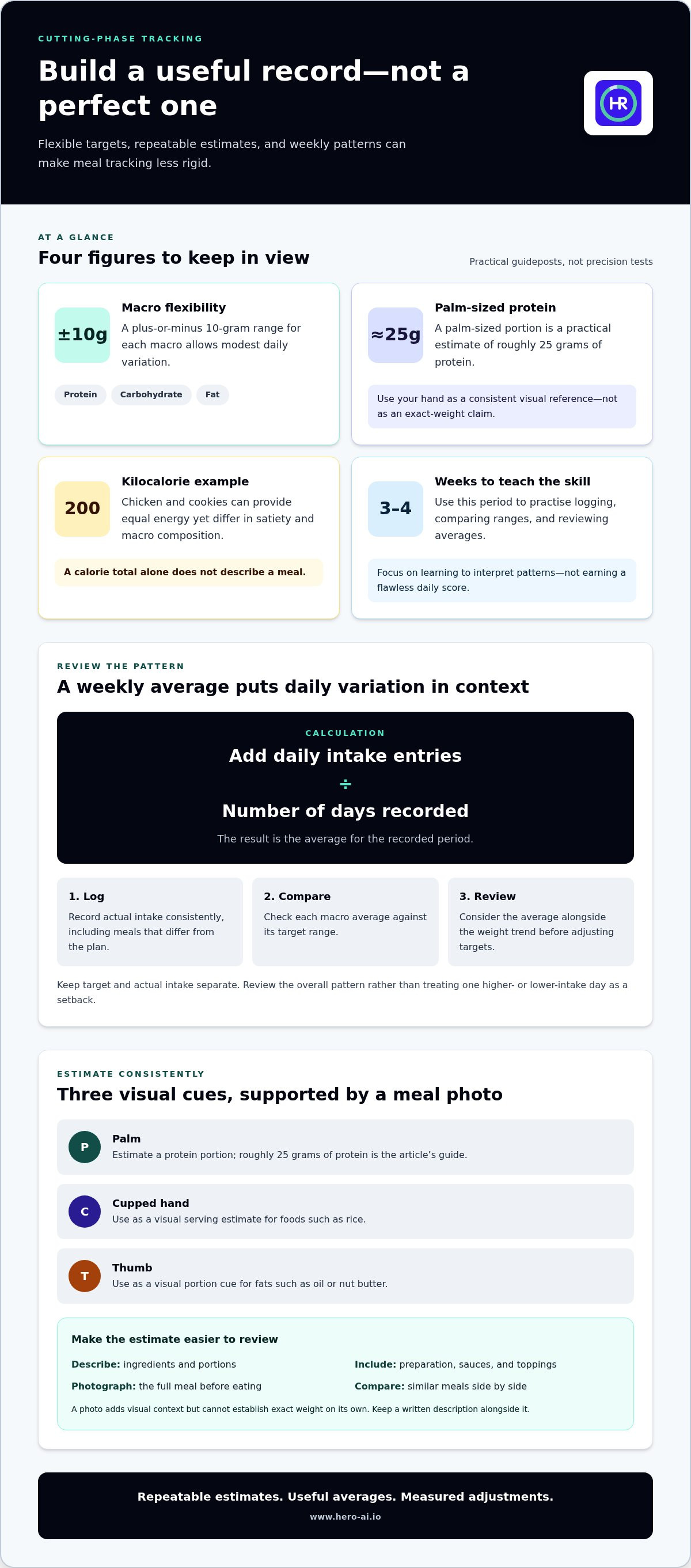
Set a target range for each macronutrient, then compare logged intake with that range. A tolerance of plus or minus 10 grams for each macro allows modest daily variation while keeping the tracking process focused. Record the target and actual intake separately so adjustments reflect the pattern, not one entry.
Apply the range to protein, carbohydrate, and fat rather than treating calories as the only measure. For example, 200 kilocalories of chicken and 200 kilocalories of cookies provide equal energy, but they can differ in satiety and macro composition. The comparison shows why a calorie total alone does not describe a meal.
Calorie Deficit Calculation
Estimate maintenance intake using a consistent record of food intake and body-weight trends, then set planned intake below that estimate. The difference is the calorie deficit. If recorded intake and the weight trend don’t align, reassess the estimate rather than changing targets in response to one day’s result.
Weekly averages make this review more useful. Add the daily intake entries for the period and divide by the number of days recorded. Compare that average with your planned intake, then review the corresponding weight trend. This can show whether a high-intake day is balanced by lower-intake days or whether the overall pattern differs from the plan.
Review macros the same way. Compare each macro’s average with its target range, then identify the meals or days behind the largest differences. For example, if carbohydrate intake varies around training or social meals, the weekly average can show whether the overall pattern remains close to your target.
- Set a target range for each macro.
- Log actual intake consistently, including meals that differ from the plan.
- Calculate averages from the days recorded.
- Review averages alongside the trend before adjusting targets.
A tracker designed for a cutting phase can make these comparisons easier by keeping daily entries and target ranges together. Use the record to guide measured adjustments, not to label an individual meal a success or failure.
Education can make the tracking routine more approachable when it is introduced as a skill to learn, rather than a test of perfect compliance. The guide recommends teaching clients macro tracking over three to four weeks. Use that period to help clients become familiar with recording intake, comparing entries with their ranges, and reviewing averages before making changes. Keep the emphasis on observing patterns and making measured decisions, consistent with the tracking approach above.
A gradual teaching process also gives clients room to ask how to log meals outside their usual routine. Encourage them to include those meals in the record, then use the same comparison method to understand the result. The goal is a repeatable way to interpret intake, not a flawless daily score.
Hand-portion estimates and meal photos
Hand portions provide a repeatable way to estimate food when a scale isn’t available. Which meal trackers sync with fitness watches, workout apps, and health platforms? Sync options vary, so compare a tracker’s stated integrations with the devices and platforms you use before choosing.
Use your hand as a consistent reference, not as a claim of exact weight. A palm-sized protein portion is estimated at roughly 25 grams of protein. A cupped hand can help estimate a serving of foods such as rice, while a thumb can represent a portion of fats such as oil or nut butter. These are practical visual guides, and preparation methods or food density can change the actual amount.
For a more useful estimate, record ingredients and portions consistently. For example, log a bowl of rice with chicken by describing the chicken as one palm-sized serving and the rice as one cupped-hand serving. Include details such as sauce, cooking oil, or toppings, since they can change the meal’s recorded composition. Consistency makes comparisons between similar meals more informative.
Meal photos add visual context to written estimates. Take a clear photo before eating, with the full plate visible and the camera angle consistent. Include a familiar object, such as a fork, if it helps show relative size. A photo can help you review portions and ingredients later, but it can’t establish exact weight on its own. Keep a written description alongside the image.
- Use the same hand reference for similar foods.
- Describe ingredients, preparation, and added sauces.
- Photograph the full meal before eating.
- Review similar meals side by side to spot changes.
Records are most useful when they reflect your routine. If a home-cooked meal changes from day to day, note the ingredient or portion difference instead of reusing an entry that no longer fits. For a meal assembled from separate foods, record each component so it’s clear what the estimate includes.
A photo and portion note can also help when reviewing a weekly log. Compare meals with similar ingredients and serving descriptions, then use the same estimation method for future entries. If a tracker connects with a watch or health platform, review what information it shares and whether that data supports your tracking purpose. For a subscription option to consider as part of your routine, see this meal tracking option.
Choose a tracker whose stated integrations include the fitness watches, workout apps, and health platforms you use.
Pre-logging meals
Pre-logging means entering planned meals before eating, then editing the record if ingredients or portions change. It gives the day a working structure and shows how a planned meal fits your intended intake. It’s a planning aid, not a requirement to follow a menu exactly.
Start with a meal you expect to eat, such as breakfast or lunch. Add its main ingredients and portions, including easy-to-overlook items such as cooking oil, dressing, or a drink. If you plan a chicken wrap with vegetables and sauce, record each component instead of choosing an entry that only says “wrap.” A complete entry makes the estimate more useful.
Prepare three to four template meals for busy days. Base them on meals you already eat, such as oats with fruit, a rice bowl, or a sandwich with a side. Save the ingredients and portions as a starting point, then adjust them when the recipe changes. Templates should simplify repeat entries, not hide differences between meals.
Pre-logging can also reveal gaps before the day begins. If your planned schedule leaves little room for a meal, the log makes that visible while you can still revise the plan. Move a snack, change a side, or choose a different meal that fits your routine. Keep the record accurate when plans change: leaving an uneaten planned meal in the log can distort the day’s totals.
Coaching field data reports that pre-logging improves adherence by 30-40%. Treat that figure as a reported observation, not a guaranteed result for every person. The practical value is the planning step itself: entering choices in advance can reduce reliance on memory and make trade-offs visible before a meal.
- Enter the meal you expect to eat and include its ingredients.
- Use three to four templates for meals that recur in your schedule.
- Edit the entry when the portion, recipe, or plan changes.
- Review the day’s planned meals and adjust before eating.
Keep planned and consumed foods distinct in your record. If a café meal replaces a prepared lunch, remove or revise the original entry instead of counting both. If a recipe changes, update the relevant ingredient rather than copying the old meal unchanged. These corrections help the log represent what you ate, not just what you intended to eat.
A tracker can simplify advance entries if it lets you save meals or edit planned items. Choose a routine that fits your schedule: pre-log predictable meals, then record variable meals after you’ve chosen them. This balances useful planning with flexibility, without turning each day into a fixed menu.
Protein-first tracking
Protein-first tracking gives one clear priority before adding more detailed targets. Track protein alone for the first 1-2 weeks, then review how consistently meals support the target. This staged approach keeps the initial task focused. It also shows whether common meals provide enough protein before you monitor every macro.
Choose a daily protein target that fits your plan, then use a practical tolerance to assess progress. For a target of 150 grams, intake from 140 to 160 grams counts as a win under a plus-or-minus 10-gram range. The range recognizes ordinary variation without making the target meaningless. Record the actual amount, then compare it with the target over time.
During the first tracking stage, aim to meet the protein target on 5 out of 7 days. Use the other days to identify what disrupts the routine, such as skipped meals or limited protein options. Note the meals that make the target easier to reach. Repeating those choices can simplify planning without requiring identical food each day.
Calories alone do not show how intake is distributed. Consider two people who each consume 2,000 kilocalories per day, with protein accounting for 40% for one person and 10% for the other. Their calorie totals match, but their protein shares differ. This example shows why a protein-focused record adds information that an energy total cannot provide.
What are the risks of aggressive calorie deficits and inaccurate food tracking? An aggressive deficit can make a plan harder to sustain, while inaccurate entries can make intake appear higher or lower than it was. Decisions based on distorted records may lead to adjustments that don’t reflect your actual eating pattern.
Use a consistent logging method to reduce avoidable discrepancies. Record the full meal, including protein sources and portions, rather than entering only the main ingredient. For example, if a meal includes eggs, toast, and yogurt, log each item. A partial entry can understate the meal and make the daily protein total less useful.
- Track protein alone for 1-2 weeks before adding more targets.
- Compare intake with the target using a plus-or-minus 10-gram range.
- Aim to meet the target on 5 out of 7 days during the initial habit-building stage.
- Record complete meals so the daily total reflects what you ate.
After the first stage, review your log for repeatable patterns. Identify which meals reliably contribute protein and where entries are often incomplete. Then decide whether to continue tracking protein only or add another macro target. This stepwise approach keeps the record focused and makes each new detail easier to interpret.
How accurate are calorie and macro estimates in meal tracking apps?
App estimates depend on the food entry and portion information provided. A packaged-food entry may differ from the product label, and a generic database match may not reflect the recipe you ate. Treat displayed calories and macros as estimates. Improve consistency by choosing entries that closely match the food and how it was prepared.
Start by matching the food’s state. Cooked rice and dry rice can have different entries because cooking changes weight through water absorption. Select the cooked or uncooked option that matches your portion. Apply the same check to meat, grains, and other foods that change during preparation.
Next, check the portion unit. An entry listed per serving may use a serving size different from yours. If you recorded your portion in grams, use an entry with a compatible gram measurement when available. If the entry uses cups or pieces, confirm that the amount resembles what you ate. A unit mismatch can distort calorie and macro totals.
Mixed meals can add further variation. A homemade curry, sandwich, or pasta dish may contain different ingredient proportions from a generic database recipe. For a home-cooked recipe, add the ingredients individually and divide the total into the portions actually served. For prepared food, use the provided nutrition information when available and match the serving size.
Use these checks when an app estimate looks inconsistent:
- Compare the food name and preparation method with the item eaten.
- Check whether the serving unit matches the recorded portion.
- Review ingredients such as oil, dressing, or sauces in mixed dishes.
- Use the same entry for the same product or recipe across repeated logs.
Consistency is more useful than changing entries without a reason. If you log the same breakfast with one database item on Monday and another on Tuesday, the difference may come from entry selection rather than the meal. Keep a reliable entry for repeat foods, and revise it when the product or recipe changes. For restaurant meals, note the dish and its components, and treat the result as an estimate rather than a precise measurement.
Reviewing the entry details helps you interpret daily totals without assuming every displayed value is exact. To continue organizing your tracking process, explore a tracking option.
A complementary practice is to eat a meal without knowing its calorie content, noticing how it tastes and feels while eating. The study “Calorie counting and fitness tracking technology: Associations with eating disorder symptomatology” appeared in Eating Behaviors, volume 26, on pages 89-92.
Hero AI: 1 year subscription
Hero AI offers a 1 year subscription for readers ready to make meal tracking part of their routine. Before choosing, identify which tracking approach fits your needs, such as logging meals ahead, estimating portions, or prioritizing protein. Consider how consistently you can record meals and which details you want to review over time. These preferences can help you decide whether a subscription suits your current approach. Review the subscription information and consider how it fits your routine before proceeding. To learn more, visit Hero AI.
Choose a tracking routine you can maintain
Your next step is to decide what a useful tracking routine looks like in daily life. Consider what you can keep consistent, such as recording meals, reviewing entries, or adjusting your approach when your schedule changes. These criteria can help you assess whether the cutting phase meal tracker software you choose supports your process without adding unnecessary steps.
Start with a clear priority and use it to guide your decision. If you want to discuss meal tracking and Hero AI’s subscription, contact Hero AI about meal tracking.
Build a workable routine through repeated use. Choose a next step, apply it consistently, and refine the process as you learn what fits.
Frequently Asked Questions
Do clients need to weigh every food item?
No. Use package serving information, household measures, or visual estimates, then weigh selected foods when extra precision is useful. For example, weigh a usual serving of cereal once and note the bowl or scoop you used. Reuse that reference for similar breakfasts. Restaurant sauces and shared dishes are harder to estimate, so record the details without treating an app’s result as exact.
What features should cutting phase meal tracker software include?
Look for editable macro targets, clear meal entries, and a way to review intake over time. Flexible logging options can suit different meals, from scanning a packaged-food label to entering a home-cooked recipe. Hero AI offers photo-based logging, barcode and nutrition-label scanning, adjustable portions, and weight-trend charts. Choose features that suit the foods you eat and the information you want to review.
What are the best meal tracking apps for a cutting phase in 2026?
There is no single best app for every routine. Compare the logging methods, nutrition information, and progress views that matter to you. Hero AI is one option, with photo-based food logging, barcode and label scanning, automatic calorie and macro logging, and weight-trend charts. Its database contains 3M+ foods. Consider whether those functions suit your usual meals before selecting an app.
How much do popular meal tracking apps cost, including free plans and subscriptions?
Meal-tracking costs depend on the app and plan. Some options provide free access, while others use subscriptions; free trials are available with selected Hero AI plans. Hero AI offers a 1 year subscription. Compare the plan terms and renewal details before subscribing, and check whether a free option includes the functions you need. No particular price applies across all apps or plans.
How should you set up a meal tracker for weight loss and track progress?
Start by entering your current plan and choosing a small set of useful records, such as meals, protein, and body-weight entries. Use consistent names for repeat meals to keep later comparisons clear. Record weight under similar conditions and review the direction of change over time instead of reacting to one measurement. If your routine or foods change, update entries so the log remains representative.


