

The fastest way to track daily calories is to make fewer decisions at each meal. Repeated food searches and portion entries add up, especially when you log the same breakfast or lunch every day. A repeatable routine can reduce those steps while keeping enough detail to make your records useful.
This guide explains how to choose a quick logging method for different foods, when photo logging or barcode scanning can help, and how saved meals or recipe imports can cut down on repeated entry. The aim is a consistent process, not a perfect estimate for every meal. HERO AI brings together photo and barcode meal logging, a database of over 3 million verified foods, and recipe importing from TikTok and Instagram.
Key Takeaways
- The fastest way to track daily calories depends on the food. Packaged items, repeat meals, and mixed dishes may call for different logging methods.
- Use a simple capture, match, portion review, and save sequence to keep entries moving.
- Log meals soon after eating, then review uncertain details without letting them prevent an initial entry.
- Check serving sizes, sauces, cooking additions, snacks, and drinks to make records more consistent.
What Is the Fastest Way to Track Daily Calories?
The fastest way to track daily calories is a repeatable process that records what you ate with as few searches and manual entries as practical. That doesn’t mean skipping useful details or expecting every estimate to be exact. The best shortcut depends on the food: packaged products, prepared meals, and familiar repeat meals each benefit from a different approach.
Speed and precision are related, but they aren’t the same. A quick capture creates a timely record; a brief review can catch a mismatched serving size or a missing ingredient. Aim for entries that are consistent enough to review and compare over time, rather than treating every meal as a precise measurement. Tracking intake can serve different purposes. Calorie restriction refers to reducing calorie intake; recording food alone doesn’t require that goal.
What makes calorie tracking take less time?
Repeated tasks add time: searching for the same food, entering its portion, and rebuilding a meal from ingredients. Reuse prepared entries for familiar meals and follow the same logging sequence each day. For example, save a regular breakfast once, then adjust it only when the ingredients or portions change. That keeps your effort focused on what’s different.
Which logging method fits which food?
Choose the capture method that best represents the food. Start with the simplest useful match, then review the entry instead of repeatedly searching for a perfect option.
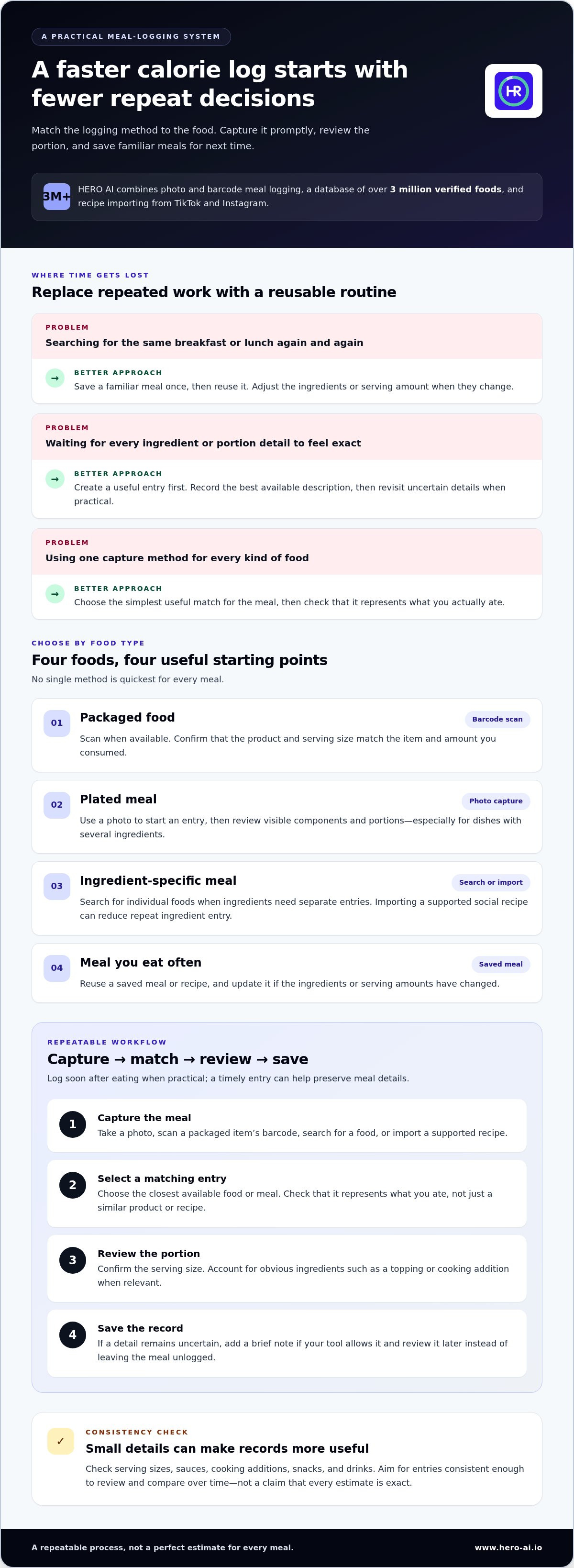
- Packaged food: Scan its barcode when available. Confirm that the item and serving size match the product and amount you consumed.
- Plated meals: Use a photo to start the entry. Review the components and portions, especially when the dish contains several ingredients.
- Ingredient-specific meals: Search for individual foods when you need to record ingredients separately. Importing a supported social recipe can reduce repeated ingredient entry.
- Meals you eat often: Reuse a saved meal or recipe, then update it if the ingredients or serving amounts have changed.
No single method is quickest for every meal. A barcode can reduce searching for packaged food, while a photo can help you start an entry for a plate with several visible components. Search may take more steps, but it can be useful when individual ingredients matter. Recipe importing can help with a known recipe, though you still need to check the portion.
Use a simple sequence: capture promptly, choose a reasonable match, review the portion, and save the entry. If a detail is uncertain, record the meal first and refine it when practical. That way, one estimate doesn’t hold up the entire log. Consistent records also make it easier to notice patterns, without implying that any single entry is exact.
Build a Fast Meal-Logging Workflow from Capture to Review
A dependable routine reduces the number of decisions you make for each meal. The fastest way to track daily calories isn’t to force every food through one entry method. Follow the same sequence, then choose the capture option that suits the meal. Logging soon after eating also helps you remember ingredients and portions.
A four-step routine for each meal
Keep the sequence short. Create a useful entry first, then resolve uncertain details without delaying the rest of the day’s log.
- Capture the meal. Take a photo of a plated meal, scan a packaged item’s barcode, search for a food, or import a supported recipe.
- Select a matching entry. Choose the closest available food or meal. Check that it represents what you ate, rather than a similar product or recipe.
- Review the portion. Confirm the serving size and account for obvious ingredients, such as a topping or cooking addition, when relevant.
- Save the record. If an ingredient or amount remains uncertain, add a brief note if your tool allows it. Review that detail later instead of leaving the meal unlogged.
Use the routine soon after eating when practical. A quick entry can preserve details that are harder to recall later, such as whether a drink was sweetened or a dish included sauce. If you can’t review everything immediately, record the best available description and return to the uncertain detail when convenient.
Reduce repeat work without losing context
Notice which foods and meals recur. Breakfast, a usual lunch, regular snacks, and drinks can all prompt repeated searches or portion entries. Reuse a saved meal or prepared entry when it still matches. Adjust it when ingredients or serving amounts change, so convenience doesn’t lead to a record that misrepresents what you ate.
Set a default for familiar meals, such as selecting a saved entry, and switch methods when another option better fits the food. A barcode suits a packaged item; a photo can capture a mixed plate; a search can help when you need to identify specific ingredients. This avoids comparing every method at every meal.
For a social recipe, importing can provide a starting point and reduce repeated ingredient entry. Review the recipe and serving details before saving it. Don’t assume the imported entry exactly reflects the portion you ate. Note any changed ingredient or serving amount, then update the record when you have the details.
A tracking tool with photo logging, barcode scanning, and recipe importing can bring these steps into one routine. HERO AI’s meal logging tools provide one way to follow this workflow.
Photo, Barcode, Search, or Recipe Import: Which Is Fastest?
No entry method is fastest for every meal. A packaged product has a label and barcode; a plated meal may contain several visible foods; and a recipe combines ingredients and amounts. Choose the method that captures the information you need with the fewest extra steps. The fastest way to track daily calories depends on the food and how much detail you need to review.
| Method | Suitable food | Likely entry effort | Review needed |
|---|---|---|---|
| Photo capture | Plated meals with visible components | Low to start; detail may take additional steps | Check the meal match, portions, and less visible ingredients |
| Barcode scanning | Packaged products | Low if the product is matched by the scan | Confirm the selected item and serving amount |
| Food search | Simple foods or meals with identifiable ingredients | Varies with the search and available matches | Check the specific food and portion |
| Recipe importing | Supported social recipes | Can reduce manual ingredient entry | Review ingredients and the portion you ate |
When photo logging or barcode scanning saves steps
A photo is a convenient starting point for a plated meal. It captures what the meal looks like, so you can select or refine an entry without first searching for every component. But a photo may not reveal what’s inside a mixed dish or how much sauce or oil was added. Review the suggested match and portion rather than treating the image as a complete record.
For packaged food, scanning a barcode can take you directly to a matching entry and reduce the need to search by product name. Still, confirm the product and serving amount, especially if you ate more or less than the listed serving.
When food search or recipe import is more practical
Search can be efficient for a simple item when a clear match is easy to find. It’s also useful when you need to record ingredients separately because a combined meal entry doesn’t reflect what you ate. The trade-off is more selection and portion detail, particularly for a dish with several components.
For a supported social recipe, importing can reduce the work of entering ingredients one at a time. Treat the imported recipe as a starting point. Check for substitutions or changed serving amounts, then adjust the record to reflect your meal.
Fast entry helps when you also review uncertain matches. Use the quickest suitable capture method, then check the details that could change the record. A packaged item and a homemade mixed dish have different matching challenges, so using one method for both can create avoidable corrections. Choose based on the food, not a universal speed ranking.
How to Track Calories Quickly Without Making the Log Less Useful
Quick capture and careful review don’t have to happen at the same moment. Record the meal while it’s easy to remember, then check uncertain details during a short review. This prevents an unclear portion from becoming a reason to skip the entry. The fastest way to track daily calories still depends on records that consistently reflect what you ate.
Focus on repeatable estimates, not false precision. If you usually describe a serving as one bowl or one slice, use that description consistently and add detail when you can. A note that a portion is estimated is more useful than implying an exact measurement you didn’t make.
What to review after a quick entry
Check the selected food against what you actually ate. Then confirm the serving size and consider what a photo or quick capture may not show. Sauces, oils, toppings, and other cooking additions can be easy to overlook, especially in mixed dishes. Include snacks and drinks too, even when they don’t feel like full meals.
- Food match: Does the entry describe the food or product you consumed?
- Serving size: Does the recorded amount match your best estimate?
- Added ingredients: Were sauces, toppings, or cooking additions left out?
- Between-meal items: Did you record drinks and snacks?
Not every uncertain detail needs an immediate correction. Record what you know and add a short note about what you don’t. For example, note that a serving was estimated or that a sauce was included but not measured. This preserves context and helps keep similar entries consistent without requiring you to reconstruct the meal from memory.
A sustainable end-of-day check
Set aside a brief review at the end of the day. Scan for omissions and obvious mismatches rather than rebuilding every meal. Check for duplicate entries, missed snacks or drinks, and saved meals that no longer match the portions you ate. Correct clear errors and keep notes for details that remain estimates.
- Review the day’s entries in order.
- Look for missing meals, drinks, or snacks.
- Remove duplicate records and correct clear food or portion mismatches.
- Leave a note where the amount or ingredient remains uncertain.
Keep the check focused on completeness and consistency. A brief, repeatable review is more practical than delaying entries until you can calculate every detail. Choose a tracker that supports the capture methods in your routine. See how HERO AI supports meal logging.
Use HERO AI to Reduce Manual Calorie-Logging Steps
A practical tracking method works best when it fits the food in front of you. HERO AI combines photo logging, barcode scanning, and social recipe importing with a database of over 3 million verified foods. These tools can reduce repeated manual entry, while review remains part of the routine. A photo or scan starts the record; you still check that the food and portion reflect what you ate.
Choose the capture method that suits the meal rather than trying to use one format for everything. A food database can help you find a match during logging, but the aim is to reduce entry steps, not to treat automated capture as a perfect measurement.
Apply photo and barcode logging to everyday meals
For a plated lunch or dinner, photo logging offers a direct starting point. Capture the meal, then review the entry and portion. A photo may not show every ingredient, especially in a mixed dish, so account for visible additions and details you already know. If you’re unsure, record the best available description and note what needs review.
For packaged foods, barcode scanning gives you a way to find an item without repeatedly searching by name. Check that the result matches the package and that the serving amount reflects what you consumed. If your portion differs from the listed serving, adjust the entry rather than assuming the scan represents your amount.
- Use a photo to begin logging a prepared plate.
- Scan a barcode to find a packaged food entry.
- Review the match and serving details before treating the record as complete.
This applies the same capture-and-review habit to different meal types. It can reduce typing while preserving a check for details that affect the usefulness of the log.
Reduce recipe entry with social media imports
For a recipe shared on TikTok or Instagram, HERO AI can import supported social recipes. This can reduce the work of entering ingredients one at a time and make a recipe easier to reuse. Treat the imported information as a starting point, not as a guarantee that every ingredient or amount matches the meal you prepared.
Review the recipe if you changed an ingredient, adjusted an amount, or ate a different portion. Save a version that reflects your preparation when you plan to make it again. That can reduce repeated entry while retaining the details of what changed. For meals that don’t come from a supported social recipe, photo logging or barcode scanning may fit better.
HERO AI’s annual subscription provides access to its nutrition and fitness tracking tools. If this workflow suits how you want to record meals, explore the HERO AI annual subscription.
Make Your Tracking Routine Your Own
Start with a routine that fits your day and is simple enough to repeat. Choose a default way to record familiar meals, then switch methods when a different food calls for another approach. Refine the process over time as you learn which details are easy to capture and which need a closer look.
The fastest way to track daily calories is the one that helps you maintain a useful record without unnecessary work. Set up your next meal entry with that goal in mind. HERO AI can support a lower-effort tracking routine. Explore the HERO AI annual subscription.
Begin with one meal, make the routine repeatable, and build from there.
Frequently Asked Questions
How long does it take to track calories each day?
There’s no fixed time because the fastest way to track daily calories depends on your meals, familiar foods, and logging method. A day with repeat meals may take less effort than one with varied dishes that need more detail. Scanning a packaged snack, for example, may take fewer steps than recording a shared meal with several components. Use a routine that reduces repeated searches.
Can I track calories without weighing every meal?
Yes. You can use consistent serving estimates when weighing isn’t practical. For example, record a usual portion with the same household measure or description each time, then note when the amount is uncertain. Packaged serving information can provide a reference, but the amount you eat may differ from the listed serving. Weighing is one way to measure food, not a requirement for keeping a useful record.
Is photo calorie tracking accurate?
A photo can help capture a meal, but it can’t always show its full contents or portion clearly. A bowl of soup, for example, may hide ingredients beneath the surface, while dressing may be difficult to identify. Review the suggested food and serving details before saving the entry. Add known ingredients or preparation details when they’re missing. Treat the photo as a starting record, not an exact measurement.
What is the quickest way to log packaged food?
Barcode scanning can be a direct way to find a packaged food entry. After scanning, check the product name and compare the serving information with the amount you ate. If you consumed half the package, make sure the record reflects that rather than defaulting to a full package. If the scan doesn’t return a suitable match, search by product name or enter the food details manually.
How can I track calories when eating at a restaurant?
Record the meal using the closest available description and the portion details you can reasonably identify. For a meal with separate components, note items such as a side dish, dressing, or drink rather than logging only the main dish. Preparation methods and ingredients may be unknown, so mark estimates as estimates. An honest entry is more useful for later review than a precise-looking number based on details you don’t have.
Should I track calories every day, including weekends?
Choose a schedule that fits your reason for tracking and that you can maintain. Recording every day may help you notice differences between workdays and days off, while a shorter tracking period can help you understand a specific routine. Don’t treat missed entries as failures. If tracking causes distress or conflicts with professional guidance, discuss a suitable approach with a qualified health professional.


