

Muscle gain and fat loss don’t always require separate phases. Body recomposition means pursuing both at the same time, typically with resistance training, adequate protein, and calories near maintenance. A balanced starting target is a weekly average deficit of about 5% of total daily energy expenditure. A body recomposition macro tracker helps you compare logged protein, carbohydrates, fat, and calories with that goal.
Choosing between body recomposition, a calorie surplus for bulking, and a deficit for cutting depends on your starting point, training experience, and priorities. Macro targets help you distribute daily energy, while consistent logging shows how your intake compares with those targets and reveals patterns across meals. This guide explains body recomposition, how to choose a goal, how to set protein, carbohydrate, and fat targets, and how to track intake against progress. It also compares recomposition with bulking and cutting to help you choose an approach that fits your objective.
Key Takeaways
- Set protein using a body-weight target, then reserve enough daily calories for a practical fat intake.
- Use the calories left after protein and fat to set carbohydrates, adjusting the balance to support training and your preferred goal.
- Choose recomposition, bulking, or cutting based on whether your priority is gradual simultaneous change, muscle gain, or fat loss.
- Log intake consistently and compare it with your targets before making changes; short-term fluctuations alone are not a useful basis for adjustment.
- Use a macro tracker to spot gaps between planned and logged intake, then reassess your targets as progress trends develop.
What is body recomp?
Body recomposition means aiming to reduce body fat while building or preserving muscle. Set calories around estimated maintenance, then adjust your food choices on training and rest days to support your priorities.
-
Set a Maintenance or Slight-Deficit Target
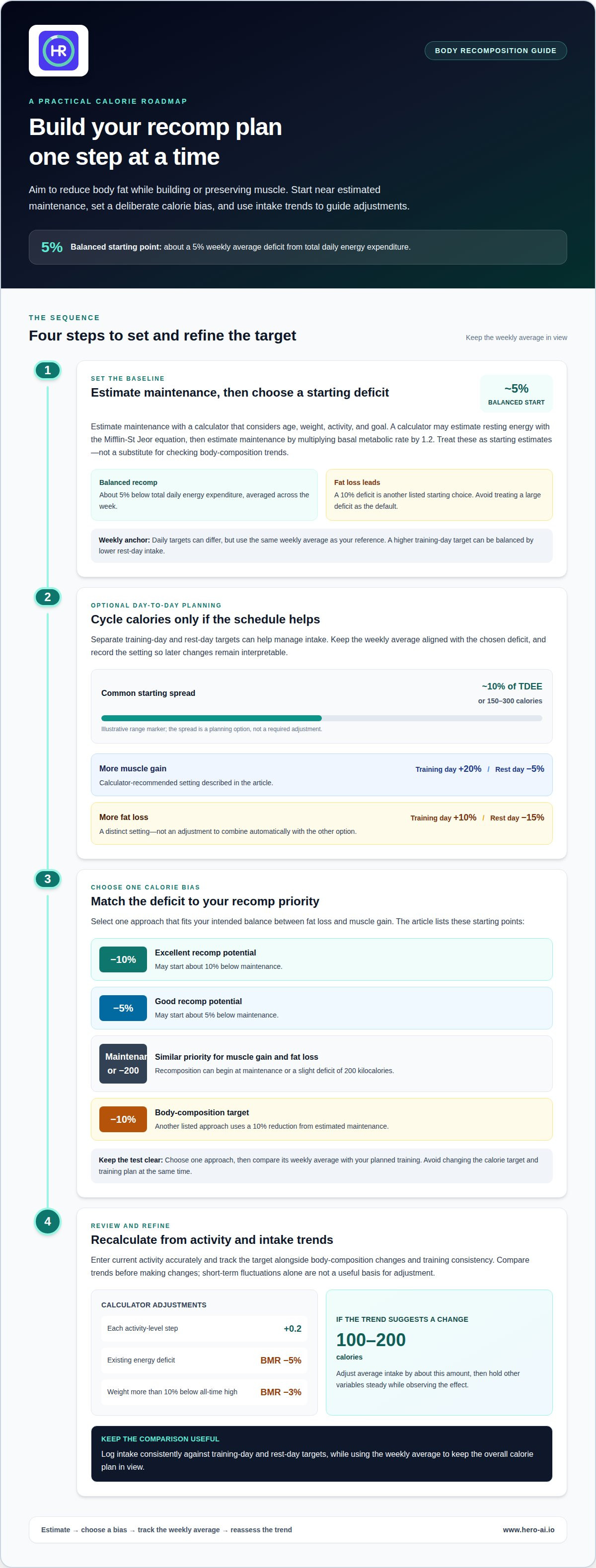
Start by estimating maintenance calories with a calculator that considers age, weight, activity, and goal. A balanced recomp starting point is a weekly average deficit of about 5% of total daily energy expenditure. Choose a 10% deficit if fat loss leads your goal. Avoid treating a large deficit as the default, because the calorie target must also support resistance training and muscle gain.
Use the same weekly average as your reference, even when daily targets differ. For example, a training-day increase can be balanced by lower rest-day intake. A calculator may estimate resting energy with the Mifflin-St Jeor equation, then estimate maintenance by multiplying basal metabolic rate by 1.2. These are starting estimates, not a substitute for comparing intake with body-composition trends.
-
Cycle Calories and Macros Across Days
Set separate training-day and rest-day targets only if the schedule helps you manage intake. A common starting spread is about 10% of total daily energy expenditure, or 150-300 calories. Keep the weekly average aligned with your chosen deficit. Place more calories on training days when performance and recovery are priorities, rather than changing daily targets without a plan.
For more muscle gain, the calculator recommends increasing training-day calories by 20% and reducing rest-day calories by 5%. For more fat loss, it recommends increasing training-day calories by 10% and reducing rest-day calories by 15%. Treat these as distinct settings, not adjustments to combine automatically. Record which setting you choose so later changes remain interpretable.
-
Choose the Calorie Bias That Fits Your Recomp Goal
Match the deficit to your intended balance between fat loss and muscle gain. People with excellent recomp potential may start about 10% below maintenance, while those with good potential may start about 5% below maintenance. A body-composition target can also use a 10% reduction from estimated maintenance. Select one approach, then compare the resulting weekly average with your planned training.
Recomposition can also begin at maintenance or a slight deficit of 200 kilocalories. This can suit a goal that gives muscle gain and fat loss similar priority. A fat-loss-led approach uses the larger listed deficit, while a balanced approach uses the smaller one. Avoid changing the calorie target and training plan simultaneously, because that makes progress harder to interpret.
-
Recalculate From Activity and Intake Trends
Enter current activity accurately. The calculator increases its activity multiplier by 0.2 for each activity-level step. Its estimate also changes when circumstances affect energy needs: it reduces estimated basal metabolic rate by 5% when you report an existing energy deficit, and by 3% when your weight is more than 10% below your all-time highest weight.
Track the target alongside body-composition changes and training consistency. If the trend suggests the calorie target needs adjustment, change average intake by about 100-200 calories. Hold other variables steady while observing the effect. A body recomposition macro tracker can make daily intake easier to compare with training-day and rest-day targets, while the weekly average keeps the overall calorie plan in view.
Protein, carbohydrate, and fat targets for recomposition
Set your protein target first, then allocate fat and carbohydrates within your calorie target. Beginners and experienced lifters can use the same broad protein range. Training volume and daily activity help determine how to distribute the remaining calories.
-
Set Protein Targets for Recomposition
Choose a daily protein target of 1.8-2.4 grams per kilogram of body weight for recomposition. A simpler range for most lifters is 1.6-2.2 grams per kilogram. Use body weight when body-fat estimates are unavailable. If you know your body-fat percentage, calculate lean mass and consider 1 gram per pound of lean mass for recomposition.
For example, a person weighing 70 kilograms could set a target within the body-weight range, then track daily intake against it. Lean-mass calculations can make targets more relevant when body-fat percentage is known. Keep the selected measure consistent; switching between total body weight and lean mass can make comparisons inaccurate.
-
Set Carbohydrate and Fat Targets
Set a fat minimum of the greater amount: 0.6 grams per kilogram of body weight or 20% of daily calories. Then assign carbohydrates from the calories remaining after protein and fat. This sequence keeps protein and fat targets visible before you distribute the rest of your calorie budget.
A 30:40:30 protein, carbohydrate, and fat split is one example, not a required ratio. A fixed percentage split can produce different gram targets as calorie intake changes. Use the ratio as a starting comparison, then check whether each macro meets its gram target and supports your training activity.
-
Adapt Targets to Experience and Activity
Keep the protein range consistent across training experience, then select a point that fits your intake and goal. A beginner and an experienced lifter can both start within 1.8-2.4 grams per kilogram for recomposition. Training history affects expected progress, but it does not require a different macro formula by itself.
Use your activity and training demands to guide carbohydrate intake within your calorie budget. A demanding training day may call for more carbohydrates, while a less active day may call for fewer. Adjust based on your workouts and recorded intake, not activity labels alone. When testing a carbohydrate change, keep protein and fat targets steady.
-
Log Meals and Protein Intake
Start by recording one meal per day or tracking protein alone. Log portions and meal details as accurately as practical, then compare the daily total with your chosen target. To assess tracking accuracy, log all food intake for 2 weeks and review recurring gaps, such as meals or snacks that are often missed.
Use meal entries to spot when protein intake falls short, then plan protein-containing foods across the day. A food logging tool can simplify entry through photo recognition, barcode scanning, or imported recipes. For example, automated meal logging can make meal records easier to maintain while you monitor targets.
- Review your full macro record before making adjustments. If you consistently meet your protein target but your carbohydrate intake varies, adjust the carbohydrate allocation rather than changing every macro at once. Note the change and compare your intake with training and body-composition trends over time. This gives each adjustment a clear purpose and makes its effects easier to interpret.
Choosing a body recomposition goal
- Choose recomposition if your priority is reducing body fat while building or preserving muscle. Pair the goal with consistent resistance training and gradual changes rather than expecting rapid weight loss. A new lifter returning to training may have different progress potential from an experienced lifter, so factor in your training history. Measure success using more than scale weight: track strength, waist measurements, and how your clothes fit, too.
- Assess whether fat loss should lead your goal. Very lean lifters, defined as men under about 12% body fat or women under about 18%, should avoid treating aggressive fat loss as the default. If fat loss is the main priority, a cutting phase may fit better than trying to balance two outcomes equally. Record your current training and body-composition indicators first, then use the same measures to review progress.
- Select a muscle-gain focus when adding strength and lean mass matters more than reducing body weight. A lean bulk uses a calorie surplus and enough carbohydrates to support training. The suggested weight-gain rate while bulking is 0.5-2% of body weight per month. Use that rate as a comparison point, not as a reason to bulk automatically. A lifter who prefers slower weight change may choose recomposition instead.
- Compare your chosen goal with the pace expected from a cut. The recommended weight-loss rate while cutting is 0.5-0.75% of body weight per week. If that pace feels inconsistent with your strength-training priority, choose a less aggressive objective and evaluate body composition over a longer period. Keep the distinction clear: cutting prioritizes fat loss, bulking prioritizes muscle gain, and recomposition aims to pursue both.
- Write down one primary outcome and supporting measures before starting. For example, make strength the primary outcome while monitoring body weight and waist measurement. Review the goal after four weeks, but allow at least eight weeks to assess recomposition. An 8-12-week checkpoint can help you judge a trend rather than a single reading. If losing weight is not the main objective, don’t use scale change alone to decide whether the plan is working.
Recomposition compared with bulking and cutting
- Decide what each phase prioritizes before choosing a nutrition target. Recomposition aims to reduce fat while adding or preserving muscle, so scale weight may change slowly. Bulking prioritizes muscle gain through a calorie surplus and resistance training. Cutting prioritizes fat loss through a calorie deficit. These terms describe different goals, not entirely different exercise systems. Each approach still relies on consistent resistance training and enough nutrition to support your chosen goal.
- Choose recomposition when you want both changes without making rapid weight movement the main measure. This approach can suit a lifter who values strength and body composition more than a fast scale result. A reported example describes Jason adding five pounds of lean muscle in four months while staying within 10 percent of his goal weight. Treat that example as an illustration, not an expected result for every person.
- Use a bulk when muscle gain is the clear priority and some weight gain fits your plan. During a lean bulk, a surplus supports training, while carbohydrates help fuel exercise. The expected pace differs with training experience: beginner trainees are advised to target weight gain of 1.5-2% of body weight per month, while intermediate trainees are advised to target 0.5-1% per month. Compare the trend with strength and training consistency.
- Choose a cut when reducing body fat takes priority over gaining muscle. Maintain resistance training while managing your calorie deficit, and assess strength alongside weight-loss progress. Cutting and recomposition can both involve a deficit, but they emphasize different outcomes. A cut focuses on a clearer downward weight trend. Recomposition allows for slower scale changes while you monitor body composition and performance. Don’t judge either plan by a single weigh-in.
- Review the plan after a defined tracking period, then adjust one variable at a time. Use an 8-12-week checkpoint to compare average weight, strength records, and body-composition measures. If weight falls but strength also declines, review the calorie deficit, protein intake, and exercise demands together. If weight stays steady while measurements or strength change, that may align with recomposition. Keep nutrition records consistent so progress comparisons remain useful.
Macro tracking for body recomposition
Track your intake against your macro targets, then compare your log with training and body-composition trends. Use the record to guide decisions, not to judge individual meals.
-
Choose a Macro Tracker App
The right app depends on what you eat and how you prefer to log it. Look for clear calorie and macro totals, a substantial food database, and entries that are easy to review. A body recomposition macro tracker should show protein alongside calories, so you can spot when you meet one target but miss another.
Consider how an app handles your usual meals, including packaged foods and home-cooked recipes. Photo recognition, barcode scanning, and recipe imports can reduce manual entry. Check whether you can adjust portions when an entry needs correction. Choose a tool that captures your normal eating pattern, then use it consistently to make meaningful comparisons.
-
Avoid Common Tracking Mistakes
Record portions and ingredients carefully. Missing cooking oils, snacks, drinks, or recipe ingredients can make the daily total less accurate. According to the U.S. Food and Drug Administration, one gram of protein provides 4 calories and one gram of fat provides 9 calories. One gram of carbohydrate provides 4 calories, so each macro contributes differently to total energy.
Don’t change several targets after one day of eating. Hold a calorie target for 2-4 weeks before changing it, then compare your log with progress. If you use macro sliders, check which values move. Some calculators change carbohydrates and fats in a 2:1 ratio by calories while keeping protein constant. Review the displayed targets after each adjustment.
-
Consider Tracking Risks and Downsides
Use a less detailed approach if strict logging feels stressful or encourages obsessive tracking. Tracking isn’t necessary for everyone, especially if you already get consistent results without it. You can simplify the task by recording one meal a day or focusing on a single macro. The right level of detail informs your decisions without letting data dominate how you eat.
Keep the log focused on patterns that can guide action. For example, review whether a recurring meal is difficult to estimate or whether protein intake varies substantially between weekdays and weekends. Reassess your records every 4-6 weeks instead of reacting to each entry. If logging adds stress without improving decisions, reduce the detail or stop tracking.
For meal logging through photo recognition, barcode scanning, or recipe imports, explore automated food tracking.
Hero AI: 1 year subscription
Hero AI can support the tracking routine described in this guide. Its AI-powered health and fitness platform logs meals through photo recognition, barcode scanning, and recipe imports from social media. The food database contains over 3 million verified foods, helping you record intake and compare it with your macro targets. You can also schedule workouts from social media content, keeping exercise planning alongside nutrition tracking.
Use Hero AI when manual food logging makes consistent records harder to maintain. A 1 year subscription provides access to the platform for that period. Visit Hero AI to explore the subscription and tracking features.
Build a Routine You Can Review
Build a repeatable progress review into your routine. Record intake consistently, then use the same measures each time you assess progress. Note changes to your schedule, missed workouts, or shifts in appetite, as these may explain why a target feels easier or harder to follow. Change one part of your plan at a time, so each decision reflects an observable pattern rather than a single meal or weigh-in.
A body recomposition macro tracker can serve as a working record, not a scorecard. Use it to identify what fits your routine, then refine the process as your priorities change. For your next review, assess whether logged intake, training, and your intended outcome still align. If they don’t, adjust the variable most closely connected to the gap. Hero AI supports meal logging and fitness planning. Contact Hero AI about macro tracking to explore its tools. Start with a clear target and build a consistent routine one decision at a time.
Frequently Asked Questions
How Does Changing My Goals Change the Calculator Output?
Changing your goal can change how a calculator distributes calories and macros. For example, selecting muscle gain may increase your calorie allowance, while a fat-loss goal may lower it. Protein recommendations may also shift with the selected goal. After changing the settings, review all your daily targets rather than assuming only your calories changed. Note your selected goal to help interpret later adjustments.
How much protein should I choose?
For recomposition, choose a daily protein target within 1.8-2.4 grams per kilogram of body weight. For example, at 70 kilograms, that range equals 126-168 grams daily. Pick a point you can reach consistently through your usual meals. If you have a known body-fat percentage, a lean-mass-based calculation can offer another way to set the target.
How should I adjust the target after 2-4 weeks?
Review the average intake you actually logged, your weight trend, training performance, and any body measurements. First correct missed meals or inconsistent portions, since these can make the recorded intake misleading. If the record is consistent but progress does not match your priority, adjust average calories by about 100-200, then observe the new trend. Change one target at a time.
If I do extra workouts, do I need to account for the calories?
Don’t automatically add every estimated workout calorie to your food target. Consider first whether the extra session is temporary or has become part of your regular activity. Record the change and monitor your weight trend, hunger, and training performance. If extra exercise becomes routine, update your activity estimate instead of repeatedly adding unplanned calories each day.
What Exactly Are Macros and Why Track Them?
Macros, short for macronutrients, are protein, carbohydrates, and fat. They provide energy and play different roles in a meal plan. Tracking them helps you see whether your daily intake matches your targets. For example, your calorie total may be on target while your protein remains low. Reviewing both calories and macro amounts gives you a clearer picture.
What if I'm already very lean?
If you’re already very lean, don’t default to aggressive fat loss. Set your priority around maintaining strength, supporting resistance training, or making gradual body-composition changes. Track performance and recovery alongside weight, since a downward trend on the scale may not reflect your main goal. If your training quality or energy declines, reassess whether your calorie target supports the outcome you want.
Who Can Successfully Recomp?
Recomposition is most practical when you can combine consistent resistance training with nutrition that supports your goal. A newer lifter or someone returning after time away may start from a different place than an experienced trainee. Training consistency, recovery, food intake, and calorie targets all affect the process. Track measures beyond weight, including strength progress and body measurements.
Why is the scale not moving if recomp is working?
The scale measures total body weight, not separate amounts of fat and muscle. If fat decreases while muscle increases, the changes can offset each other on the scale. Daily weight can also fluctuate with food, fluid, and digestion. Compare measurements, clothing fit, and training records over time rather than treating one unchanged weigh-in as proof that your body composition hasn’t changed.


