

Will a yearly calorie counter subscription support a routine you can maintain, or become an unused annual commitment? Its practical value depends on how easily its tracking tools fit your usual ways of recording meals and planning activity. Before committing, compare the subscription with free apps and manual logs, then identify which features you would actually use.
Hero AI offers a one-year subscription to an AI-powered nutrition and fitness platform. You can log meals through photo recognition, barcode scanning, or recipe imports from TikTok and Instagram. The food database contains over three million verified foods, and the platform also supports scheduling workouts from social-media content.
This guide explains how those features fit into everyday tracking. Use it to assess whether the workflows match your habits and goals, and whether you are likely to use them throughout the year. It also gives you a practical way to compare the subscription with free or manual options without assuming savings or particular health outcomes.
Key Takeaways
- Check whether a yearly calorie counter subscription suits your tracking goals and how often you expect to log.
- Compare annual access with free tools and manual tracking by looking at commitment, effort, workflow, and likely consistency.
- Match meal-entry options to how you typically record food, whether by photo, barcode, or recipe import.
- Include workout scheduling in your decision if it fits your activity-planning routine.
- Review the subscription functions and purchase terms before deciding. Don’t assume a particular cost or health outcome.
Yearly Calorie Counter Subscription: What the Commitment Actually Means
Definition: A yearly calorie counter subscription provides paid access to a calorie-tracking service for a one-year term. Its value depends on whether the features meet your needs and whether you expect to use them regularly.
The term tells you how long access lasts, not how accurate an app is or what results someone will achieve. A longer subscription does not automatically make tracking more useful. Start by listing the tasks you want an app to support, such as recording meals, reviewing food entries, or organizing activity information.
Think about frequency as well as features. Someone who logs meals occasionally may use annual access differently from someone who plans to review nutrition records throughout the year. Neither pattern makes a subscription automatically worthwhile or unsuitable. The key question is whether its functions match your purpose and expected use.
What should an annual calorie counter subscription clarify?
Consider the access period and the other plan terms separately. A one-year term describes duration, but it doesn’t tell you how payment is collected or whether access renews. Cancellation and refund conditions are also separate details. Review the terms presented with the subscription instead of inferring them from the word “yearly.”
Next, compare the listed features with the routine you want to build. For example, decide whether you need an easy way to record meals, a database to support food entries, or a way to organize workouts. Keeping those needs distinct from billing and renewal terms makes it easier to assess the plan clearly.
Calorie tracking is a record-keeping activity, not proof that someone is following a restrictive diet. Understanding Calorie Restriction provides background on that separate concept. A tracking tool can help organize records, but the subscription term does not determine a person’s nutrition choices or health outcomes.
When does a year-long commitment deserve consideration?
Consider annual access if reviewing nutrition or activity records is likely to remain part of your routine. For instance, someone who intends to log meals regularly may value continued access more than someone who only wants to record food for a short period. Think about the tasks you expect to repeat, not just the features that sound appealing.
Occasional logging can still be useful, but it may not call for the same ongoing access as a regular tracking habit. Compare your likely frequency with the subscription term, then check whether the app supports the way you plan to record information. The Hero AI one-year subscription overview describes the platform’s functions.
- Expected use: Decide whether you plan to log occasionally or make tracking a recurring routine.
- Practical fit: Identify which functions support the records you want to keep.
- Plan terms: Consider access duration separately from billing, renewal, cancellation, and refund conditions.
A yearly calorie counter subscription is worth considering when its term and functions fit a realistic routine. The one-year access period is a commitment, not a guarantee that you will use the app consistently or achieve a particular outcome.
How Hero AI's Calorie Tracking Workflows Support Ongoing Use
A tracking method is easier to use when it fits how you already handle food and activity. Hero AI brings together several meal-entry options and a separate workout-planning function. These workflows give you different ways to record nutrition information and organize fitness plans. To judge their practical value, consider which options suit your routine and which you would use repeatedly.
Meal logging through photos, barcodes, and recipes
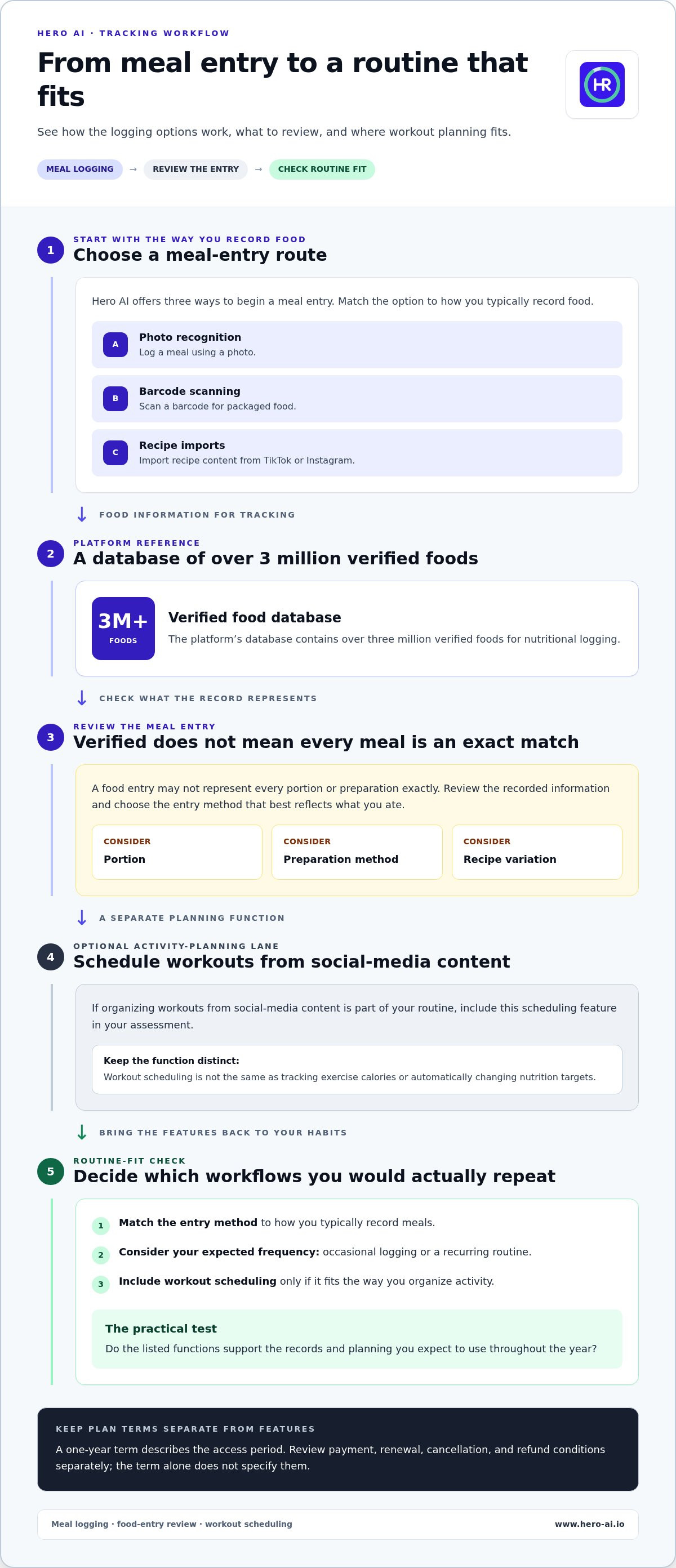
Hero AI supports meal logging through photo recognition, barcode scanning, and recipe imports from TikTok and Instagram. You can start a meal entry with a photo, scan a barcode for packaged food, or import recipe content from the stated social-media platforms. These options provide alternatives to entering meal details manually.
The platform’s food database contains over three million verified foods. This gives you a defined information base for nutritional logging, but “verified” does not mean every entry will match every meal or portion exactly. Portions, preparation methods, and recipe variations can affect what a meal entry represents. Review the recorded information and choose the entry method that best reflects what you ate.
When evaluating an AI calorie counter, consider how recognition and other data-entry methods fit your habits. For general guidance on calorie counting, Harvard's Guide to Calorie Counting offers another reference to consult alongside the app’s functions.
Hero AI’s meal and planning workflows include photo meal recognition, barcode scanning, recipe imports from TikTok and Instagram, and workout scheduling from social-media content.
Connecting nutrition records with workout planning
Workout scheduling is a separate fitness-planning function. Hero AI lets you schedule workouts from social-media content, which can help you organize workout ideas you find there. Scheduling workouts is distinct from tracking exercise calories or automatically changing nutrition targets.
Assess both parts of the platform in relation to your routine. If your main goal is to record meals, focus on whether the food-entry methods suit the way you log. If you also organize workouts from social-media content, include scheduling in your assessment. These functions support planning and record keeping, not a particular nutrition or fitness outcome.
To evaluate a yearly calorie counter subscription, connect each feature to a real task. Note whether you tend to photograph meals, scan packaged foods, import recipes, or schedule workouts from social-media content. That simple exercise can help separate features you expect to use from those that are merely available. Explore the Hero AI nutrition and fitness platform to review its workflows.
Annual Subscription vs Free or Manual Calorie Tracking
Compare tracking methods by how well they fit your routine. Paid access is not automatically more complete, and free or manual methods are not automatically inadequate. A yearly calorie counter subscription provides access for a defined term and may bring several functions together. Free tools vary, while manual tracking lets you keep records without a dedicated app. The best fit depends on the tasks you need to do and whether you will keep doing them.
Access commitment
Annual subscription: Access lasts for a one-year term. Consider whether you expect to use it over that period.
Free tool: Access and available functions depend on the tool.
Manual tracking: You don’t need an app subscription, but you choose how and where to keep your records.
Logging effort
Annual subscription: The effort depends on which entry methods you use and how often you record meals.
Free tool: Logging steps depend on the tool and its available features.
Manual tracking: You enter and organize information using your chosen method.
Tracking workflow
Annual subscription: Hero AI combines food-entry options with workout scheduling from social-media content.
Free tool: Workflows differ, so compare specific functions rather than assuming all tools work alike.
Manual tracking: You choose what to record and how to structure it.
Expected consistency
Annual subscription: Continued value depends on whether you use the functions regularly.
Free tool: Consistency depends on how well the tool fits your habits.
Manual tracking: Consistency depends on maintaining your own recording process.
What a subscription may offer beyond a free or manual approach
Consider whether Hero AI’s combination of photo meal recognition, barcode scanning, recipe imports, a food database, and workout scheduling suits the way you want to track. These functions create a particular digital workflow. They don’t mean every free tool lacks similar features, or that manual records are necessarily less accurate or more time-consuming. Compare the specific tasks you want to complete with what each option provides.
How to assess annual value without assuming savings
Ask yourself whether you expect to use the available workflows throughout the year. An annual plan is not automatically cheaper than another option. To compare cost, use the actual plan terms available for each option rather than assuming a saving. Consider function, access duration, and likely use separately. A photo food tracker subscription analysis can also help you think through automated food-entry workflows.
Comparison takeaway: The right method depends on consistent use and the functions your routine requires. Choose based on fit, not on the assumption that subscriptions, free tools, or manual records are universally better.
A Practical Checklist for Deciding Whether an Annual Calorie Counter Fits
Use this checklist to match the subscription’s functions to your routine. Focus on what you want to track, how often you expect to do it, and whether a one-year commitment suits your plans.
Match the tracking tools to your real routine
- Set your tracking goals and expected frequency. Decide what you want to record, such as meals, food details, or workout plans. Then consider whether you expect to log regularly or only occasionally. A realistic estimate is more useful than assuming you will use every feature throughout the year.
- Match meal entry to your habits. Think about whether taking meal photos, scanning barcodes, or importing recipes suits the foods you usually record. If you prefer to enter information yourself, consider whether the other methods would add practical value or go unused.
- Include workout planning only if it meets a need. HERO AI supports scheduling workouts from social-media content. Include this function if organizing workout ideas is already part of your routine. If you are choosing mainly for nutrition logging, focus on the meal-tracking workflows you expect to use.
- Estimate continued use across the term. Picture an ordinary week, not an ideal one. When would you record meals, and what would prompt you to use the platform? Would you use the same entry method consistently or switch between options? These questions help distinguish a recurring workflow from a feature that sounds useful but doesn’t fit your habits.
Review the commitment before choosing
- Read the displayed plan terms. Before proceeding, review the subscription period and purchase terms shown at the point of purchase. Keep the access duration separate from other conditions, and base your decision on the terms presented.
- Compare your intended use with the included functions. Identify which features you expect to use and why. A yearly calorie counter subscription may suit you if its workflows support recurring tracking needs. If only one feature seems relevant, consider whether that function alone makes a year-long commitment worthwhile for you.
Decision point: Choose fit if you have clear tracking goals, expect regular use, and can name specific functions that support your routine. Reconsider if you are likely to log only occasionally or the term doesn’t suit your plans. Compare further if you are unsure whether the workflows match your needs or want to weigh them against free or manual tracking.
To apply the checklist to the platform, review HERO AI’s nutrition and fitness platform.
What the HERO AI One-Year Subscription Includes and How to Proceed
HERO AI offers a one-year subscription to an AI-powered nutrition and fitness platform. Its stated functions cover meal logging, food information, recipe imports, and workout scheduling. They describe the available tools, not a promise of particular nutrition, weight, or fitness results. Assess each function against the tasks you expect to do before choosing an annual commitment.
The stated functions included in HERO AI
The platform brings together functions for different parts of a tracking routine. Consider which ones match your habits instead of assuming you need to use every feature.
- Photo meal recognition: Use a meal photo as an entry method for food logging.
- Barcode scanning: Scan barcodes as another way to enter food information.
- Verified food database: Use a database containing over three million verified foods to support nutritional logging. The database size does not guarantee that every entry will match every meal or portion.
- Social-media recipe imports: Import recipes from TikTok and Instagram as part of meal logging.
- Workout scheduling: Schedule workouts from social-media content as a separate fitness-planning function.
Each function serves a different purpose. Meal-entry options help you record food, recipe imports add another source for meal information, and workout scheduling supports planning. Consider HERO AI’s macro-tracking app functions alongside these tools when reviewing its nutrition-tracking capabilities. None of the listed functions guarantees a particular outcome.
Review the platform and subscription information at View HERO AI.
Next steps for a considered subscription decision
Before purchasing, review the subscription information and terms displayed with it. Consider the one-year access period separately from other purchase conditions, and base your decision on the information presented.
Then compare the functions with your expected use. If you regularly record meals, decide whether photos, barcodes, or recipe imports fit the way you handle food logging. If workout scheduling addresses a real planning task, include it in your assessment. If you expect to use only one function, consider whether it supports enough of your routine to make continued access useful.
A yearly calorie counter subscription is a practical fit when its stated functions match your needs and likely use across the term. If the tools don’t suit your routine, reconsider or compare other tracking approaches. Make the decision based on your goals and expected use, not on an assumed result from subscribing.
Make Your Next Step a Routine Check
Before choosing a yearly calorie counter subscription, picture how it would fit into an ordinary week. Decide when you would record information, what would prompt you to use the platform, and which tasks you want it to support. A realistic routine is a stronger basis for a decision than an ideal plan you may not maintain.
Next, compare that expected use with the subscription information. If the access period and functions fit your needs, you can proceed with a clearer understanding of the commitment. If the fit is uncertain, reconsider what you need from a tracking method before deciding.
Review HERO AI’s subscription information as part of your decision. View HERO AI to assess the platform and decide whether it fits your routine.
Frequently Asked Questions
Is a yearly calorie counter subscription worth it?
It may be worthwhile if you expect to track regularly and can name specific tools you will use. Think about when you would log meals during a typical week and what you want to review in those records. Compare that expected use with the commitment shown at purchase. Paid access doesn’t guarantee health results or savings, so judge it against free or manual methods based on your needs.
Can I use a calorie counter without a subscription?
Yes. Some calorie-tracking services provide free access, while others offer paid plans or require a subscription. Available functions vary, so compare the tasks each option supports, such as recording meals or organizing food information. You can also keep food records manually. HERO AI offers a one-year subscription to its platform, with functions that include meal logging and workout scheduling.
How much does a yearly calorie counter subscription cost?
There is no single standard price for a yearly calorie counter subscription. Costs vary by service and can change, so another app’s price or a general estimate won’t establish the cost of the plan you are considering. Review the current purchase information for the displayed total and applicable terms. When comparing annual access with a shorter plan, use the amounts and conditions shown for both rather than assuming the annual option saves money.
What does the HERO AI one-year subscription include?
HERO AI’s one-year subscription provides access to its nutrition and fitness platform. Its functions include photo meal recognition, barcode scanning, a verified food database, recipe imports from TikTok and Instagram, and workout scheduling from social-media content. These tools support food logging and workout planning, but don’t guarantee a particular nutrition or fitness result. Review the subscription information and purchase terms before deciding.
Does a calorie counter subscription replace advice from a nutrition professional?
No. A tracking app records food information, but it doesn’t provide individualized professional advice or a diagnosis. A food log can help organize what you have recorded, but it can’t determine whether a specific diet is suitable for a medical condition. If you have dietary requirements, health concerns, or questions about eating, seek guidance from an appropriate qualified health professional.
What happens if I stop using an annual calorie counter subscription before the year ends?
The effect depends on the terms that apply to the subscription. Don’t assume unused access can be paused, that a refund is available, or that renewal works in a particular way. Review the purchase terms before committing. If your routine may change, consider that uncertainty when weighing the access period against how often you realistically expect to use the tracking tools.


