

A larger food database doesn't guarantee better weight loss results. In fact, evaluations published in Nutrients show that unverified, crowdsourced food libraries carry caloric discrepancy rates between 15% and 37%, quietly eroding your planned deficit. Finding the best calorie tracking app isn't about choosing vanity database metrics or scrolling through duplicate entries. You already know the administrative friction of manual tracking: spending minutes typing individual ingredients, guessing portion weights, and struggling to log complex social media recipes.
Sustainable dietary adherence demands zero-friction capture alongside mathematically verified macro accuracy. This guide provides an objective evaluation framework to identify the best calorie tracking app based on data precision, automation protocols, and administrative efficiency. We evaluate Hero AI across multimodal visual logging speed, database curation standards, and cross-platform recipe ingestion to determine how the platform delivers the highest operational precision for your routine.
Key Takeaways
- Daily logging latency directly dictates deficit adherence, with complex multi-step inputs substantially lowering long-term tracking consistency.
- Selecting the best calorie tracking app requires auditing core software architecture, specifically contrasting legacy text search against automated computer vision capture.
- Curated food libraries provide greater caloric precision than raw database volume by eliminating erroneous entries common to crowdsourced platforms.
- Modern nutritional administration relies on cross-platform data ingestion, allowing direct imports of social media recipes and synchronized activity timelines.
Core Evaluation Metrics for Digital Calorie and Macro Trackers
The best calorie tracking app operates as an administrative data management system for metabolic energy balance. Digital calorie trackers must translate biological energy intake into accurate, structured numerical records. Legacy applications treat this process as a manual journaling routine, which introduces friction into daily workflows. Modern software architectures prioritize process automation over manual documentation. Evaluating these platforms requires objective metrics centered on three fundamental technical criteria: total input latency, database integrity, and automated pipeline integration.
Quantitative Logging Latency
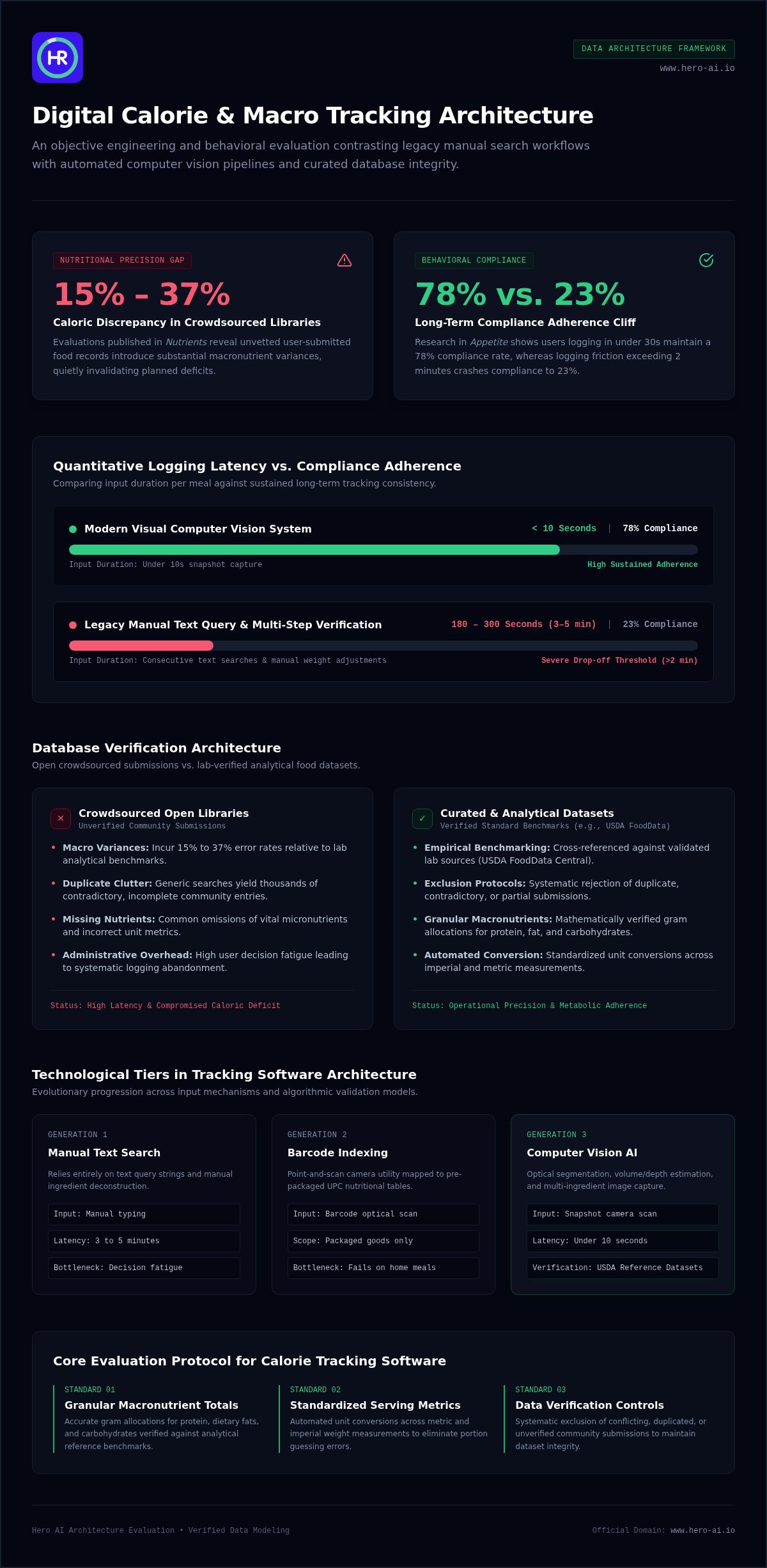
Input latency measures the precise duration required to translate a physical meal into recorded nutritional values. In conventional applications, logging a multi-ingredient meal requires consecutive text searches, manual serving size adjustments, and ingredient-by-ingredient confirmations. This sequence demands three to five minutes per entry.
Behavioral research published in Appetite demonstrates that input duration directly impacts sustained tracking consistency. Users who complete logging actions in under 30 seconds maintain a long-term compliance rate of 78%. When interface friction extends logging beyond two minutes, compliance drops to 23%. Modern visual input systems reduce this processing window to under 10 seconds via snapshot scanning. This transition from manual text queries to automated image recognition systematically eliminates administrative drop-off.
Nutritional Data Architecture
Database reliability dictates calculation efficacy. Most legacy applications rely heavily on crowdsourced libraries. These open architectures accept unvetted user submissions, creating databases cluttered with duplicate records, missing micronutrients, and inaccurate caloric values. Independent evaluations show that crowdsourced food logs introduce macro variances between 15% and 37% compared to standard analytical references.
A functional tracking tool applies foundational calorie counting principles using verified nutritional data architecture. To identify the best calorie tracking app, users must audit whether a platform deploys curated, lab-verified datasets or relies on unverified user entries. Reliable platforms maintain structured datasets that deliver standard values across three core variables:
- Granular Macronutrient Totals: Accurate gram allocations for protein, dietary fats, and carbohydrates.
- Standardized Serving Metrics: Automated unit conversion across metric and imperial weight measurements.
- Data Verification Controls: Systematic exclusion of conflicting, duplicated, or unverified community submissions.
Technological Tiers in Calorie Tracking Software Architecture
Calorie tracking applications fall into three distinct software generations based on their input mechanisms and data validation models. Early utilities relied on manual transcription. Intermediate iterations introduced point-and-scan barcode indexing for packaged goods. Contemporary third-generation platforms operate on artificial intelligence, computer vision, and unstructured data ingestion. Evaluating these architectural tiers identifies how modern systems reduce tracking latency.
Legacy Manual Entry Applications
First-generation architecture depends entirely on keyword search queries and manual serving adjustments. Users must deconstruct complex meals into individual raw ingredients. This approach imposes significant cognitive overhead on home-cooked meals. Searching for generic terms like "grilled chicken" returns thousands of contradictory community entries. Users face decision fatigue, which increases logging abandonment over time.
Automated Visual and Computer Vision Systems
Third-generation platforms replace manual text searches with optical object detection. Proprietary image recognition algorithms segment mixed plates into distinct food categories and calculate volume estimates from a single image capture. Visual recognition accuracy in modern nutritional software relies on parsing depth, surface area, and ingredient density to derive precise macronutrient profiles. These visual models instantly cross-reference identified items against structured databases, including verified sources like USDA FoodData Central, ensuring nutritional outputs align with empirical benchmarks rather than unverified user approximations.
Dynamic Media Parsing Engines
A major architectural advancement in third-generation tracking is the extraction of dietary parameters from unstructured digital media. Traditional applications cannot parse dynamic content from video platforms. Modern platforms incorporate natural language processing pipelines to convert recipes from TikTok, Instagram, and web URLs directly into itemized macronutrient targets. Users interested in streamlining recipe extraction and workout scheduling can review social media fitness integration protocols to observe automated ingestion pipelines in action.
Understanding these software tiers highlights the primary shift in the industry: moving from manual data logging to automated administrative capture. For users seeking the best calorie tracking app, shifting to visual detection removes daily friction. Selecting a modern platform like Hero AI ensures access to automated computer vision and rapid ingestion workflows.
Database Verification Protocols: Crowdsourced vs. Curated Libraries
Database volume provides little operational utility if record integrity remains unverified. Many tracking tools advertise libraries containing over 14 million entries to project administrative scale. Most of these entries originate from unmoderated user submissions. Crowdsourced architectures create extensive catalog bloat, with dozens of conflicting entries for identical items. For someone determining the best calorie tracking app, data verification protocols matter far more than raw index volume.
Systemic Risks in Crowdsourced Indices
Unvetted community libraries introduce compounding errors into daily dietary accounting. When users submit personal entries with missing fiber metrics, miscalculated fat grams, or estimated serving sizes, these errors replicate across the entire network. A clinical evaluation of diet-tracking app accuracy highlights how systematic coding discrepancies in commercial trackers disrupt user energy calculations.
Peer-reviewed analyses indicate that crowdsourced records produce variance rates between 15% and 37% for macronutrient totals. Duplicate entries for standard whole foods exhibit discrepancies between 30% and 50%. These statistical distortions create specific operational risks:
- Macronutrient Misallocation: Unverified records often log caloric totals correctly while miscalculating protein, carbohydrate, and fat splits.
- Serving Measurement Ambiguity: Crowdsourced entries frequently use subjective descriptors such as "bowl" or "slice" instead of verified gram weights.
- Deficit Invalidation: Consistent calculation errors of 200 to 400 calories per day can eliminate an intentional caloric deficit entirely.
Curated 3M+ Verified Food Datasets
Curated platforms resolve data degradation by establishing standardized validation pipelines. Instead of allowing unvetted user additions, systems like Hero AI restrict their core catalog to over 3 million verified items. Every entry undergoes validation against national and international food composition tables to confirm biochemical accuracy.
Deploying a dedicated macro tracking app with strict data validation protects nutritional precision across diverse global food profiles. Curated database scale functions as the primary determinant of long-term tracking accuracy and metabolic predictability. Operating from a verified baseline ensures that caloric and macronutrient targets reflect actual nutritional intake rather than community-generated guesswork.
Comprehensive Protocol to Select the Best Calorie Tracking App
Selecting an operational tracking utility requires auditing specific workflow friction points. Users often select platforms based on marketing visibility rather than technical capability. A systematic evaluation protocol ensures software architecture matches daily routine demands. Identifying the best calorie tracking app requires analyzing input velocity, database verification, and cross-platform synchronization.
Dietary Input Diagnostics
Dietary habits dictate the required software input mechanisms. Users should audit meal composition over a typical seven-day cycle before choosing an administrative system:
- Packaged Goods vs. Scratch Cooking: High consumption of commercial items requires instant barcode retrieval. Diets emphasizing home-cooked meals require computer vision capable of segmenting composite plates.
- Digital Recipe Sourcing: Sourcing meals from video platforms demands automated URL parsing. Re-entering ingredients manually from external platforms creates administrative overhead.
- Precision Tolerances: Structured athletic training requires gram-level macro allocation and verified reference datasets rather than user-estimated entries.
Confirming support for digital recipe links removes the primary bottleneck associated with dynamic home cooking routines.
Automation and Synchronization Requirements
Nutritional intake operates alongside physical exertion. Legacy systems isolate dietary logs from training routines, forcing users to manage multiple independent tracking applications. This fragmentation increases administrative overhead and obscures net metabolic status.
Advanced tracking architectures synthesize physical training and nutritional intake onto a unified dynamic timeline. These systems ingest unstructured exercise posts from video platforms, translate movements into programmed workout structures, and adjust daily caloric targets against verified energy expenditure. Auditing integration across connected devices ensures continuous data transfer without manual cross-referencing.
Eliminating logging friction requires transitioning to automated visual capture and unified timeline management. Standardize your daily nutritional accounting and deploy automated intake tools directly by visiting Hero AI.
HERO AI: Technical Specifications and Subscription Architecture
Hero AI automates metabolic tracking through computer vision and neural networks. Rather than functioning as a passive digital logbook, the platform replaces manual data entry with programmatic capture. The software translates visual inputs directly into verified macronutrient figures, establishing a streamlined workflow for body composition management. When evaluating candidates for the best calorie tracking app, automation depth and algorithmic speed define functional utility.
Core Operational Capabilities
The system processes meals via proprietary image recognition algorithms. A single snapshot identifies discrete ingredients, calculates serving portions, and maps totals against an internal library of over 3 million verified items. This curated index avoids crowdsourced errors, ensuring baseline calculations remain biologically accurate.
Beyond visual logging, the platform incorporates dynamic media parsing. Users import recipes directly from social channels, including TikTok and Instagram. Natural language parsing algorithms scan video captions and ingredient lists, converting external media into itemized caloric and macronutrient targets. Integrated workout scheduling systems parse fitness routines from digital channels, synchronizing planned physical exertion with daily nutritional allowances on a single timeline.
1 Year Subscription Deployment
Hero AI structures its operational access around a 1 Year Subscription model. This deployment delivers full technical integration without modular paywalls for essential administrative features.
Key operational parameters of the 1 Year Subscription include:
- Full Engine Access: Complete utilization of computer vision recognition, barcode processing, and cross-platform recipe ingestion pipelines.
- Continuous Model Optimization: Regular software updates refining visual segmentation neural networks and expanding verified nutritional registries.
- Global Infrastructure: Consistent system architecture accessible worldwide, supporting diverse international food items without regional feature limits.
- Integrated Activity Management: Unified administration linking workout programming directly to dynamic daily metabolic targets.
Selecting the best calorie tracking app depends on eliminating administrative friction. Users requiring automated data ingestion and verified macro precision can Initialize the Hero AI platform for automated nutritional tracking.
Upgrading to Automated Nutritional Management
Sustained weight loss requires consistent dietary data. Manual entry workflows and unvetted crowdsourced records introduce variance that can compromise calculated deficits. Determining the best calorie tracking app requires prioritizing data precision and low input latency over legacy feature sets.
Modern nutritional management relies on automated infrastructure. HERO AI optimizes daily tracking using its proprietary photo nutrition recognition engine alongside a database of 3 million verified food records. With automated social media recipe parsing, complex meals convert into structured macro targets in seconds. You don't have to waste time auditing conflicting ingredient entries or manually logging multi-step recipes.
Eliminating logging friction creates a repeatable baseline for long-term body composition control. Activate your HERO AI 1 Year Subscription for automated nutritional logging and establish a reliable, automated foundation for your health objectives.
Frequently Asked Questions
How do computer vision models recognize ingredients in complex home-cooked meals?
Computer vision models identify ingredients by executing multi-layered semantic segmentation on captured photographs. The neural network detects boundary edges, color gradients, and surface textures to isolate individual components on a plate. These visual markers map against internal libraries to establish ingredient identities. The system then calculates volumetric ratios and cross-references density tables to estimate caloric and macronutrient values without requiring manual item entry.
What is the primary difference between crowdsourced and verified food databases?
The difference centers on data validation and quality control protocols. Crowdsourced databases allow open user submissions, resulting in duplicate listings, erroneous macronutrient allocations, and missing nutritional data. In contrast, verified databases curate entries against standard biochemical reference tables. The best calorie tracking app utilizes curated records to eliminate the 15% to 37% calculation variance commonly found in unmonitored community indexes.
Can modern calorie tracking platforms parse recipes directly from social media platforms?
Yes, advanced platforms extract nutritional profiles directly from external social media URLs. Natural language processing models parse video descriptions, captions, and on-screen text from platforms like TikTok and Instagram. The software isolates listed ingredients, standardizes unit measurements, and cross-references items against validated food records. This administrative pipeline generates structured meal logs from unstructured social content in seconds without manual entry.
How does automated photo food logging impact long-term dietary compliance?
Automated photo logging increases compliance by drastically reducing administrative friction. Studies confirm that tracking routines requiring under 30 seconds per meal achieve long-term retention rates of 78%, compared to 23% for workflows exceeding two minutes. By replacing multi-step text queries with sub-ten-second visual capture, automated systems minimize cognitive fatigue. Consistent data capture prevents tracking abandonment and preserves planned caloric deficits over extended periods.
Is an active network connection required for computer vision meal processing?
Yes, an active internet connection is standard for processing visual inputs through computer vision models. High-resolution food segmentation and multi-component neural network analysis run on cloud-based server clusters rather than local mobile device processors. Cloud infrastructure ensures rapid querying against massive catalogs of over 3 million verified items. Once processed remotely, structured macronutrient and caloric totals return to the local application timeline instantly.
What parameters are included within the HERO AI 1 Year Subscription model?
The HERO AI 1 Year Subscription provides complete access to all automated nutritional management tools. Subscribers receive unrestricted use of the proprietary computer vision photo recognition engine, continuous access to 3 million verified database entries, and cross-platform recipe parsing from TikTok and Instagram. The subscription also includes integrated workout scheduling systems that align exercise energy expenditure directly with daily nutritional targets worldwide.
How do automated calorie tracking applications measure portion sizes without scales?
Applications estimate portion sizes using reference geometry and optical density algorithms. When a user captures a food photo, the software assesses perspective, plate diameter, and vertical volume. These dimensional calculations translate visual surface area into cubic volume. The software then applies standard density coefficients for identified ingredients to determine weight. When selecting the best calorie tracking app, these mathematical models replace manual kitchen scales.
Can workout routines be scheduled programmatically alongside nutritional data?
Yes, modern tracking platforms integrate physical training schedules directly into the nutritional tracking environment. Systems extract exercise routines from social media videos or fitness media channels and map them onto a unified calendar. The software calculates estimated energy expenditure for each session and dynamically updates remaining caloric allowances. This programmatic integration eliminates the need to run separate workout and diet applications concurrently.


