

Manually transcribing a 60-second cooking video requires 10 to 15 minutes, and visual guesswork often skews calculations by 300 to 500 calories per serving. An automated tiktok recipe calorie importer eliminates this friction by transforming unstructured video media into verified nutritional datasets within seconds. If you log your food daily, you already know the frustration of pausing fast clips, estimating unmeasured ingredients, and typing individual items into legacy apps that can't read social links directly.
This reference guide explains the technical architecture, data processing pipeline, and verification standards behind automated video recipe imports. You'll understand how systems combine speech recognition and computer vision to extract ingredients, how density algorithms normalize informal culinary measurements, and how multi-million-item verified databases validate macronutrient counts. Here is how modern ingestion pipelines turn viral social cooking content into reliable dietary data without manual entry errors.
Key Takeaways
- Discover how an automated tiktok recipe calorie importer deploys optical character recognition and speech models to parse raw video into structured data.
- Learn the multi-stage ingestion pipeline that converts informal creator measurements into standardized metric units and accurate portion yields.
- Identify systematic auditing protocols to catch hidden cooking fats and verify macronutrient counts against established energy conversion standards.
- Understand how cross-referencing extracted ingredients against verified databases of over 3 million items eliminates common tracking inaccuracies.
What Is a TikTok Recipe Calorie Importer? Technical Architecture
A tiktok recipe calorie importer is a specialized software system designed to translate unstructured social video assets into machine-readable nutritional data. Standard web scrapers depend on structured JSON-LD schema tags embedded in traditional recipe blogs. In contrast, vertical video platforms do not provide clean semantic markup. Video importers bridge this gap. They programmatically capture media files, isolate descriptive strings across captions and text overlays, and map detected items to validated nutrient indexes. The system then calculates gross caloric totals, macronutrient splits, and per-serving distributions.
Core Architectural Components of Ingestion Engines
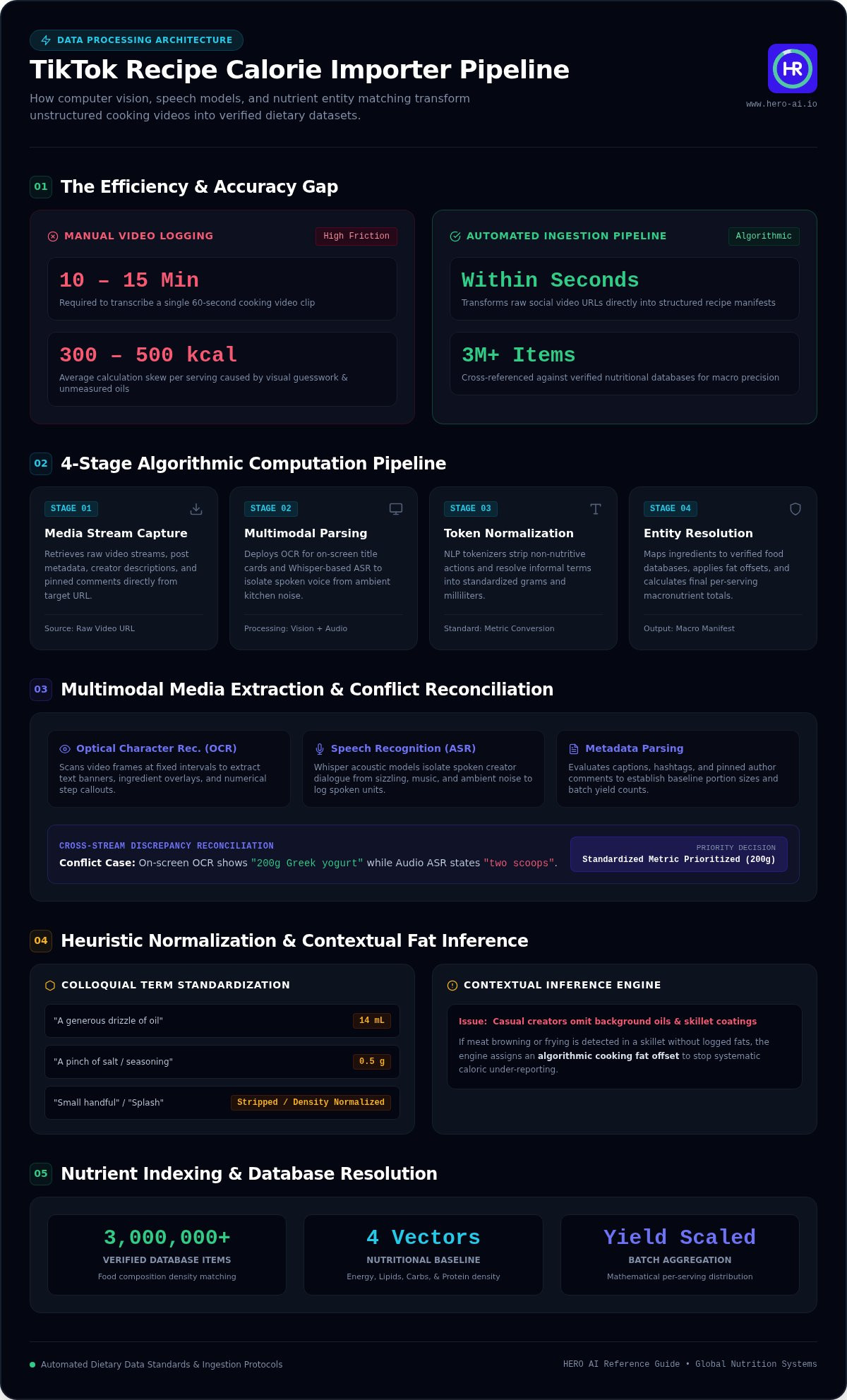
The ingestion engine executes across three primary functional layers to extract usable dietary information:
- Data Collection: Automated scrapers retrieve post metadata, video captions, pinned comments, and creator descriptions from the target URL.
- Natural Language Parsing: Linguistic tokenizers separate ingredient quantities from non-nutritive culinary actions, stripping informal phrases like "generous splash" or "small handful."
- Entity Resolution: Resolved ingredient tokens match against standardized food composition databases to retrieve baseline energy, lipid, carbohydrate, and protein densities per unit of mass.
Once the engine maps every detected entity to a verified database index, a mathematical aggregator scales raw values against designated batch yield sizes.
The Problem of Unstructured Short-Form Video Data
Short-form social media presents substantial data hygiene challenges for dietary logging. Content creators rarely present ingredients using standardized metric weights or volumetric measurements. Casual voiceovers frequently omit baseline cooking fats, background marinades, and pan-coating oils entirely.
Rapid visual cuts also obscure true yield dimensions. A robust tiktok recipe calorie importer counters these data deficits using contextual inference models. If a creator browns meat in a skillet without logging butter or oil, the inference engine assigns an algorithmic cooking fat offset. This mechanism prevents systematic caloric under-reporting and delivers reliable macronutrient estimates directly from raw social URLs.
The Algorithmic Ingestion Pipeline: From Social Video to Macro Data
A modern tiktok recipe calorie importer processes incoming URLs through a deterministic four-stage computation pipeline. First, the pipeline extracts raw visual, acoustic, and text media streams from the social link. Second, an optical character recognition engine reads on-screen text overlays, while automated speech models transcribe the spoken audio track. Third, natural language tokenizers parse raw transcriptions into discrete culinary entities. Fourth, cross-reference algorithms reconcile competing signals into a single unified recipe manifest.
Multimodal Extraction: Vision, Audio, and Text Layers
Short-form video platforms distribute recipe details inconsistently across media tracks. Some creators write measurements solely in video text cards. Others state ingredient weights aloud while displaying unrelated titles. Robust ingestion pipelines extract data across three primary layers simultaneously:
- Optical Character Recognition (OCR): Scans video frames at fixed intervals to extract text banners, ingredient callouts, and step markers.
- Automated Speech Recognition (ASR): Whisper-based acoustic models isolate the creator's voice track from ambient background kitchen noise to capture spoken units of measure.
- Metadata Parsing: Evaluates video captions, hashtags, and pinned author comments to identify referenced ingredient yields.
Reconciliation algorithms then cross-check these inputs. If an on-screen title card states "200g Greek yogurt" while the audio track states "two scoops," the parser prioritizes the metric weight. This multimodal alignment forms the backbone of modern social media fitness integration protocols, ensuring raw social media formats translate into reliable dietary logs.
Ingredient Normalization and Database Matching
Isolated text strings cannot calculate calories without standardized normalization. Once the pipeline identifies raw text items, heuristic conversion tables transform colloquial phrasing into absolute mass or volume values. Standard industry defaults quantify ambiguous inputs: a "drizzle" resolves to 14 milliliters of oil, while a "pinch" maps to 0.5 grams.
The normalized quantities then query reference food databases, including USDA FoodData Central, to establish standard 100-gram nutritional profiles. These profiles supply protein, carbohydrate, fat, and micronutrient coefficients. Finally, cooking state parameters adjust calculations for physical preparation methods. If raw meat loses 25% of its moisture mass during roasting, the system recalculates caloric density per final serving weight accordingly.
To automate these extraction layers within a single dietary tracking routine, users can test direct video importing through HERO AI.
Manual Logging vs. Automated Social Media Recipe Importing
Manual transcription of short-form culinary videos introduces high operational friction. A user tracking a multi-component meal manually must pause playback continuously, record raw measures, search every ingredient independently, and calculate yield partitions. This workflow degrades adherence to long-term nutritional protocols. A modern tiktok recipe calorie importer replaces this multi-stage manual sequence with automated programmatic extraction, lowering temporal overhead while systematically standardizing component quantities.
Quantitative Latency and Input Friction Metrics
Comparative logging benchmarks reveal substantial differences in operational overhead between manual entry and automated parsing protocols:
- Manual Input Overhead: Transcribing a standard 8-to-12 ingredient video recipe requires 10 to 15 minutes. The user must conduct repeated search queries, convert volumetric estimates, and sum individual macronutrient lines manually.
- Automated Ingestion Latency: Passing a direct video URL into an automated ingestion pipeline executes full ingredient tokenization and calculation within 5 to 10 seconds.
- Data Error Vulnerability: Unverified crowdsourced databases allow up to 10% to 20% variance across manual selections. Conversely, matching parsed items against an authoritative USDA FoodData Central reference database restricts caloric variance to a 5.8% to 8.5% margin.
Eliminating repetitive interface interactions sustains daily compliance across structured training phases. As detailed in our breakdown of the best calorie tracking app alternatives, reducing logging latency directly improves longitudinal dietary data capture.
Systematic Handling of Yields and Serving Variations
Video creators regularly document total batch preparations without stating individual serving sizes. A creator might combine 800 grams of chicken breast, two jars of sauce, and multiple aromatics into a shared baking dish without clarifying meal yields. A manual logger must sum total raw mass, compute compound macronutrient densities, and execute manual division. This manual math frequently leads to human arithmetic errors.
Automated platforms solve this through algorithmic batch yield management. Once the tiktok recipe calorie importer extracts the gross ingredient manifest, it generates a master batch profile. The interface provides modular controls where the user inputs a numerical division target, such as four meal-prep portions or six family servings. The underlying engine recalculates per-serving protein, lipid, and carbohydrate totals instantly, guaranteeing mathematical consistency across every portion.
Systematic Verification Protocols for Imported Social Recipes
Automated ingestion accelerates data entry, but maintaining rigorous dietary tracking requires systematic user verification. Algorithms extract information based on observable video frames and audio signals. If a video creator misrepresents ingredient amounts, the parsed output reflects that error. Executing a 30-second audit prevents data drift and ensures imported macronutrients match actual dietary intake.
Ingredient Audit and Density Calibration
Before committing an imported entry, review the parsed item list against standard culinary preparation standards:
- Thermal State Identification: Verify whether meats and complex carbohydrates are logged in their raw or cooked states. Raw poultry yields roughly 165 calories per 100 grams, whereas pan-cooked breast reaches approximately 220 calories per 100 grams due to water loss. Selecting the wrong state introduces substantial tracking errors.
- Composite Condiment Breakdown: Examine sauces, rubs, and store-bought marinades. Creator videos frequently treat glazes as zero-calorie aromatics, ignoring blended sugars and starches.
- Volumetric vs. Gravimetric Metrics: Ensure volumetric units like cups or tablespoons convert accurately to metric grams. A cup of dry oats weighs roughly 80 grams, but a cup of packed nut butter exceeds 250 grams. Gravimetric mass must match the true density of the ingredient.
Resolving Ambiguities and Missing Video Information
Short-form cooking videos prioritize pacing over technical precision. Creators routinely add cooking fat to a hot pan without mentioning it in the voiceover or text overlay. A single unrecorded tablespoon of olive oil introduces roughly 119 to 120 calories and 14 grams of lipids into a meal.
When auditing results from a tiktok recipe calorie importer, verify that base cooking mediums appear in the manifest. If oil or butter was omitted by the creator, manually insert the missing fat quantity. Finally, validate the parsed macro ratios against basic Atwater energy constants: multiply total protein and carbohydrates by 4, and total fats by 9. The sum must approximate the displayed calorie count within a normal variance window.
To access automated parsing verified against multi-million-item databases, start your 1 year subscription to HERO AI today.
Automating Daily Nutrition with HERO AI Recipe Import Workflows
HERO AI delivers automated dietary tracking by resolving unstructured content directly from source URLs. The system functions as an integrated tiktok recipe calorie importer, accepting shared links from TikTok and Instagram to extract ingredient profiles without manual text entry. Users eliminate the guesswork typical of multi-component home cooking while maintaining consistent nutritional logs across complex recipes.
Unified Ingestion via Verified Food Databases
Automated ingestion depends on database fidelity to prevent calculation errors. HERO AI cross-references every parsed video ingredient against a proprietary reference database containing over 3 million verified food items. This validation structure prevents the data corruption commonly observed in unmoderated, crowdsourced nutritional libraries.
The platform consolidates multiple input modalities into a single interface. Users capture dietary intake through several primary tracking mechanisms:
- Social Recipe Ingestion: Direct link parsing extracts ingredients, volume metrics, and yields from viral cooking videos.
- Computer Vision Capture: Photo recognition algorithms categorize plated meals and estimate volumetric mass automatically.
- Barcode Scanning: Optical barcode readers query packaged product registries to retrieve verified manufacturer nutrition labels.
These modalities feed into a centralized dashboard, maintaining strict accounting of daily caloric limits, protein thresholds, and carbohydrate allocations.
Connecting Nutrition Data with Programmatic Training
Nutritional tracking functions most effectively when linked directly to physical training output. Many standalone tools isolate dietary logs within closed systems, forcing athletes to manage nutrition and athletic programming across disconnected software. HERO AI unifies daily macro accounting with structured workout scheduling.
When an imported recipe logs into the daily timeline, the software updates available energy targets relative to scheduled training sessions. Heavy resistance training or high-volume conditioning days automatically reflect adjusted macronutrient demands. Users schedule lifting sessions, log conditioning work, and import viral video recipes within a single operational environment.
Athletes and fitness professionals seeking an automated, unified dietary workflow can access complete tracking features through the HERO AI 1 Year Subscription.
Optimizing Nutritional Precision Across Digital Media
Automated video parsing converts unstructured culinary media into verified macronutrient data. Combining speech recognition, optical text extraction, and database matching cuts logging latency from minutes to seconds per dish. Systematic auditing of cooking fats and serving yields ensures manual creator omissions don't corrupt your daily totals. Deploying an algorithmic tiktok recipe calorie importer protects nutritional compliance by removing data entry friction from viral culinary discoveries.
Sustained dietary control relies on streamlined tools that accurately capture real-world intake. HERO AI unifies automated recipe imports from platforms like TikTok and Instagram with photo recognition, barcode scanning, and a database containing over 3 million verified food items. Integrating these dietary inputs directly with scheduled training routines guarantees dependable accounting throughout every fitness phase. Access automated social recipe tracking with the HERO AI 1 Year Subscription to modernize your daily nutrition logging with speed and confidence.
Frequently Asked Questions
How does a TikTok recipe calorie importer extract ingredients from a video link?
A tiktok recipe calorie importer extracts ingredients by downloading the video media and processing it across parallel computational models. An automated speech recognition engine transcribes voiceover audio, while optical character recognition scans visual frames for text overlays. Natural language processing models then isolate ingredient nouns, volumetric amounts, and preparation methods from descriptions, pinned comments, and spoken dialogue to assemble a structured ingredient manifest.
Can automated recipe importers accurately track hidden cooking oils and sauces?
Automated importers track visible or audibly mentioned cooking mediums, but they rely on programmatic imputation when creators omit unmeasured additions. Advanced parsing engines detect cooking techniques like searing or roasting and automatically apply standard volumetric oil defaults. Users should still audit parsed outputs to ensure unstated skillet oils, glazes, or salad dressings don't get missed during physical preparation.
What is the difference between OCR extraction and caption parsing in video tools?
OCR extraction uses computer vision to detect and transcribe graphic text overlaid directly onto video frames, such as title cards and timed ingredient callouts. Caption parsing processes the textual metadata attached to the video container, including the author description and user comments. Ingestion engines evaluate both streams simultaneously to reconcile discrepancies and build a single comprehensive nutritional manifest.
How do automated nutrition tools handle recipes that lack stated serving sizes?
When recipes lack stated serving yields, automated tools calculate the gross nutritional aggregate of all parsed raw ingredients. The system creates a master batch profile containing total calories and macronutrients. Users then assign a division factor based on divided meal containers or target plate counts. The underlying engine recalculates per-portion caloric values and macronutrient distributions across the selected number of servings.
Why is ingredient normalization necessary when parsing social media content?
Ingredient normalization is required because social media culinary language uses non-standard terms, colloquial volumes, and subjective descriptions. A robust tiktok recipe calorie importer translates expressions like "a drizzle," "two scoops," or "a bunch" into fixed metric values such as grams or milliliters. Normalizing these inputs allows algorithms to query standard reference nutritional databases with exact mass figures.
Can a TikTok calorie importer distinguish between raw and cooked meat metrics?
Ingestion algorithms parse context clues from preparation steps to differentiate between raw and cooked food states. Thermal processing evaporates water mass, concentrating caloric density per gram. Parsers assign appropriate moisture-retention factors and database keys based on explicit terminology such as "raw diced chicken" versus "grilled breast." If a creator is ambiguous, user auditing verifies the correct state before logging.
How do automated recipe tracking tools integrate with global food databases?
Automated tracking tools connect via REST APIs to extensive reference datasets, such as USDA FoodData Central and curated international libraries. HERO AI matches parsed recipe tokens against a verified database containing over 3 million food items. This cross-referencing process queries laboratory-verified nutritional compositions, assigning precise protein, lipid, carbohydrate, and energy totals to every imported component worldwide.


