

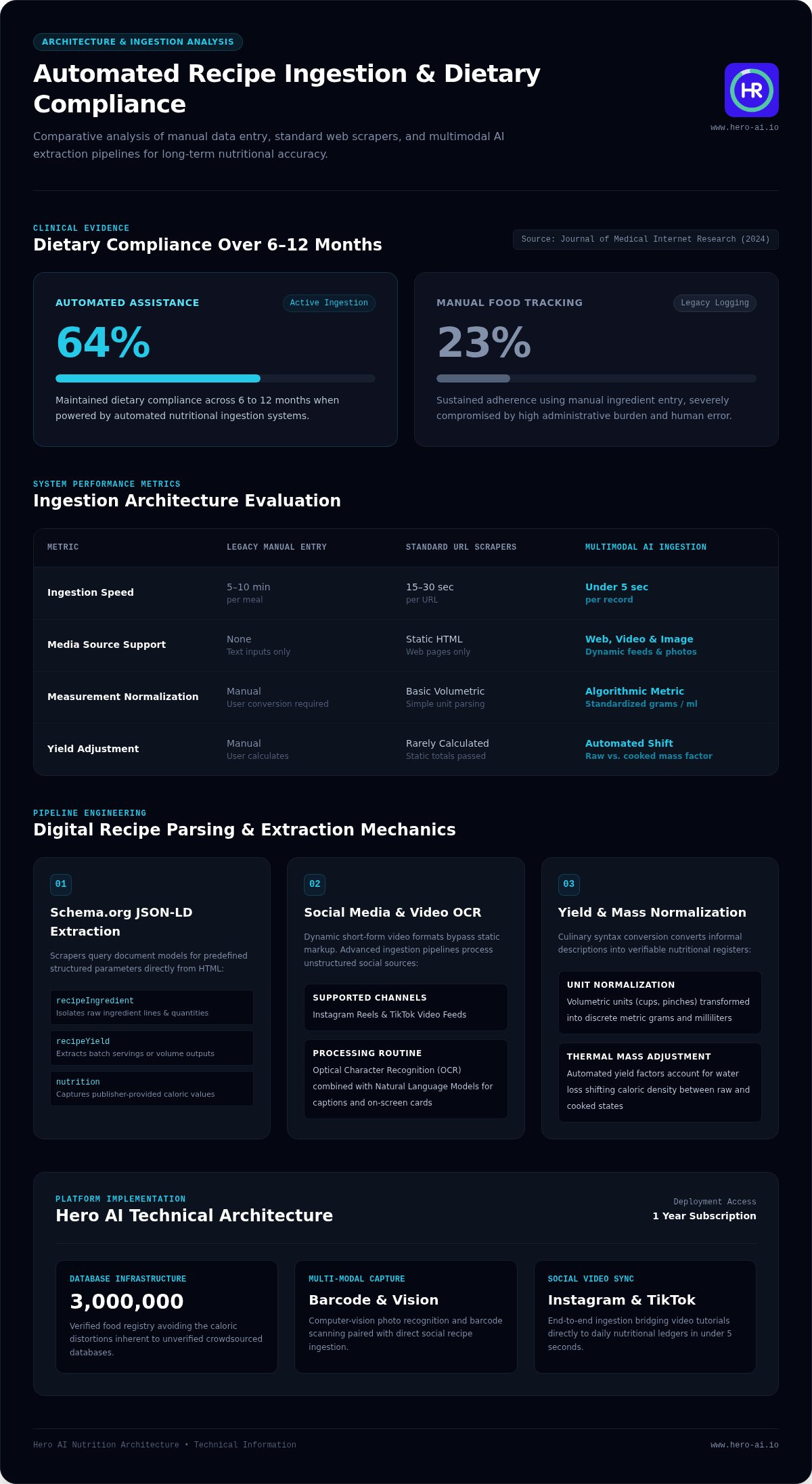
A 2024 study published in the Journal of Medical Internet Research revealed that 64% of users using automated assistance maintained dietary compliance over six to twelve months, compared to just 23% who tracked food manually. Entering every ingredient by hand consumes excessive time and introduces human error. Most basic scrapers fail to process modern video content, while crowdsourced databases frequently distort macro totals. Deploying an advanced nutrition app with recipe import eliminates this administrative bottleneck by converting raw ingredient lists into verified nutritional records automatically.
You already know that inaccurate measurement parsers and broken scrapers compromise your daily caloric targets. This technical guide helps you evaluate automated ingestion architectures so you can select the optimal platform for dietary compliance. We examine how modern ingestion systems extract ingredients from digital and social recipes, verify macro calculations per serving, and synchronize meal planning directly with your daily nutrition logs.
Key Takeaways
- Automated ingestion architectures extract structured dietary data from Schema.org JSON-LD tags and social media formats without manual transcription.
- Deploying an advanced nutrition app with recipe import standardizes measurement parsing and calculates precise macronutrient values per serving.
- Curated and verified database infrastructures prevent the caloric distortions common in unverified, crowdsourced food libraries.
- Multimodal capture systems, including barcode scanning and computer-vision photo recognition, streamline data synchronization between planning and tracking workflows.
- Integrated platforms like Hero AI combine social media recipe ingestion from Instagram and TikTok with a 3-million verified food database through a 1 year subscription.
Core Evaluation Criteria for Recipe Import Nutrition Apps
Selecting a reliable nutrition app with recipe import requires evaluating data ingestion mechanics, parsing precision, and registry verification protocols. System utility depends on how effectively software converts unstructured text into normalized database entries. Standardized nutritional analysis methods depend on validated nutrient registries to calculate caloric density and macronutrient distributions. Without automated validation routines, ingestion pipelines pass raw transcription errors directly into daily tracking ledgers. Platforms must maintain strict data hygiene across international food databases to ensure regional ingredient profiles remain accurate across diverse markets.
| Evaluation Metric | Legacy Manual Entry | Standard URL Scrapers | Multimodal AI Ingestion |
|---|---|---|---|
| Ingestion Speed | 5–10 minutes per meal | 15–30 seconds per URL | Under 5 seconds per record |
| Media Source Support | None (text inputs only) | Static HTML web pages | Web, video feeds, image captures |
| Measurement Normalization | Manual conversion required | Basic volumetric parsing | Algorithmic metric standardization |
| Yield Adjustment | User calculates manually | Rarely calculated | Automated raw versus cooked yield shifts |
Automated Extraction Architecture vs. Manual Entry
Manual food entry imposes a continuous administrative burden. Users must search, quantify, and log every discrete component individually. This manual workflow consumes up to ten minutes per home-cooked meal. Algorithmic extraction systems eliminate this manual overhead. Modern ingestion pipelines isolate ingredient strings, numeric units, and thermal preparation states instantly. Reducing this operational friction directly improves long-term logging consistency across diverse dietary protocols.
Ingredient Parsing and Fractional Unit Conversion
Culinary data contains non-standard syntax, colloquial terms, and fractional units. Advanced parsers normalize volumetric units, such as cups or pinches, into discrete metric mass units like grams and milliliters. Ingestion engines must also calculate yield factors, accounting for mass discrepancies between raw and cooked states. Thermal processing alters water content, shifting caloric density per serving. Reliable parsing architectures flag ambiguous ingredients automatically, prompting immediate user confirmation before committing the final record to the ledger.
Technical Mechanics of Digital Recipe Parsing and Extraction
Modern ingestion engines convert unstructured multimedia into structured nutritional databases. Rather than depending on basic text copy-pasting, a capable nutrition app with recipe import deploys automated scrapers and machine learning parsers. While standard implementations handle static web markup, capturing modern culinary content requires processing dynamic video feeds and varied social transcripts. A recent university study on app accuracy emphasized that tracking applications often struggle with complex, non-standard recipes. Resolving this issue requires parsing pipelines that combine standardized metadata scrapers with natural language extraction routines.
HTML and JSON-LD Web Scraping Protocols
Structured websites embed recipe details within their document object models using Schema.org microdata formats. Ingestion scrapers query these HTML files specifically for the Recipe type schema, extracting predefined parameters:
recipeIngredient: Isolates discrete ingredient lines and raw quantities.recipeYield: Identifies total batch servings or volume outputs.nutrition: Extracts pre-calculated calories and macronutrients if provided by the publisher.
When pages lack structured JSON-LD tags, systems deploy heuristic pattern-matching to separate narrative text from ingredient lists.
Social Media Ingestion from Short-Form Video Platforms
Dietary inspiration increasingly originates on platforms like Instagram and TikTok, where creators post instructions inside video reels and descriptive captions. Static web scrapers fail completely on these dynamic sources. Modern architectures bridge this gap by deploying optical character recognition (OCR) alongside natural language models. These systems read on-screen text overlays, transcribe audio tracks, and parse unstructured captions into measurable quantities. Users managing active routines can leverage unified social media fitness integration to align their imported recipes directly with daily activity protocols. Utilizing an automated tiktok recipe calorie importer removes the manual burden of transcribing visual food media.
Yield Calculation and Serving Allocation Algorithms
Once raw ingredients pass into the system, math engines calculate proportional nutrient distributions. Gross batch totals divide across designated serving counts, dynamically adjusting macro values whenever a user alters portion sizes. For recurring meal preparation, software retains persistent ingredient baselines so individual meals track accurately over time. If you want to streamline this operational workflow across your meal planning, explore the automated tracking features at Hero AI.
Database Verification and Nutritional Accuracy Standards
An ingestion parser is only as reliable as the reference registry behind it. When an automated system extracts ingredients from a recipe, it routes those text strings into a database to pull caloric and macronutrient values. Choosing a nutrition app with recipe import supported by verified libraries prevents systematic tracking errors. Many consumer applications rely on crowdsourced repositories that contain unchecked user submissions. In contrast, verified platforms benchmark their entries against authoritative sources such as the USDA FoodData Central API or equivalent international food composition tables. Without verified baseline data, imported recipes accumulate compounding errors across every logged serving.
Risks of Crowdsourced Nutritional Repositories
Open-submission food databases introduce systemic calculation errors. Crowdsourced libraries often contain thousands of duplicate records for identical items, many displaying conflicting values. Common structural faults include:
- Omission of critical micronutrients, dietary fiber, and sugar alcohol subcategories.
- Incorrect serving sizes caused by inconsistent user input standards.
- Typographical errors that record zero grams of fat or protein for calorie-dense items.
These errors distort daily energy balances. A single inaccurate ingredient can throw off a four-serving recipe calculation by several hundred calories.
Curated Databases with Verified Food Records
Curated architectures replace crowdsourced guessing with strict data governance. In a verified macro tracking app, parsed ingredient strings map directly to authenticated reference entries. Curated registries maintain lab-analyzed profiles that account for complete macro distributions, moisture retention, and cooking transformations. Platforms indexing millions of verified foods cross-reference ingredient synonyms automatically, mapping terms like "courgette" and "zucchini" to the same standardized nutrient profile. This algorithmic pairing ensures that whether you import a complex braise or a rapid skillet meal, the calculated nutritional values reflect true physiological baselines rather than unverified user entries.
System Selection Framework: Choosing the Right Nutrition Architecture
Selecting an effective software architecture requires assessing individual logging complexity and platform integration needs. Rather than treating all tracking tools as equal, users must evaluate specific technical capabilities. A functional nutrition app with recipe import should consolidate multiple data capture modalities into a unified ledger. Detailed comparisons of the best calorie tracking app alternatives demonstrate that missing ingestion options lead to tracking fatigue and abandoned logs. The following three-step rubric establishes objective criteria for selecting a tracking system.
Step 1: Audit Data Capture Modalities
Modern dietary routines involve varied meal sources, from prepackaged items to scratch-cooked recipes. A robust system must support three core capture channels:
- Barcode scanning for commercial food packages and pantry staples.
- Camera-based computer vision for rapid plate and portion recognition.
- Algorithmic batch ingestion for published recipes and complex cooking preparations.
Centralizing these inputs prevents users from juggling separate tools for home-cooked meals and commercial packaged foods.
Step 2: Verify Social Media Platform Compatibility
Social media platforms serve as major hubs for modern recipes. Your selected tracking architecture must directly parse URLs from networks like TikTok and Instagram. Confirm whether the extraction pipeline processes creator captions containing non-standard measurements, localized ingredient names, and combined instructions. The system should extract complete ingredient profiles from short-form video links without requiring manual copy-pasting or secondary transcription apps.
Step 3: Evaluate Ecosystem and Workflow Integration
Nutritional tracking functions best when integrated into broader lifestyle workflows. Software should synchronize bidirectionally with operating system health frameworks and wearable activity monitors. Look for platforms that connect meal planning schedules directly with workout calendars. Fragmented setups require manual data reconciliation across multiple dashboards. Choosing a fully synchronized architecture automates this administrative process entirely. To deploy a consolidated tracking and fitness system, start your setup with Hero AI.
Enterprise-Grade Consumer Tracking: Deploying the Hero AI Platform
Traditional logging setups force users to juggle disconnected tools for meal tracking, workout scheduling, and recipe storage. Hero AI consolidates these operations into an automated tracking platform. Choosing a modern nutrition app with recipe import streamlines the daily administrative burden of health management. Through its multimodal capture infrastructure, the platform processes nutrition via photo recognition, barcode scanning, and direct social video ingestion. Deploying this system through a 1 year subscription establishes an uninterrupted operational baseline for long-term body composition tracking. Users can review deployment parameters via the Hero AI 1-Year Subscription service overview.
Automated Social Ingestion and Database Precision
The ingestion engine directly parses culinary content from Instagram and TikTok posts. Instead of transcribing recipe steps by hand, users submit post links directly to the ingestion pipeline. The system extracts listed components, standardizes quantities, and matches items against a database containing 3 million verified foods. This automated cross-referencing prevents the caloric distortions typical of open user-submitted registries. Programmatic extraction saves significant time per meal while preserving macronutrient calculation accuracy across custom yields.
Unified Nutrition and Workout Synchronization
Nutritional intake forms only one half of energy balance management. In addition to dietary logging, Hero AI extracts and schedules structured workout routines directly from social media platforms. The software aligns daily caloric targets against programmed physical expenditure variables automatically. This programmatic integration eliminates the need for separate calendar systems, workout databases, and food logging spreadsheets. Consolidating energy tracking and athletic programming into a unified interface provides reliable support for long-term body recomposition goals worldwide.
Deploying Advanced Automated Nutrition Architectures
Manual data entry introduces logging fatigue and calculation drift over time. Deploying an advanced nutrition app with recipe import replaces manual estimation with automated precision. Ingestion pipelines parse raw ingredients from static markup and social video feeds, standardizing measurements into discrete metric values. Pairing programmatic extraction with verified nutrient libraries ensures your daily caloric and macronutrient records remain physiologically accurate.
Hero AI eliminates fragmented tracking systems by consolidating dietary logging and training management into a single platform. The infrastructure combines multimodal logging via photo recognition and barcode scanning with automated recipe ingestion from TikTok and Instagram. Every parsed ingredient maps directly against an authenticated database of 3 million verified records, preserving data fidelity across every meal. To establish a structured, reliable logging framework for your long-term fitness goals, deploy automated nutrition tracking with the Hero AI 1 Year Subscription.
Frequently Asked Questions
How does a nutrition app with recipe import parse ingredients from social media?
A nutrition app with recipe import processes social media posts by combining text scrapers, optical character recognition, and natural language processing. The ingestion engine extracts caption text and on-screen graphic overlays from platforms like TikTok and Instagram. Language models isolate ingredient strings, quantities, and preparation states from creator phrasing. Once parsed, the system normalizes the data into discrete units and maps items against an authenticated database for precise macro calculations.
Can recipe import apps accurately calculate macros for multi-serving meals?
Yes, modern platforms accurately compute multi-serving macros by dividing total aggregate batch nutritional values by the declared serving yield. The math engine aggregates the calories, protein, carbohydrates, and fats across all raw ingredients. It then divides these sums evenly across the designated portion count. If you alter the serving yield later, the application dynamically recalculates the per-serving nutritional metrics without requiring a new recipe entry.
What is the technical difference between verified databases and crowdsourced food logs?
Verified databases contain laboratory-analyzed or government-audited food records, whereas crowdsourced databases rely on unvetted public submissions. Crowdsourced repositories frequently suffer from missing micronutrients, duplicate records, and clerical input errors. Verified databases, such as curated libraries holding 3 million authenticated items, maintain standardized macro profiles, moisture loss adjustments, and precise serving metrics. This distinction ensures algorithmic matching maps recipe ingredients to biochemically accurate nutritional baselines.
Does recipe import software support both metric and imperial culinary measurements?
Yes, advanced recipe import systems support both metric and imperial culinary measurements through automated unit conversion algorithms. When an imported recipe lists volumetric units like tablespoons, fluid ounces, or cups, the parser normalizes them into standard mass units like grams or milliliters. The system applies density conversion factors specific to each food item. This prevents measurement errors caused by varying international recipe conventions.
Can an automated nutrition app extract recipes from video content on TikTok or Instagram?
Yes, modern platforms extract dietary data from short-form video content on TikTok and Instagram. Software deploys optical character recognition to read text baked into video frames alongside automated audio transcription to capture spoken instructions. The natural language engine processes these streams together with post captions. This multi-layered extraction isolates the exact ingredients and quantities needed to calculate complete macro profiles without manual user transcription.
How do photo food logging and recipe import function together within a single platform?
Photo food logging and recipe import operate as complementary capture modalities feeding into the same central ledger. Recipe import handles batch preparation planning and structured home cooking, calculating accurate yields in advance. Photo recognition uses computer vision to log plated meals instantly when dining out or consuming unprepared foods. A capable nutrition app with recipe import unifies both workflows, ensuring consistent daily tracking regardless of meal sourcing.
What happens when an imported recipe contains an unlisted or rare ingredient?
When an ingestion engine encounters an unlisted ingredient, it flags the item for manual user review rather than committing inaccurate data. The system presents the closest verified match based on nutritional composition and taxonomic classification. Users can either approve the suggested substitute, search the database manually, or input custom macronutrient values. This confirmation gate preserves registry data hygiene and prevents unverified entries from corrupting daily tracking logs.


