

Manual data entry in fitness tracking results in a baseline error rate of 1% to 5%. This technical friction leads to data fragmentation and user attrition. The current year is 2026. Digital ecosystems now prioritize efficiency through social media fitness integration. Manual transcription of TikTok recipes or Instagram workout sets is an inefficient process. This administrative burden limits the utility of content found on social platforms.
This article details the technical mechanisms for integrating social media content directly into automated tracking systems. You will learn how AI-driven photo recognition and direct API protocols facilitate the seamless importation of recipes and routines. We examine the transition from manual logging to programmatic scheduling. This analysis covers the reduction of administrative time and the synchronization of health data using global standards. Each section provides discrete information on optimizing data-driven fitness management.
Key Takeaways
- Understand the functional purpose of social media fitness integration for the programmatic synchronization of health data.
- Evaluate the mechanics of AI-driven visual recognition for estimating portions and ingredients from social media images.
- Compare the efficiency of automated data importation against manual logging to reduce administrative overhead by up to 60%.
- Implement standard protocols to import TikTok and Instagram recipes directly into personal health databases.
- Access a 1-year subscription to Hero AI to leverage photo recognition and a database of 3 million verified items.
Defining Social Media Fitness Integration and Its Functional Purpose
Social media fitness integration is a technical protocol for the programmatic synchronization of social media content with personal health databases. It functions as a data-capture system that converts unstructured media into actionable biometric and nutritional information. In 2026, the industry has shifted from passive content consumption to active data acquisition. Users no longer simply view fitness content; they ingest it directly into tracking software. This evolution aligns with the quantified self movement, which prioritizes the use of technology to monitor physical activity and biological data. Primary categories for this integration include recipe importation, workout scheduling, and biometric benchmarking.
The Shift Toward Health Data Automation
Manual logging from social media creates a persistent data bottleneck. Users who manually record data often face high attrition rates due to cognitive friction. Manual entry incurs a baseline error rate of 1% to 5% because of memory bias and transcription errors. Automated systems eliminate these inaccuracies. AI bridges the gap between unstructured video content and structured numerical data. Platforms like Hero AI facilitate this process. A 1-year subscription to Hero AI provides a technical bridge for maintaining long-term data consistency. Research indicates that users with automated data feeds demonstrate 35% higher adherence over a 6-month period compared to those using standalone apps.
Standard Platforms for Fitness Data Extraction
Different platforms require specific extraction protocols based on their media formats. Digital systems use varied methods to capture this information:
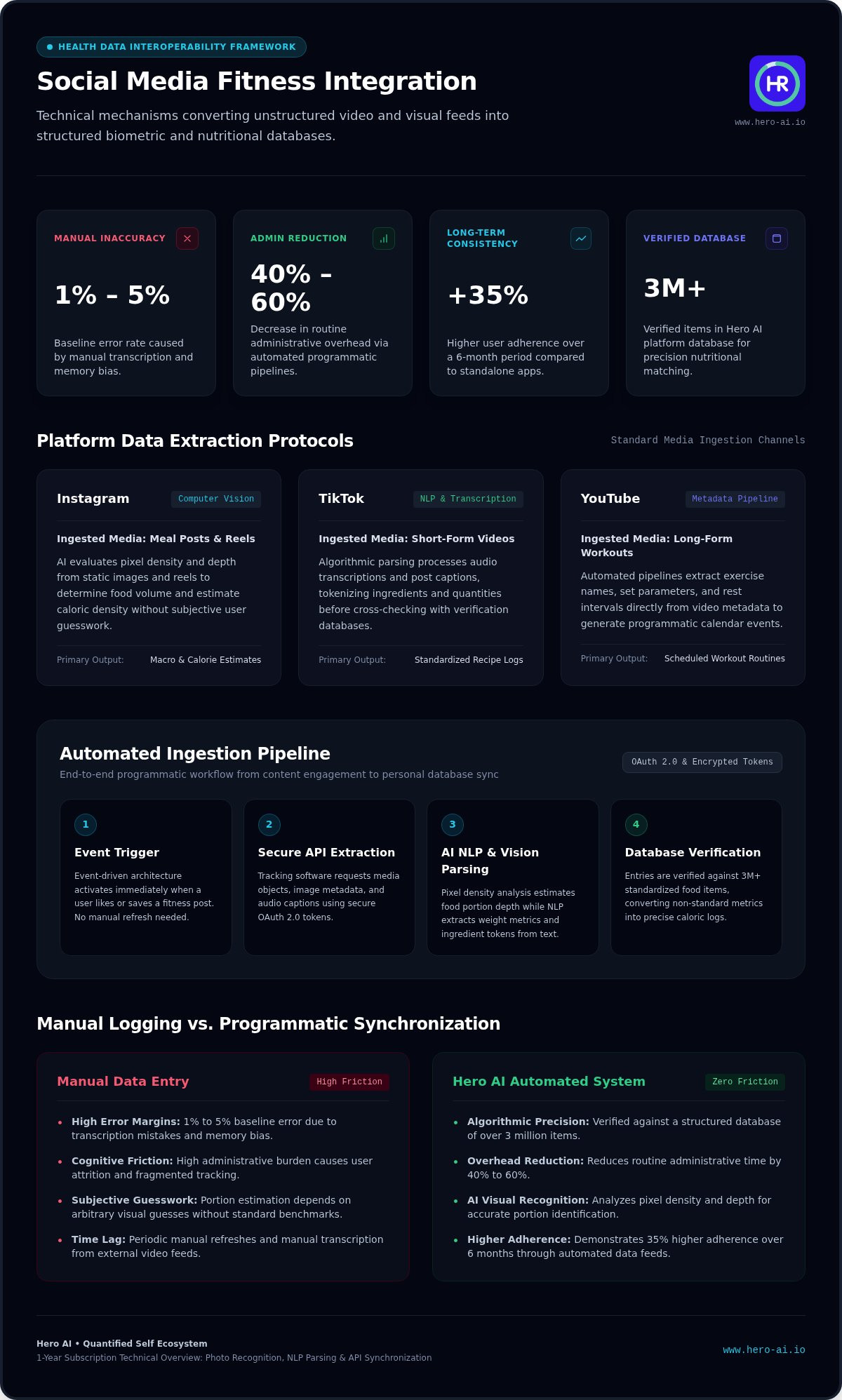
- Instagram: Systems use computer vision to extract macros from visual meal posts and reels. Software identifies food volume and estimates caloric density.
- TikTok: Algorithmic verification processes short-form recipe videos. It identifies ingredients and quantities from captions and audio transcriptions.
- YouTube: Automated pipelines convert long-form workout content into scheduled calendar events. They extract exercise names, sets, and rest intervals from video metadata.
These programmatic pipelines reduce routine administrative overhead by 40% to 60%. Automated social media fitness integration ensures that the transition from content discovery to data logging is instantaneous. It removes the need for human intervention in the data entry phase. This leads to higher precision in nutritional and physical activity tracking.
The Mechanics of Automated Data Importation from Social Platforms
Automated data importation relies on programmatic pipelines that connect social media APIs to fitness management software. These pipelines facilitate health and fitness data interoperability by standardizing unstructured information. Algorithmic scraping identifies ingredients and quantities from social captions. Simultaneously, visual recognition uses AI to analyze pixel density and depth to estimate portion sizes from images. This process removes the subjectivity of human estimation. It ensures that social media fitness integration remains a precise administrative tool for health tracking. These systems use encrypted tokens to maintain data security during the transfer from social platforms to personal health databases. Real-time synchronization prevents the lag associated with manual data entry.
APIs function as the primary interface for data exchange between social feeds and fitness applications. They allow tracking software to request specific media objects, such as video captions or image metadata, without user intervention. This connection is established through OAuth 2.0 protocols to ensure secure access. Once the connection is active, the system monitors social media activity for relevant fitness content. This event-driven architecture ensures that data importation occurs as soon as a user saves or likes a post. It eliminates the need for periodic manual refreshes of the fitness database.
AI-Powered Recipe Scraping Protocols
NLP parses social media text to identify nutritional data. The software extracts tokens like weight and ingredient names from post descriptions. These entries are verified against a comprehensive database. This step corrects inaccurate nutritional claims in social media posts. The system converts non-standard measurements into standardized metrics. This is essential for a precise caloric log. It doesn't require manual oversight. A 1-year subscription for an AI-powered fitness platform provides these scraping protocols.
Workout Scheduling via Social Content
Workout scheduling maps social media routines to programmatic planners. Software extracts exercise names, sets, and rest intervals from video metadata. These routines synchronize with digital calendars to automate training schedules. This supports adherence to social media-based programs. It allows for direct importation from TikTok and Instagram. Programmatic pipelines convert video data into training logs. This automation is a key feature of modern social media fitness integration systems.
Database cross-referencing serves as the final validation layer. It matches extracted social media ingredients to verified nutritional entries. This step prevents the fragmentation of health metrics. It provides a consistent data structure for long-term health monitoring. The integration of social feeds into fitness software creates a unified data environment. This environment prioritizes accuracy and efficiency over manual estimation. API endpoints facilitate the real-time transfer of this validated data into the user's primary health dashboard. This infrastructure supports the aggregation of multiple social media sources into a single, verifiable report.
Manual Entry vs. Programmatic Integration: An Efficiency Analysis
Manual logging requires significant cognitive effort and consistent user intervention. It involves identifying ingredients, measuring quantities, and searching databases for matching entries. Programmatic social media fitness integration automates these steps to ensure data consistency. This technical shift reduces the time spent on data entry from minutes to seconds per entry. Manual entry has a baseline error rate of 1% to 5% due to transcription fatigue and memory bias. In contrast, AI-verified database matching eliminates these transcription errors entirely. This precision ensures that health records remain accurate for long-term analysis.
Research into fitness technology and social media behaviors shows that data engagement directly impacts exercise adherence. Fragmented records are a primary risk in manual systems. When users don't log a meal or workout immediately, the dataset becomes incomplete. Automated systems prevent this by capturing data at the point of discovery. This programmatic approach ensures that every social media-inspired activity is recorded without delay. It maintains a continuous data stream that supports better health outcomes.
Quantifying the Administrative Burden
Logging a complex TikTok recipe manually takes an average of five to seven minutes. This process includes pausing the video, noting ingredients, and estimating weights. Using an ai calorie counter reduces this friction. The software extracts data from video metadata and captions automatically. This automation allows for the immediate importation of nutritional profiles. It reduces administrative overhead by 40% to 60% compared to manual methods. Data persistence is maintained through these consistent, automated logging cycles.
Precision in Nutritional Data Capture
Influencer-provided nutritional estimates are frequently inaccurate or incomplete. These creators often omit "hidden calories" such as cooking oils, dressings, or sauces. A functional macro tracking app corrects these discrepancies. It cross-references ingredients against a database of 3 million verified items. This process removes user guesswork and provides a standardized nutritional profile. AI-driven precision provides a more accurate representation of actual caloric intake. This level of verification is essential for users who prioritize data-driven execution over social media estimation.
The transition to automated systems is a standard for maintaining data integrity in 2026. Manual systems can't match the speed or precision of programmatic pipelines. Users who link their applications to automated integrations demonstrate 35% higher adherence over a 6-month period. This is because the technical barriers to entry are removed. A 1-year subscription to Hero AI provides the necessary infrastructure for this level of automated health tracking.
Standard Protocols for Syncing Social Media Content to Fitness Plans
Standardized protocols ensure data consistency when moving content from social feeds to health journals. The process follows a four-step sequence. First, identify high-quality content. This includes posts with detailed captions, high-resolution visuals, or clear ingredient lists. Second, use the 'Share' or 'Import' function. This action sends the post URL to an integrated fitness application via encrypted API tokens. Third, review the AI-parsed data. The system presents a breakdown of macros or exercise sets for user verification against the original source. Fourth, confirm the entry. This logs the meal or schedules the workout in the central health journal. This systematic approach is the foundation of social media fitness integration.
Reviewing the parsed data is a critical validation step. Users compare the AI's output against the original post to ensure ingredient quantities match the visual context. The system uses natural language processing to identify tokens like weight and ingredient names. In 2026, these protocols are designed to be stateless. This means they transform data without storing proprietary social media content on the tracking platform. This ensures compliance with global data protection standards while maintaining a high level of tracking precision.
Importing Recipes from Instagram and TikTok
The technical workflow converts a post URL into a macro-balanced meal entry. The application extracts ingredient data from captions or uses photo recognition for visual analysis. Once the data is parsed, users adjust portion sizes within the app interface. This ensures the log reflects actual consumption rather than the influencer's prepared quantity. These entries can be saved to a personal digital cookbook for future use. This repository maintains a structured record of social media-inspired nutrition. It allows for the rapid retrieval of nutritional profiles during future meal planning cycles.
Scheduling Social Media Workouts
Direct importation of exercise sequences occurs through video metadata and descriptions. The system maps these sequences to programmatic planners. Users set reminders and frequency protocols for specific fitness trends. This automation ensures that social media challenges are integrated into long-term training cycles. In 2026, modern social media fitness integration protocols utilize standardized health data subsystems to bridge social media content with biometric recovery data. This creates a closed loop between social media content and actual physical output. These systems sync with biometric tracking devices to monitor physiological responses like heart rate zones and volume load.
The use of standardized protocols reduces the friction of data acquisition. It ensures that unstructured media becomes a functional part of a health plan. Subscribe to a 1-year fitness platform plan to access these automated synchronization features.
Hero AI: Integrating Social Media Data into Personal Health Metrics
Hero AI functions as a technical bridge between social media inspiration and data-driven execution. The platform provides a 1-year subscription for global fitness management. Users utilize photo recognition to log social media-inspired meals instantly. This system identifies food items and estimates portion sizes from visual data. It removes the administrative hurdles associated with manual data entry. Accessing a database of 3 million verified items allows for the immediate verification of social media nutritional claims. This ensures that the social media fitness integration remains accurate and verifiable.
The platform streamlines the fitness journey by automating the data acquisition phase. It captures unstructured information from TikTok and Instagram and converts it into structured biometric records. This process is essential for maintaining a precise health journal in 2026. The technical infrastructure supports the synchronization of workout routines and nutritional plans. This automation reduces the time spent on fitness planning and record-keeping. It prioritizes data integrity over the subjective nature of social media content.
Automated Nutrition Management
Hero AI processes visual data from social media to achieve macro precision. The system analyzes pixels to identify specific ingredients and caloric density. A photo food tracker subscription provides the functional benefit of automated nutritional analysis. It eliminates the need for users to guess ingredient weights or nutritional values. This technology allows for the maintenance of a consistent food diary without administrative fatigue. The AI-driven recognition engine handles complex social media recipes by cross-referencing visual cues with verified data points.
Global Accessibility and System Stability
Continuous data tracking requires a stable and accessible infrastructure. The HERO AI 1-Year Subscription is the standard for maintaining long-term data consistency. The platform serves a broad international audience without geographic limitations. It adheres to global data protection and interoperability standards. This ensures that health metrics remain secure and portable across different digital environments. The system stability prevents data gaps that occur with intermittent tracking tools. It provides a reliable digital infrastructure for users worldwide.
Starting an automated fitness integration workflow involves three primary steps. First, users establish a connection between their social media accounts and the Hero AI platform. Second, they utilize the import functions to capture relevant recipes or workouts. Third, the system parses and logs the data into the central health metrics dashboard. This final protocol ensures that the transition from content discovery to physical execution is seamless. It prioritizes efficiency and accuracy for a global user base. The platform maintains a strictly professional and functional interface for all administrative health tasks.
Optimizing Health Data Workflows for 2026
The transition from manual logging to programmatic systems is essential for maintaining data accuracy. Automated social media fitness integration eliminates the baseline error rate associated with human transcription. This technical shift ensures that nutritional and workout data remain precise over long-term tracking cycles. Users maintain consistency by utilizing verified databases rather than relying on influencer estimates. Programmatic pipelines convert unstructured content into actionable biometric records without user intervention.
Hero AI provides the digital infrastructure required to manage these complex data streams. The platform features an automated social media recipe importer and AI photo recognition technology. These tools facilitate the instant conversion of TikTok and Instagram content into structured health metrics. A database of 3 million verified foods serves as the primary reference point for all nutritional logs. This system removes the friction of manual entry and supports sustained fitness progress. It's a functional solution for modern health management.
Access the Hero AI 1-Year Subscription for automated fitness integration to begin your data-driven health journey. Reliable systems produce measurable physical outcomes.
Frequently Asked Questions
How does social media fitness integration improve macro accuracy?
Social media fitness integration improves macro accuracy by cross-referencing influencer content with verified databases. Hero AI utilizes a database of 3 million verified items to correct inaccurate nutritional claims. This programmatic verification removes user guesswork. It ensures that the logged macros reflect verified nutritional standards rather than unverified social media captions. This process reduces the baseline human error rate of 1% to 5% found in manual estimation.
Can I import recipes from both TikTok and Instagram into one app?
Yes, the Hero AI platform supports direct importation from multiple platforms. Users can sync recipes from TikTok and Instagram into a single unified health journal. The system uses specific API protocols to extract ingredient lists and quantities from both short-form videos and static image posts. This centralized approach prevents data fragmentation across different social media sources. It maintains a consistent data structure for all nutritional logs.
Is a subscription necessary for automated social media fitness tracking?
A 1-year subscription is required for full access to the automated synchronization features. This annual plan includes the AI-powered photo recognition and recipe importation tools necessary for social media fitness integration. Subscriptions ensure consistent access to the verified food database and ongoing system stability. This model supports long-term data consistency and technical maintenance of the extraction pipelines. It provides a reliable digital infrastructure for global fitness tracking.
How does AI recognize ingredients in a social media video?
AI recognizes ingredients using natural language processing (NLP) and computer vision. NLP parses text in captions and video metadata for specific ingredient tokens. Computer vision analyzes visual frames to estimate the volume and type of food shown. These data points are then cross-referenced against a database of 3 million verified items to confirm nutritional values. This multi-layered approach ensures high precision when analyzing complex recipes in social media videos.
What happens if a social media recipe has no nutritional information?
The system generates a nutritional profile based on the extracted ingredient list. Hero AI identifies individual components like protein sources, fats, and carbohydrates from the video or text description. It then calculates the total macros using verified data from its internal database. This process allows users to log social media meals even when the original creator provides no macro data. It removes the need for manual estimation and ensures tracking consistency.
Can I schedule workouts from YouTube using integration software?
Integration software converts workout video metadata into scheduled calendar events. The system extracts exercise names, set counts, and rest intervals from the video description or transcript. These routines are then mapped directly to a programmatic workout planner. This automation ensures that long-form workout content is integrated into a structured training cycle without manual entry. It supports adherence to social media fitness trends through consistent and automated scheduling protocols.
How much time does automated social media integration save compared to manual logging?
Automated systems reduce administrative logging overhead by 40% to 60%. Manual entry of a complex recipe typically requires five to seven minutes of user intervention. Programmatic integration completes the same task in seconds. This efficiency gain is achieved by removing the need for manual database searches and transcription. Users spend less time on planning and more on execution. It minimizes the friction that often leads to user attrition.
Is my social media data secure when using integration apps?
Integration apps use encrypted OAuth 2.0 protocols to ensure secure data transfer. These systems function as a stateless bridge, transforming social media content into health metrics without storing personal social media credentials. Hero AI adheres to international data protection standards to maintain user privacy. Data synchronization occurs through secure API endpoints. This architecture protects against unauthorized access while maintaining the efficiency of the automated tracking workflow for a global user base.


