

Manual data entry is an obsolete friction point in nutritional management. Logging individual ingredients is repetitive and inefficient. Users frequently report inaccurate portion estimations and difficulty tracking recipes from social media platforms. Achieving macro tracking without manual entry is now possible through standardized technical protocols and computer vision. These systems remove the administrative burden of dietary logging.
Standard tracking methods consume excessive time. They often lack the precision required for accurate reporting. This article identifies the AI-driven systems and automated data capture methods that replace manual input. We examine how visual recognition technology and verified database integrations create a seamless nutritional environment. The following sections detail how photo recognition and direct social media recipe imports, supported by databases of 3 million verified items, integrate into existing digital habits. You will learn how these tools facilitate precise nutritional compliance without the need for manual data entry.
Key Takeaways
- Learn how computer vision and volumetric analysis automate the identification of food items and portion sizes from digital images.
- Understand the role of GS1 barcode standards and verified databases in maintaining high levels of nutritional reporting accuracy.
- Identify the technical protocols required for macro tracking without manual entry through direct recipe imports from social media platforms.
- Discover how automated data capture systems eliminate logging fatigue and improve long-term dietary compliance.
- Evaluate the administrative efficiency of utilizing an AI-powered 1-year subscription to consolidate photo recognition and barcode scanning workflows.
Limitations of Manual Macro Entry in Nutrition Management
Manual macro entry refers to the traditional process of searching for individual food items within a digital database and recording their specific weights or volumes. This method relies entirely on user initiative and manual input. It's a high-friction process that requires constant attention to detail. Every meal requires several minutes of administrative work to ensure every ingredient is accounted for correctly.
The "logging fatigue" phenomenon is a primary cause of decreased user compliance. When tracking becomes a repetitive administrative burden, users often stop recording small snacks or complex ingredients. This selective logging compromises the integrity of the nutritional data set. Achieving macro tracking without manual entry is necessary to bypass these behavioral failures. Automated systems maintain data consistency where human persistence often fails over long durations.
The Cognitive Load of Traditional Tracking
Traditional tracking requires a substantial time commitment across three daily meals and various snacks. Each entry involves a series of digital steps: identifying the food, searching a database, selecting the correct entry, and inputting the portion size. This sequence repeats for every ingredient in a meal. The cumulative time spent on these tasks creates a significant psychological barrier. Complex database searches often return conflicting results, which increases user frustration and cognitive load. When the friction of data entry exceeds the user's immediate motivation, they typically abandon their nutritional goals. Technical automation reduces this load by simplifying the data capture process into a single action.
Inaccuracy in Manual Estimation
Statistical inaccuracies are inherent in human-led portion estimation. Untrained users frequently fail to accurately assess weight or volume by sight alone. Visual estimations of portions can deviate from actual weights by significant margins. These errors are particularly common with calorie-dense items where small volume differences lead to large macro discrepancies. Accurate macro tracking without manual entry uses computer vision to provide more reliable measurements.
Manual logs also suffer from the omission of "hidden" macros. Cooking oils, butter, and sauces are often excluded from manual entries because they aren't perceived as primary ingredients. However, these items contribute substantial caloric value and alter the nutritional profile of a meal. A macro tracking app provides a functional analysis of how AI systems identify these components more reliably than human observers. Automated systems use standardized protocols to ensure that all nutritional data is captured accurately. This level of precision is essential for maintaining long-term data integrity in nutrition management.
Technical Mechanisms of Automated Macro Recognition
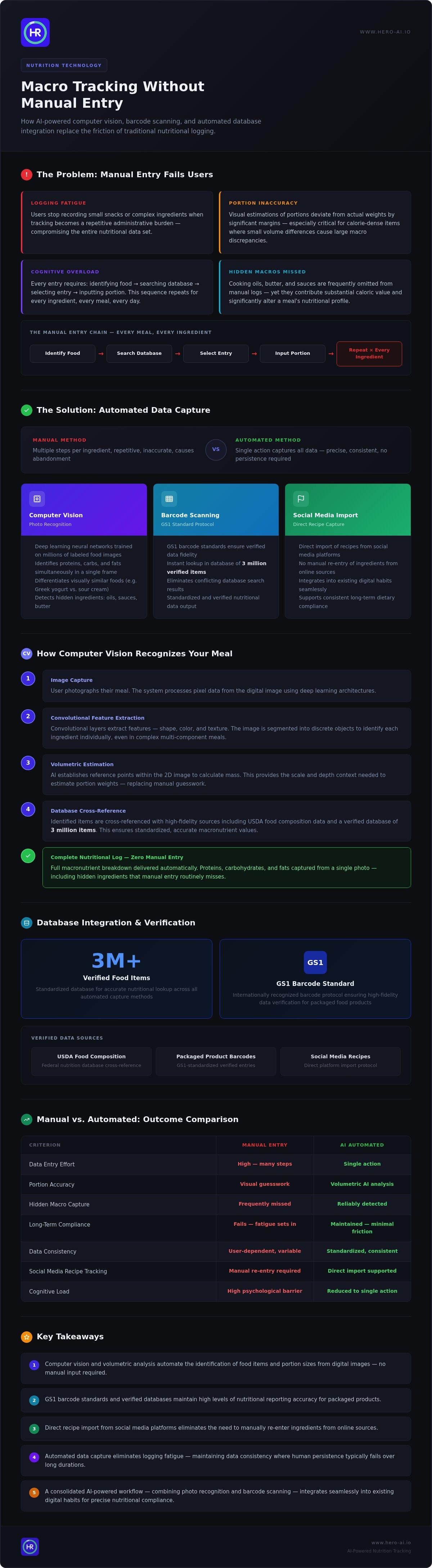
The transition to automated nutritional management depends on the integration of Computer Vision (CV) and machine learning. Computer vision serves as the primary technical layer for macro tracking without manual entry. It uses deep learning architectures to process pixel data from digital images. Neural networks are trained on extensive datasets to recognize broad food categories and specific ingredients. These models identify components in multi-component meals by segmenting the image into discrete objects. This process allows for the simultaneous recognition of proteins, carbohydrates, and fats within a single frame. For detailed information on the technical capture process, refer to this ai calorie counter analysis.
Computer Vision and Food Identification
Neural network training requires millions of labeled images to achieve high accuracy in food recognition. These systems utilize convolutional layers to extract features like shape, color, and texture. Machine learning models have evolved to distinguish between visually similar ingredients. Algorithms now differentiate between items like Greek yogurt and sour cream by analyzing subtle differences in surface consistency. Once the system identifies an item, it translates the visual data into specific macronutrient values. It cross-references these identified objects with high-fidelity sources like USDA food composition data. This algorithmic translation ensures that the resulting data is standardized and verified.
Volumetric Estimation Protocols
AI calculates the mass of a food object by establishing reference points within the 2D image. These points provide necessary context for the scale and depth of the item. Volumetric analysis in 2026 nutritional AI is defined as the mathematical estimation of a food's three-dimensional space based on two-dimensional visual inputs and geometric modeling. The precision of these metrics often exceeds human estimation for irregularly shaped foods like mixed salads or grain bowls. While human observers often undercount portions by significant margins, AI models maintain consistent accuracy through objective spatial analysis. Implementing a 1-year subscription to an automated platform provides the digital infrastructure needed to maintain these precision standards daily.
Database Integration and Data Verification Protocols
Data integrity in nutritional management requires a high-fidelity reference system. Verified databases prevent data corruption by ensuring every logged item corresponds to laboratory-tested nutritional profiles. User-generated databases often contain errors or duplicates; they don't provide the same reliability as verified sets. These inconsistencies lead to significant reporting deviations over time. Automated systems reconcile visual capture data with these verified sets to ensure accuracy. This digital infrastructure is a prerequisite for macro tracking without manual entry on a global scale.
The Role of Verified Food Data
Laboratory-verified data provides a standardized baseline for all nutritional reporting. Unlike user-generated entries, which vary in quality, verified items undergo strict validation protocols. A large database scale is necessary for global users who interact with diverse food products. The Hero AI platform utilizes a database of 3 million verified food items to support this requirement. Maintaining a precise macronutrient balance and nutrition management strategy depends on the reliability of these underlying data points. For specific technical requirements regarding database architecture, see the calorie tracker with food database analysis.
Barcode Scanning and Logistical Integration
The integration of global GS1 barcode standards enables the immediate identification of packaged goods. Automated apps process these identifiers with high speed, retrieving nutritional data in milliseconds. This logistical framework accounts for regional variations in packaged food data by mapping barcodes to localized nutritional labels. If a barcode is unrecognized, the system employs fail-safe mechanisms. These include secondary visual analysis or requests for supplemental image data to maintain the log's integrity. This multi-layered verification process ensures that macro tracking without manual entry remains functional even in complex retail environments.
Automated systems use specific protocols to reconcile visual data with database entries. When a food item is identified via computer vision, the system assigns a probability score based on the database's verified entries. It compares visual features like texture and color against the 3 million verified items to select the most accurate match. This automated reconciliation removes the ambiguity inherent in manual database selection. It ensures the final nutritional report reflects the actual contents of the meal; it's a more reliable method than user guessing. Precise data capture remains the standard for maintaining long-term health objectives.
Strategic Implementation of Automated Tracking Workflows
Strategic implementation of automated nutritional systems follows a five-step sequence. This workflow ensures high data integrity. It simplifies compliance. Users begin by capturing visual evidence of their meal via photo recognition. This initial capture serves as the primary data source for the AI system. The second step involves importing complex recipes directly from social media platforms. Once the AI processes the visual and textual data, users verify the generated macro summary for any outliers or recognition errors. The fourth step synchronizes this verified information with a centralized digital fitness planner. Finally, users review automated weekly reports to identify nutritional trends and compliance levels. This structured approach facilitates macro tracking without manual entry while maintaining high precision.
Importing Recipes from Social Media
Modern nutritional systems utilize algorithmic extraction to identify ingredients from TikTok and Instagram descriptions. These algorithms parse unstructured text and video metadata to isolate specific food components and quantities. This technology converts viral social media recipes into usable macronutrient data sets immediately. Users don't need to manually transcribe ingredient lists from video captions. This feature is particularly beneficial for individuals following macro tracking for bodybuilders, where recipe complexity is often high. The system maps social media content directly to the verified database items discussed in previous sections.
Automated Food Diary Maintenance
The transition from manual logs to a timestamped visual diary improves long-term accountability. A visual diary provides objective evidence of food consumption that text-based logs often lack. This visual record allows for retrospective reviews of portion sizes and food variety. Photo-logging requires significantly less time than traditional typing. It's a more efficient process. Reducing the time spent on logging removes the primary friction point in nutritional compliance. Efficient data capture ensures that the digital record remains complete and accurate over months of use. Users can access these features by starting a 1-year subscription for automated tracking.
Verification of AI summaries is a critical step in the workflow. While AI models achieve high accuracy, user verification provides a necessary fail-safe for complex or layered dishes. Users confirm ingredient identifications before the data synchronizes with their fitness planner. This synchronization ensures that nutritional data is available across all integrated digital platforms. Automated weekly reports then consolidate this data into actionable insights. These reports highlight trends in caloric intake and macronutrient distribution without requiring manual data manipulation. This end-to-end automation supports consistent nutritional management with minimal user intervention.
Implementing Automated Systems with Hero AI
Hero AI offers a 1-year subscription that functions as a centralized hub for nutritional automation. This service aggregates photo recognition, barcode scanning, and recipe import capabilities into a single interface. By utilizing these tools, users achieve macro tracking without manual entry while maintaining high data precision. The platform serves as the digital infrastructure necessary to execute the strategic workflows detailed in earlier sections. It replaces fragmented tracking methods with a unified technical layer that operates with minimal user intervention. This consolidated approach is designed to eliminate the administrative friction that typically leads to logging fatigue.
The 1-Year Subscription Framework
An annual subscription ensures consistent access to the verified database and recognition algorithms. This framework is cost-efficient compared to modular or short-term services. It includes continuous software improvements and database updates to maintain accuracy as new food products enter the global market. The subscription model provides a stable environment for long-term health monitoring. It removes the administrative task of managing multiple service tiers or manual software updates. This stability is essential for users who require reliable data over extended training cycles. Users are encouraged to view the Hero AI subscription overview for a detailed analysis of service inclusions and functional specifications.
Holistic Fitness Automation
Beyond nutritional capture, Hero AI integrates workout scheduling directly from social media metadata. The system extracts exercise parameters from platforms like TikTok and Instagram to align physical activity with dietary logs. This integration streamlines the entire health management process by removing the need for manual cross-referencing between different platforms. A centralized, AI-driven infrastructure provides a unified view of fitness progress. It allows for an objective analysis of how specific nutritional intakes influence physical performance. The system automatically adjusts to the user's digital habits by capturing data from the platforms they already frequent. Initiating automated tracking requires the activation of the subscription service to link these disparate data streams into a coherent plan. This holistic approach ensures that all aspects of a fitness regimen are documented without the friction of manual entry.
Transitioning to Automated Nutritional Infrastructure
The transition from manual logging to automated data capture addresses the primary friction points identified in nutritional management. Technical protocols such as computer vision and volumetric analysis provide a level of precision that human estimation cannot replicate. These systems eliminate the psychological burden of logging fatigue while ensuring long-term data integrity. By standardizing dietary records through a verified database of 3 million food items, users prevent the reporting errors common in user-generated logs. Implementing macro tracking without manual entry allows for a more consistent and objective approach to health management.
The Hero AI platform provides the centralized infrastructure necessary for this digital transition. It utilizes photo-to-macro recognition technology and a social media recipe importer to streamline nutritional reporting across all food categories. This system integrates nutrition tracking with digital fitness habits efficiently to support long-term goals. Access automated macro tracking with a Hero AI 1-Year Subscription to implement these technical standards today. Automated systems ensure that dietary compliance remains a passive and highly accurate process.
Frequently Asked Questions
Can AI really track macros from a single photo?
AI systems utilize computer vision to identify food items and estimate their volume from a single image. This process involves segmenting the photo into discrete components and cross-referencing them with a verified database. Volumetric analysis calculates the mass based on visual reference points. This technology enables macro tracking without manual entry for various meal types. The system provides an objective assessment of nutritional content by analyzing pixel data and geometric properties within the frame.
How accurate is macro tracking without manual entry compared to using a scale?
Digital scales provide the highest level of weight precision for individual ingredients. However, automated AI systems offer significantly higher accuracy than human visual estimation. Most untrained users undercount portions by significant margins when logging manually. AI models use standardized spatial metrics to determine food volume. This method reduces the margin of error associated with guessing. Macro tracking without manual entry maintains a consistent and reliable data set for long-term nutritional monitoring.
Does the database include international food items?
The Hero AI database contains 3 million verified food items to support a global user base. This extensive catalog includes nutritional profiles for diverse ingredients and regional packaged goods. It follows international standards for food composition to ensure data accuracy across different jurisdictions. The platform updates its database continuously to reflect new product releases and local nutritional labeling. This scale is necessary for maintaining precise tracking in varied culinary environments worldwide.
How do I import recipes from TikTok or Instagram into my macro tracker?
Users import recipes by selecting social media content within the platform. The AI parses unstructured text from TikTok and Instagram descriptions to identify ingredients and quantities. It converts this metadata into structured macronutrient data using its internal database. This process eliminates the need to transcribe ingredient lists manually from video captions. It allows for the immediate integration of viral recipes into a personalized fitness plan without administrative friction or data entry.
Is a barcode scanner necessary if the app has photo recognition?
Barcode scanning remains a functional component for identifying packaged goods. While photo recognition handles raw ingredients and prepared meals, barcodes provide direct access to manufacturer-specific nutritional labels. This dual-layer approach ensures maximum data fidelity. Barcodes use GS1 standards to confirm exact product formulations. Photo recognition serves as a primary tool for non-packaged items. Both features work together within the 1-year subscription to provide a comprehensive and automated logging environment.
Can I track my workouts and macros in the same automated system?
The Hero AI platform enables the simultaneous tracking of nutrition and physical activity. It extracts workout routines from social media metadata and synchronizes them with caloric intake data. This centralized infrastructure connects energy consumption with energy expenditure. Users manage their entire fitness plan within a single digital interface. This integration reduces the cognitive load of switching between disparate applications. It creates a unified health management process that prioritizes administrative efficiency and data accuracy.
What happens if the AI incorrectly identifies a food item?
User verification serves as a critical fail-safe in the automated workflow. If the system incorrectly identifies an item, the user can adjust the entry before it synchronizes with the fitness planner. The AI presents a summary for review to ensure all data points are accurate. This verification step maintains the high integrity of the nutritional log. It allows the system to learn from corrections while preventing incorrect data from corrupting the long-term reporting metrics.
Is macro tracking without manual entry suitable for professional bodybuilders?
Professional bodybuilders benefit from the precision and efficiency of automated systems. These tools manage the complex recipes and high-frequency logging required for competitive preparation. The system supports specific macronutrient targets for muscle hypertrophy and fat loss. By utilizing a database of 3 million verified items, the platform ensures that nutritional reporting remains accurate. This level of detail is essential for athletes who require strict adherence to specific dietary protocols and performance metrics.


