

A saved fitness post is often where an effective routine goes to die. Bookmarks multiply across Instagram, TikTok, and YouTube, leaving valuable exercises trapped inside disconnected platform silos. You already know how tedious it is to transcribe sets, reps, and movement cues into calendar apps. Without an organized pipeline, scattered posts lead to missed sessions and stalled physical progression. Integrating a dedicated social media workout scheduler bridges the operational gap between digital content discovery and real-world execution.
In this guide, you will discover how modern automation systems ingest unstructured social media fitness content and structure programmatic workout schedules. We examine the underlying architecture, data parsing pipelines, and schedule synchronization models that eliminate manual data entry. You'll gain a clear blueprint for centralizing multi-platform workout routines into a single, cohesive training calendar.
Key Takeaways
- Deploying a dedicated social media workout scheduler replaces static post bookmarking with programmatic, chronological calendar synchronization.
- A standardized five-step ingestion protocol transfers exercise data directly from social URLs into calendar records without manual data entry.
- Automated ingestion eliminates transcription errors, preserves routine formatting, and improves physical training adherence.
- Modern parsing engines combine natural language processing and computer vision to extract exercises, sets, and reps from video frames and captions.
- Unified health tracking architectures align automated exercise scheduling with dietary intake metrics to streamline performance management.
What Is a Social Media Workout Scheduler?
A social media workout scheduler is software designed to convert social fitness posts into chronological, structured calendar events. Unlike static graphic templates or basic bookmark lists, these tools parse external digital media into actionable training sessions. Users discover routines across platforms like TikTok, Instagram Reels, and YouTube Shorts. The software extracts movement patterns from these unstructured clips, converting raw video descriptions into specific exercises, prescribed sets, target reps, and assigned rest periods. Operating through automated social media fitness integration, these systems remove the cognitive load of manually transcribing exercises, ensuring training programs move directly from digital discovery to programmatic execution.
The Structural Problem with Saved Social Media Workouts
Traditional bookmarking fails to support long-term athletic progression. Saved folders on social networks function as static repositories without timeline logic. Routines get abandoned because native feeds lack chronological sorting, load monitoring, or session reminders. During a gym session, retrieving a specific saved reel requires scrolling through unrelated bookmarks, creating operational friction. This friction interrupts workout momentum, increases gym down-time, and breaks progressive overload tracking across consecutive training blocks.
Core Computational Mechanics of Workout Schedulers
Modern scheduling platforms rely on established automated planning and scheduling engines to manage data transformation. The ingestion pipeline executes three primary operations:
- Metadata Parsing: The ingestion engine analyzes post captions, creator notes, and video text overlays to isolate training variables.
- Entity Classification: Natural language processing and optical character recognition detect exercise names, rep ranges, and movement patterns.
- Calendar Export: The system structures extracted routines into standardized `.ics` or REST-compatible formats for platforms like Google Calendar and iCal.
Deploying a dedicated social media workout scheduler replaces manual entry with programmatic accuracy. Raw social media uploads are standardized into structured database objects, matching each routine against user schedules and recovery requirements.
How to Schedule Workouts from Social Media Posts Step-by-Step
Transitioning unstructured video posts into calendar entries follows a structured data pipeline. A modern social media workout scheduler standardizes disparate fitness content into organized database records through a five-step protocol:
- Data Capture: Forward the target post link via the operating system's native share utility or URL input field.
- Automated Extraction: Processing models analyze caption syntax and on-screen text to identify exercise names, rep counts, and load guidelines.
- Data Verification: Review the parsed routine within the staging interface to correct exercise ordering or missing parameters.
- Split Mapping: Assign the routine to an open calendar block based on current training splits and recovery targets.
- Calendar Synchronization: Commit the verified session to the designated calendar ecosystem to establish automated reminders and tracking triggers.
Capturing and Ingesting Unstructured Post Data
Ingestion begins when a link enters the processing queue. When a post contains written workout details in the caption, extraction scripts parse alphanumeric patterns directly into structured data fields. For video-only demonstrations lacking explicit captions, optical character recognition and visual models interpret text overlays and movement sequences. If an uploaded post omits rep counts or set volumes, the system flags the missing variables and inserts neutral placeholder values for manual review.
Allocating Training Volume Across Weekly Splits
After data extraction, the system maps workouts against defined training schedules. Recent developments in AI integration into apps enable algorithmic balancing of weekly training volume across different movement patterns. Scheduling engines evaluate muscle group overlap across consecutive days, preventing overtraining when importing workouts from disparate creators. Configured calendar timeblocks then generate automated push alerts, ensuring adherence to designated training intervals.
Validating Biomechanical Logic Before Scheduling
Programmatic scheduling requires logic verification before writing entries to calendar databases. The scheduling engine audits exercise sequences to confirm that compound lifts precede isolation work and that warm-up phases remain intact. Standardized fitness taxonomies resolve creator-specific slang into universal anatomical definitions. To automate this capture and alignment process within your daily workflow, configure your profile on HERO AI to sync routines across your devices seamlessly.
Manual vs. Automated Workout Scheduling: A Technical Comparison
Managing fitness programming through manual notes creates operational inefficiencies. Athletes relying on manual transcription copy individual exercises, target sets, and prescribed rep ranges from social feeds into personal productivity software. Implementing a dedicated social media workout scheduler replaces this fragmented workflow with direct data ingestion. The following evaluation matrix contrasts core functional parameters between manual logging workflows and automated scheduling engines:
| Operational Parameter | Manual Journaling / Notes Apps | Automated Scheduling Engines |
|---|---|---|
| Time Expenditure | High latency (5-10 minutes per routine) | Near-instantaneous link ingestion (< 5 seconds) |
| Data Consistency | Prone to transcription errors and omissions | Exact parameter parsing from source media |
| Adherence Verification | Unstructured checkboxes; no timeline tracking | Programmatic calendar blocks with notifications |
| Format Agility | Static text files requiring manual reorganization | Dynamic database objects compatible with standard calendars |
Latency and Administrative Overhead Analysis
Manual transcription requires significant time investment. Documenting a standard 6-exercise routine from a video clip involves repeated pausing, switching between mobile applications, and typing parameters by hand. This process averages roughly 5 to 8 minutes per post. For an athlete programming four sessions each week, manual entry consumes up to 30 minutes of administrative effort weekly. Over a full training calendar, this overhead amounts to more than two hours per month spent entirely on data transfer rather than training execution.
Data Fidelity and Parameter Retention
Data integrity degrades when relying on manual entry. Transcribing quickly often leads to omitted tempo instructions, missed rest intervals, or incorrect rep brackets. These small errors degrade the intended training stimulus. In contrast, an automated social media workout scheduler captures complete movement details directly from post captions and visual overlays. It stores the original post URL inside the calendar event metadata. During training, you retain one-tap access to the source demonstration, allowing immediate form verification without searching through disorganized social bookmark feeds.
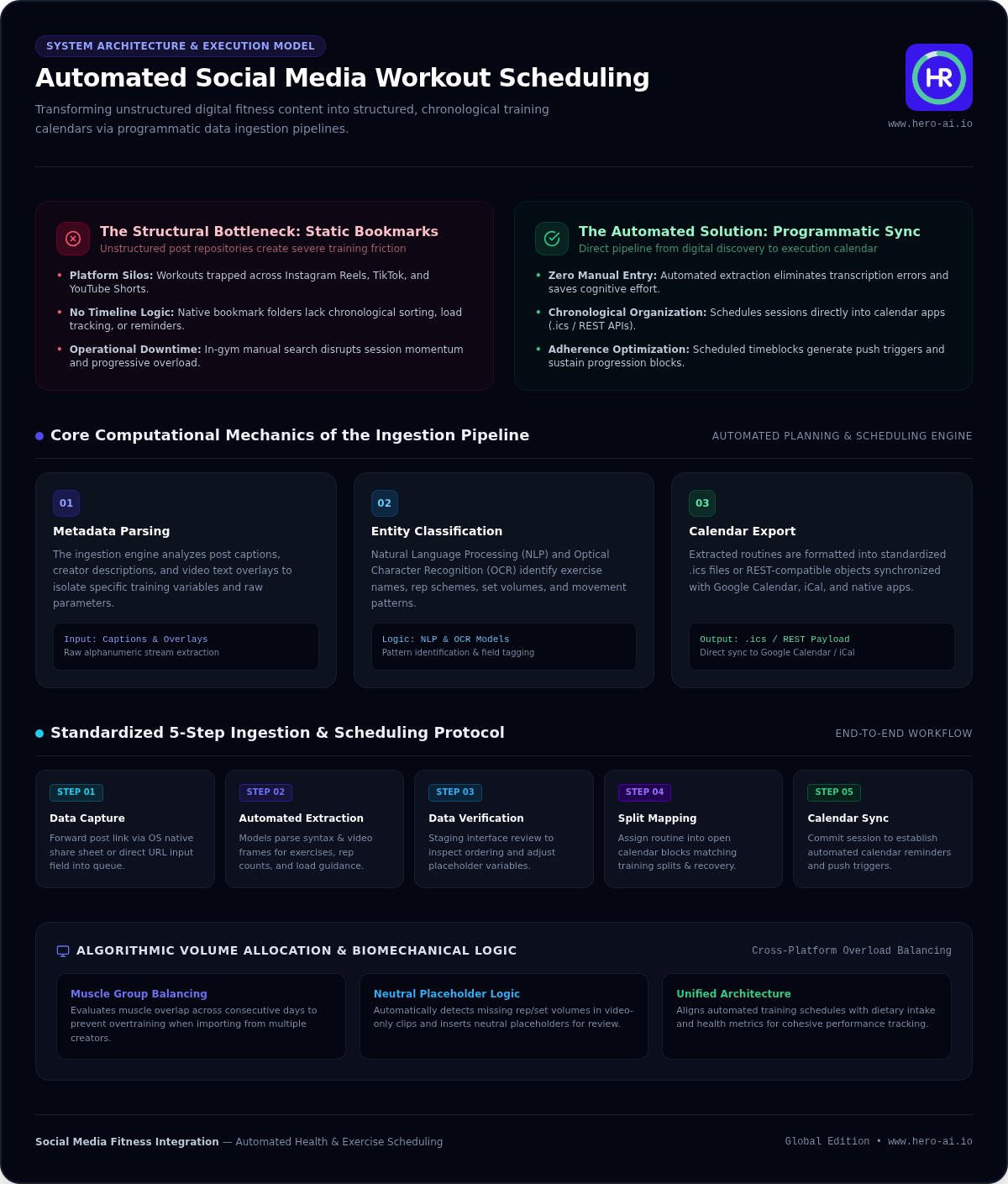
System Architecture: How Modern Scheduling Engines Parse Fitness Data
The computational architecture behind an automated social media workout scheduler consists of three primary layers: data ingestion, natural language understanding, and event serialization. Raw video frames pass through convolutional neural networks to classify physical postures, barbell trajectories, and machine configurations. Simultaneously, text streams from titles and captions undergo tokenization. This structural extraction mirrors the data normalization models used within a nutrition app with recipe import, translating unstructured public media into deterministic database entries ready for programmatic deployment.
Text Parsing and Entity Recognition in Captions
Caption extraction engines deploy named entity recognition models combined with targeted regular expressions. These pipelines isolate numerical values associated with sets, repetitions, and prescribed loading parameters. The parser identifies non-standard lifting terminology, classifying technical parameters like Rate of Perceived Exertion (RPE), As Many Reps As Possible (AMRAP), and descending drop sets. Downstream semantic mappers resolve informal gym shorthand, converting colloquial names into formal anatomical movement categories within the central system index.
Calendar Synchronization and Notification Architecture
Once parameters settle into structured schemas, the export pipeline interfaces with external calendar services through secure REST endpoints. The technical stack manages calendar scheduling through standardized protocols:
- Calendar API Endpoints: Bi-directional sync pipelines dispatch formatted payloads directly to Google Calendar, Apple EventKit, and Microsoft Outlook.
- Local Alert Dispatch: Operating systems schedule high-priority push notifications configured against UTC training timestamps stored in the user profile.
- Relational Storage: PostgreSQL schemas log routine execution status, maintaining training volume compliance records over multi-week macrocycles.
Modern platforms handle these operations without requiring external scripts. You can deploy this automation directly by setting up your training pipeline through access HERO AI today.
Unifying Workout Scheduling and Nutrition: The HERO AI Approach
Operating fitness planning and dietary logging in separate applications introduces administrative drag. Isolated tracking tools force users to manually balance physical activity expenditure against daily nutritional inputs. HERO AI resolves this operational division by providing a unified environment that coordinates both disciplines. By deploying a comprehensive social media workout scheduler alongside automated food logging, the platform aligns mechanical work output directly with nutritional intake metrics. The software transforms scattered health content into a coordinated, objective system.
Consolidating Social Ingestion for Nutrition and Training
The core utility of HERO AI rests on parallel ingestion pipelines. Users process dynamic exercise routines from platforms like TikTok and Instagram directly into their training calendar while simultaneously deploying a dedicated tiktok recipe calorie importer to capture culinary content. The mobile ecosystem parses both video formats and written descriptions, pairing automated movement schedules with verified macro breakdowns. This direct ingestion removes manual transcription barriers across all daily health habits, establishing an accurate record of training volume and energy expenditure within a single interface.
System Access via the 1 Year Subscription
Platform capabilities are delivered through a standardized operational model designed for sustained athletic tracking:
- Direct Content Ingestion: Automated workout extraction from social media posts straight into synchronized calendar engines.
- Automated Nutrition Logging: Photo-based food tracking alongside social media recipe parsing for precise caloric oversight.
- Standardized Access: Complete ecosystem availability provided through a straightforward 1 Year Subscription.
- Model Enhancements: Ongoing pipeline updates to adapt to emerging social media video architectures and caption syntax standards.
Transitioning from static bookmarks to programmatic tracking requires eliminating friction at the point of discovery. Implementing a dedicated social media workout scheduler within an integrated ecosystem ensures training routines and dietary targets operate as a cohesive unit. You can access the complete automated pipeline and deploy this tracking infrastructure worldwide with the HERO AI 1 Year Subscription.
Automating Your Training Pipeline for Long-Term Progression
Fragmented bookmarks create operational friction that compromises athletic consistency. Transitioning to an automated social media workout scheduler eliminates the administrative delay of manual journaling. Natural language models and vision processing extract exercises, sets, and rep ranges directly from TikTok and Instagram content. The system synchronizes these parameters straight into your preferred calendar, ensuring structured training splits take precedence over disorganized feeds.
Combining physical volume tracking with an integrated nutrition database of over 3 million foods establishes full operational clarity across your daily habits. By pairing automated workout scheduling with photo-based food logging, you eliminate guesswork across recovery and energy expenditure. Activate automated workout scheduling and macro tracking with the HERO AI 1 Year Subscription to deploy this unified tracking architecture globally. Building a repeatable, structured fitness pipeline starts with reliable automation, keeping your training on schedule every week.
Frequently Asked Questions
Can a social media workout scheduler extract exercises from video clips without captions?
Yes, advanced systems extract routines from video-only media using optical character recognition and visual processing models. When creators post movement demonstrations without written captions, the software samples individual frames to read on-screen text overlays. If text is absent, vision models detect barbell trajectories and movement patterns to identify standard exercises. The parsed movements populate an editable staging card where you confirm set and repetition targets before scheduling.
How do automated workout schedulers handle posts with irregular formatting or slang?
Automated schedulers pass raw post descriptions through natural language processing pipelines built with specialized fitness taxonomies. These semantic mappers parse unconventional shorthand like "tri-sets", "AMRAP", and "RPE 8" into structured database parameters. If an athlete describes a "leg day burn" using creator-specific terminology, the engine resolves the slang against standardized movement registries, categorizing exercises into anatomical muscle groups without manual correction.
Is it possible to edit scheduled workouts after they have been parsed from social media?
Workouts remain fully customizable both before and after synchronization. Once the social media workout scheduler extracts exercises from a post, it places the data into a staging interface. You can adjust the assigned day, change rep counts, reorder compound movements, or swap movements to match available gym equipment. Edits made in the app update across all synchronized calendar events automatically.
Do social media workout schedulers synchronize with Apple Calendar and Google Calendar?
Native calendar integration operates through standard iCal formatting and secure REST API connections. The scheduling engine converts parsed routines into standard calendar entries compatible with Apple Calendar, Google Calendar, and Microsoft Outlook. Each scheduled event includes prescribed exercises in the event notes, targeted session durations, and a direct URL link to the original social media clip for real-time form checks.
What happens if a creator updates or deletes the original social media workout post?
Post deletion does not impact your scheduled routine once ingestion is complete. The system stores all extracted exercises, sets, reps, and programmatic notes directly inside the application's local database. Because the routine parameters exist as independent database objects rather than live embeds, your training calendar retains full exercise functionality even if the source URL becomes unavailable on TikTok or Instagram.
Can workout scheduling tools estimate caloric expenditure from imported routines?
Workout schedulers estimate energy expenditure by cross-referencing extracted movement types, volume load, and session duration against user biometrics. Comprehensive platforms like HERO AI combine this data with verified nutritional registries containing over 3 million foods. This alignment allows the ecosystem to balance mechanical training expenditure directly against daily caloric and macronutrient targets within a single interface.


